 By Anzo Trader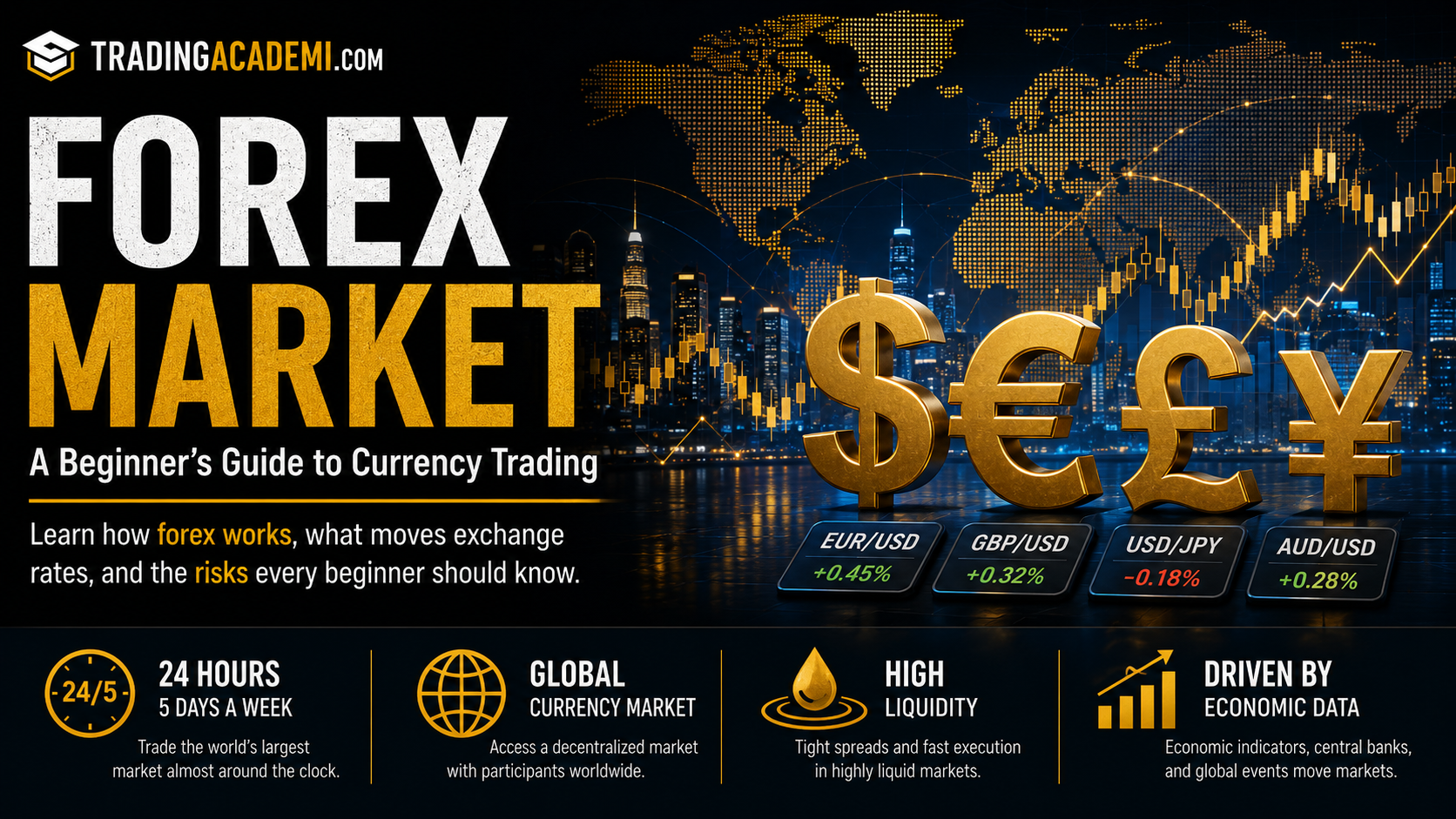
The forex market is one of the most active financial markets in the world. Every day, currencies are exchanged by banks, businesses, governments, investors, travelers, and traders. Some people use the forex market because they need to exchange money for international business or travel. Others participate because they want to trade currency price movements.
For beginners, forex can look simple at first. You may see currency pairs like EUR/USD, GBP/USD, or USD/JPY moving up and down on a chart and think it works like any other market. But forex has its own structure, language, risks, and behavior.
Unlike the stock market, where you buy shares of a company, the forex market is about exchanging one currency for another. When you trade forex, you are always dealing with two currencies at the same time.
This guide explains what the forex market is, how it works, what currency pairs are, who participates in the market, what moves exchange rates, and what beginners should know before trading forex.
What Is the Forex Market?
The forex market, also called the foreign exchange market or FX market, is a global marketplace where currencies are bought and sold.
Forex stands for “foreign exchange.” It simply means exchanging one currency for another.
For example, if someone travels from the United States to Europe, they may exchange U.S. dollars for euros. If a company in Japan buys products from the United States, it may need to exchange Japanese yen for U.S. dollars. If a trader believes the euro will rise against the dollar, they may buy EUR/USD.
All of these activities are connected to the forex market.
The forex market is different from many other markets because it is decentralized. This means there is no single central exchange like the New York Stock Exchange. Instead, forex trading happens electronically through a global network of banks, brokers, institutions, and trading platforms.
Why Does the Forex Market Exist?
The forex market exists because the global economy needs currency exchange.
Countries use different currencies. The United States uses the U.S. dollar. The eurozone uses the euro. Japan uses the yen. The United Kingdom uses the pound. Morocco uses the dirham.
When businesses, governments, banks, and individuals interact across borders, currencies must be exchanged.
For example, an American company importing goods from Europe may need euros to pay suppliers. A European investor buying U.S. assets may need dollars. A tourist visiting another country needs local currency. A central bank may buy or sell currencies to support economic policy.
The forex market helps make international trade, investment, travel, and global finance possible.
It also allows traders and investors to speculate on changes in exchange rates.
How Does Forex Trading Work?
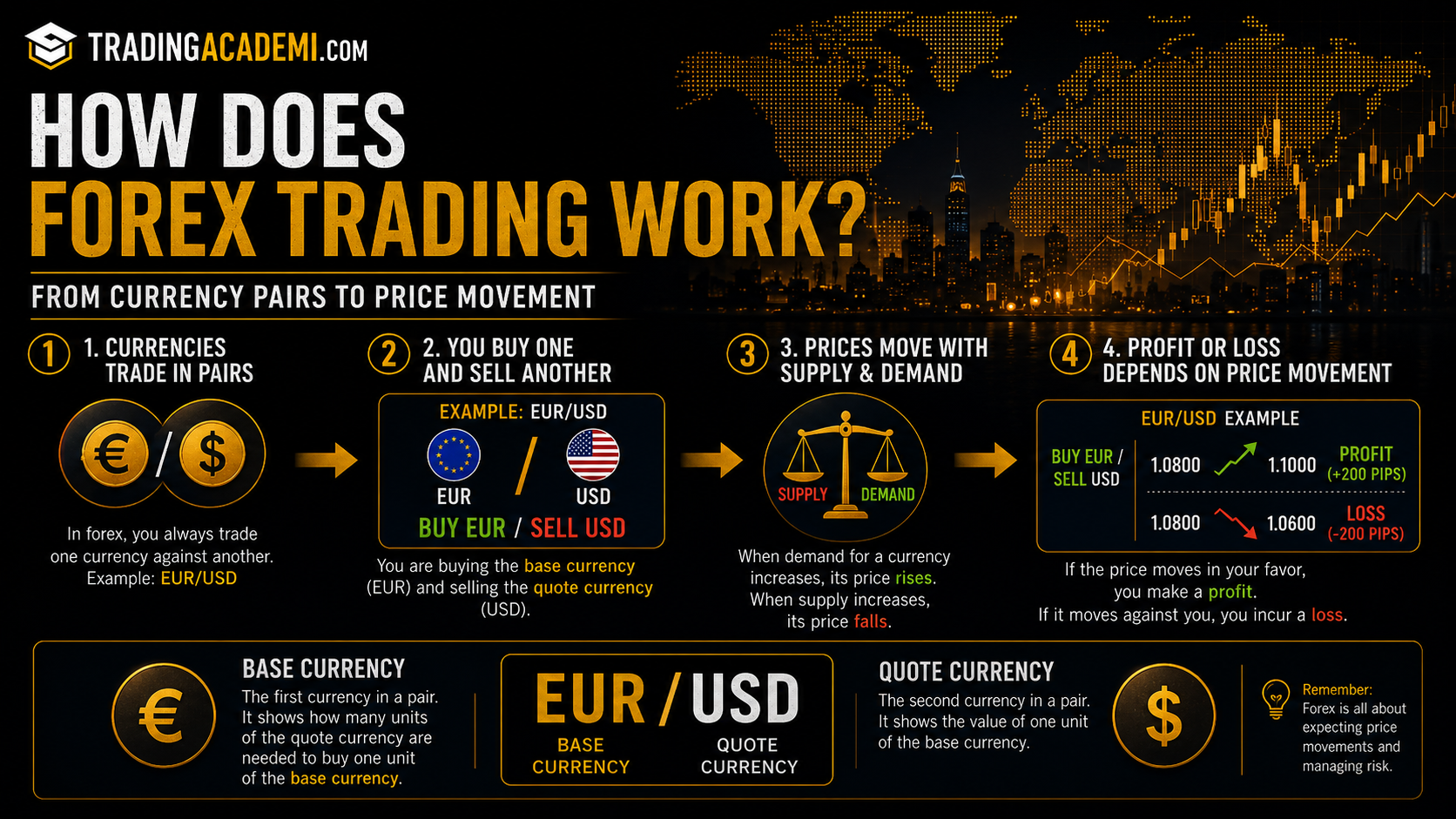
Forex trading works through currency pairs.
A currency pair shows the value of one currency compared to another.
For example:
EUR/USD
GBP/USD
USD/JPY
USD/CAD
AUD/USD
If EUR/USD is trading at 1.1000, it means 1 euro is worth 1.10 U.S. dollars.
When you trade a currency pair, you are buying one currency and selling the other at the same time.
If you buy EUR/USD, you are buying euros and selling U.S. dollars.
If you sell EUR/USD, you are selling euros and buying U.S. dollars.
This is one of the most important ideas in forex: every trade involves two currencies.
Base Currency and Quote Currency
Every forex pair has two parts: the base currency and the quote currency.
The base currency is the first currency in the pair.
The quote currency is the second currency in the pair.
Example:
EUR/USD
EUR is the base currency.
USD is the quote currency.
If EUR/USD is at 1.1000, it means 1 euro equals 1.10 U.S. dollars.
Another example:
USD/JPY
USD is the base currency.
JPY is the quote currency.
If USD/JPY is at 150.00, it means 1 U.S. dollar equals 150 Japanese yen.
Understanding base and quote currencies helps beginners understand whether they are buying or selling a currency.
What Are Currency Pairs?
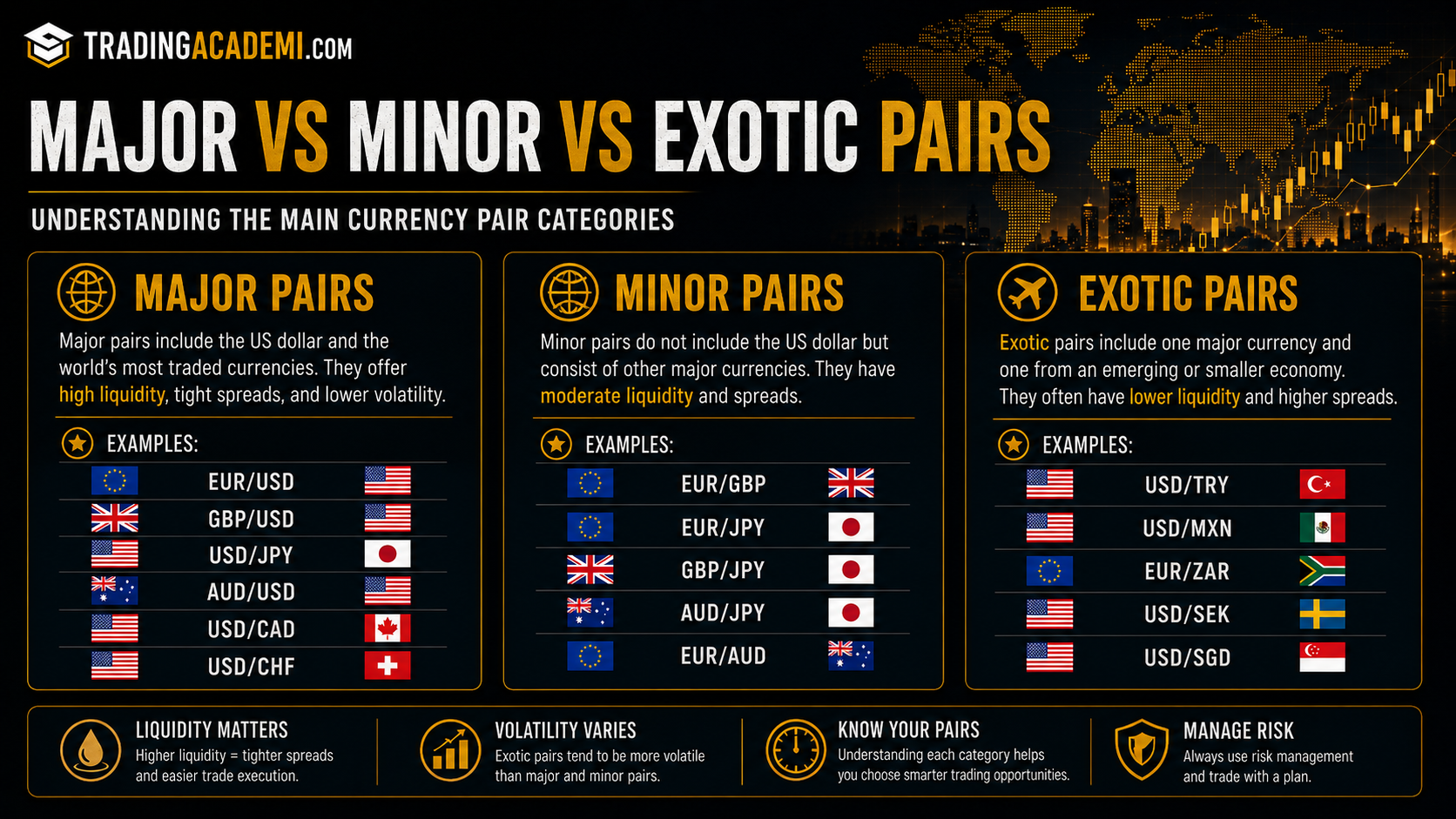
Currency pairs are usually grouped into three main categories: major pairs, minor pairs, and exotic pairs.
1. Major Currency Pairs
Major pairs include the U.S. dollar and another major global currency.
Examples include:
EUR/USD
GBP/USD
USD/JPY
USD/CHF
USD/CAD
AUD/USD
NZD/USD
Major pairs are usually the most liquid and widely traded. They often have tighter spreads and more market activity.
For beginners, major pairs are usually easier to follow than exotic pairs because there is more information, more liquidity, and more stable trading conditions.
2. Minor Currency Pairs
Minor pairs do not include the U.S. dollar, but they include other major currencies.
Examples include:
EUR/GBP
EUR/JPY
GBP/JPY
AUD/JPY
EUR/AUD
Minor pairs can still be liquid, but some of them may have wider spreads or stronger volatility than major pairs.
3. Exotic Currency Pairs
Exotic pairs include one major currency and one currency from a smaller or emerging economy.
Examples include:
USD/TRY
USD/MXN
EUR/ZAR
USD/SEK
USD/SGD
Exotic pairs can be more volatile and may have wider spreads. They can move strongly because of political events, interest rates, liquidity, inflation, and local economic conditions.
Beginners should be careful with exotic pairs because the risk can be higher.
What Is an Exchange Rate?
An exchange rate tells you how much one currency is worth compared to another.
For example, if EUR/USD is 1.1000, it means one euro can be exchanged for 1.10 U.S. dollars.
Exchange rates move constantly because currencies are affected by supply and demand.
If demand for a currency increases, its value may rise. If demand decreases, its value may fall.
Currencies can move because of interest rates, inflation, economic data, central bank policy, geopolitical events, and market sentiment.
What Is a Pip in Forex?
A pip is a small unit of price movement in forex.
For most currency pairs, one pip is usually the fourth decimal place.
For example, if EUR/USD moves from 1.1000 to 1.1001, that is a move of one pip.
For Japanese yen pairs, one pip is usually the second decimal place.
For example, if USD/JPY moves from 150.00 to 150.01, that is one pip.
Pips are used to measure price movement, profit, and loss in forex trading.
What Is the Spread?
The spread is the difference between the bid price and the ask price.
The bid is the price at which you can sell.
The ask is the price at which you can buy.
For example:
EUR/USD bid: 1.1000
EUR/USD ask: 1.1002
The spread is 2 pips.
The spread is one of the main costs of forex trading. Major currency pairs usually have smaller spreads because they are highly liquid. Exotic pairs usually have wider spreads because they are less liquid.
Before entering a trade, beginners should always check the spread.
What Is Leverage in Forex?
Leverage allows traders to control a larger position with a smaller amount of capital.
For example, with leverage, a trader may control a position worth $10,000 with much less money in the account.
Leverage is one reason forex attracts many retail traders. However, it is also one of the biggest risks.
Leverage can increase profits, but it can also increase losses. A small market move can have a big impact on the trading account.
Many beginners lose money in forex because they use too much leverage without understanding the risk.
The most important rule is simple:
Leverage should be used carefully, not emotionally.
What Is Margin in Forex?
Margin is the amount of money required to open and maintain a leveraged position.
It is not a fee. It is a portion of your account that is set aside by the broker while the trade is open.
If the trade moves against you and your account equity becomes too low, you may receive a margin call or the broker may close your position automatically.
This is why risk management is essential in forex trading.
Beginners should understand margin before trading with real money.
Who Trades in the Forex Market?
The forex market is used by many different participants.
Banks
Large banks are among the biggest participants in forex. They trade currencies for clients, manage risk, and participate in global financial markets.
Central Banks
Central banks influence currencies through interest rate decisions, monetary policy, and sometimes direct market intervention.
Examples include the Federal Reserve, European Central Bank, Bank of Japan, and Bank of England.
Businesses
Companies that operate internationally often need to exchange currencies. They may also hedge currency risk to protect profit margins.
Governments
Governments may participate in forex for reserves, trade, debt management, or economic policy.
Hedge Funds and Institutions
Large institutions trade forex for investment, speculation, hedging, or macroeconomic strategies.
Retail Traders
Retail traders use brokers and trading platforms to speculate on currency price movements.
Retail traders are small compared to banks and institutions, but they are an active part of the market.
What Makes Forex Prices Move?
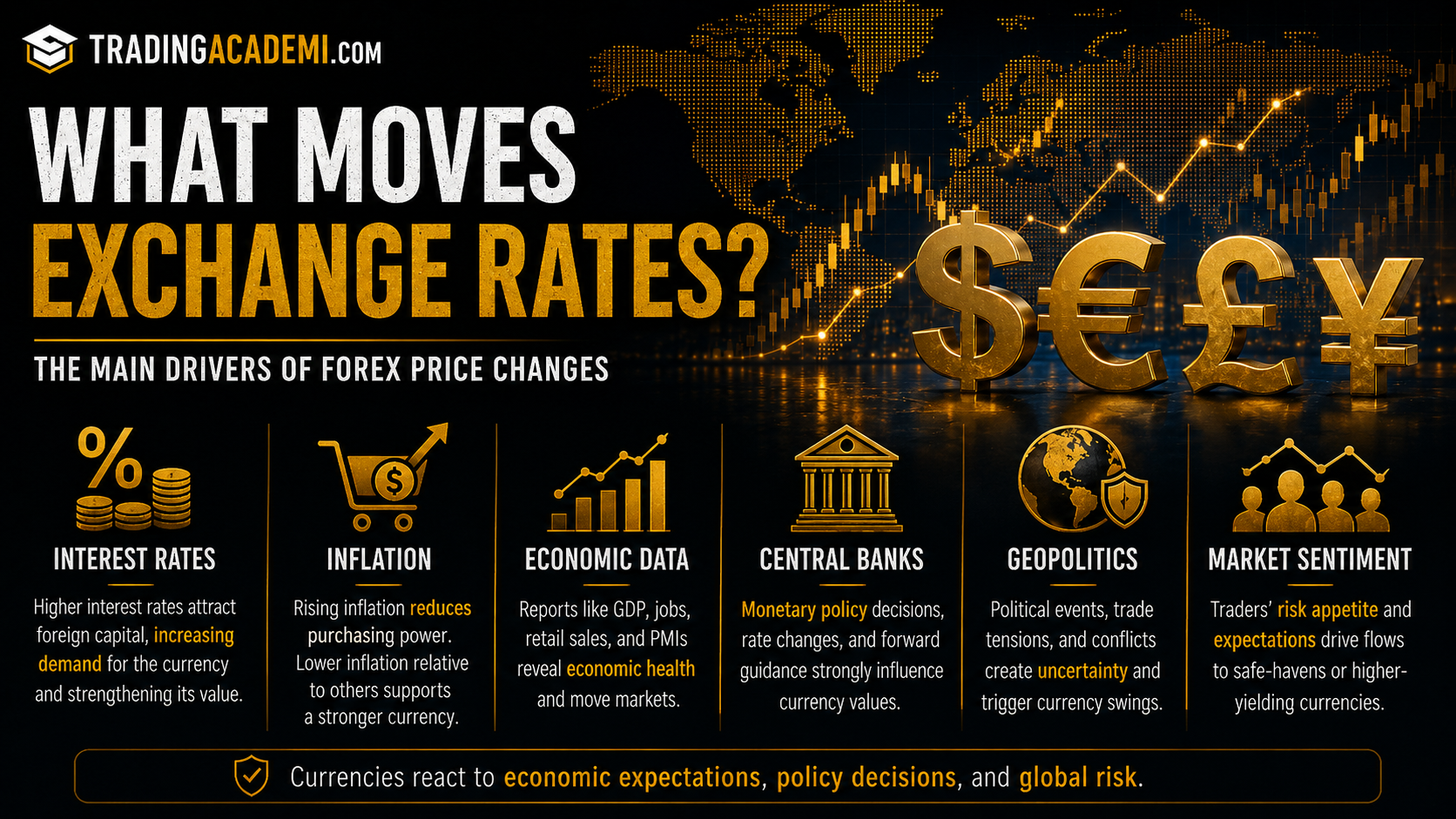
Forex prices are driven by many factors. The most important ones include interest rates, inflation, economic data, central banks, geopolitical events, and market sentiment.
1. Interest Rates
Interest rates are one of the strongest drivers of currency values.
If a country raises interest rates, its currency may become more attractive because investors may earn higher returns on assets in that currency.
If rates fall, the currency may weaken because returns become less attractive.
However, markets often move based on expectations, not only actual decisions.
2. Inflation
Inflation affects purchasing power.
If inflation is too high, a currency may lose value because goods and services become more expensive.
Central banks may raise interest rates to fight inflation, which can also affect currency prices.
This is why inflation data is closely watched by forex traders.
3. Economic Data
Economic reports can move currencies quickly.
Important data includes:
Employment reports
GDP growth
Retail sales
Inflation reports
Manufacturing data
Consumer confidence
Trade balance
Strong economic data can support a currency. Weak data can pressure it lower.
4. Central Bank Policy
Central banks play a major role in forex.
They influence interest rates, money supply, and market expectations.
When a central bank sounds more aggressive about raising rates, the currency may strengthen. When it sounds more cautious or supportive, the currency may weaken.
Forex traders often watch central bank speeches, meeting minutes, and policy statements.
5. Geopolitical Events
Wars, elections, sanctions, trade disputes, and political uncertainty can move currencies.
During uncertain times, traders may move money into currencies considered safer, such as the U.S. dollar, Swiss franc, or Japanese yen.
However, safe-haven behavior can change depending on the situation.
6. Market Sentiment
Forex markets are also influenced by risk appetite.
When investors feel confident, they may prefer higher-yielding or growth-sensitive currencies. When fear rises, they may move toward safer currencies.
This is why forex is strongly connected to global markets, stocks, bonds, commodities, and economic expectations.
Forex Market Sessions
The forex market is often described as a 24-hour market because trading moves across different global sessions.
The main forex sessions are:
Sydney session
Tokyo session
London session
New York session
The London and New York sessions are often the most active because they include major financial centers and high trading volume.
Different currency pairs may be more active during different sessions.
For example, JPY pairs may move more during the Asian session, while EUR and GBP pairs often move more during the London session.
Forex Trading vs Stock Trading
Forex trading and stock trading are different.
In the stock market, you usually analyze individual companies. You may look at earnings, revenue, management, products, and valuation.
In forex, you analyze economies and currencies. You may look at interest rates, inflation, central banks, employment data, and geopolitical risk.
Stocks are traded on exchanges. Forex is decentralized.
Stocks usually have specific market hours. Forex trades almost 24 hours during the business week.
Both markets require education and risk management, but they are not the same.
Recommended reading:
What Is the Stock Market?
Forex Market vs Commodities Market
The forex market and commodities market are connected in several ways.
Many commodities are priced in U.S. dollars. This means the strength of the dollar can influence commodity prices.
Some currencies are also linked to commodity exports.
For example, countries that export oil, metals, or agricultural products may see their currencies affected by commodity prices.
A trader who understands both forex and commodities may better understand global macro trends.
Recommended reading:
What Is the Commodities Market?
Advantages of the Forex Market
The forex market has several advantages.
It is highly liquid, especially for major currency pairs.
It is active almost 24 hours a day during the trading week.
It allows traders to participate in global macroeconomic trends.
It offers many currency pairs and trading opportunities.
It can be accessed by retail traders through online brokers.
However, these advantages do not remove the risks.
Risks of Forex Trading
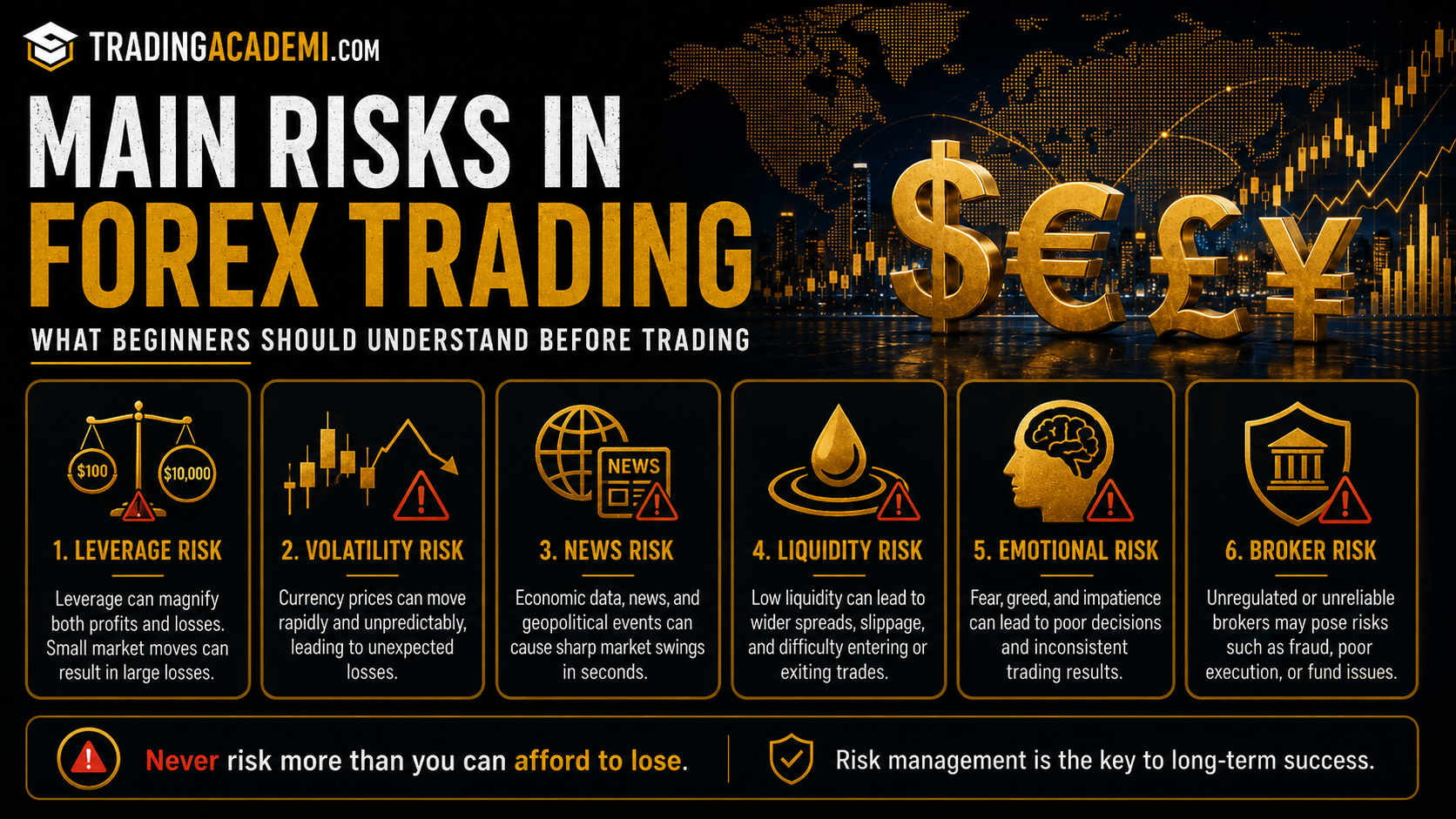
Forex trading can be risky, especially for beginners.
The biggest risks include:
Leverage risk
Volatility risk
Spread and cost risk
News event risk
Emotional trading risk
Margin risk
Broker risk
Because forex often involves leverage, losses can happen quickly if risk is not controlled.
A beginner should never trade forex only because the market is open or because a pair is moving. Every trade should have a plan.
Common Mistakes Beginners Make in Forex
One common mistake is using too much leverage.
Another mistake is trading during major news events without understanding the risk.
Some beginners also trade too many pairs at once. This creates confusion and makes it harder to follow market behavior.
Another mistake is ignoring the spread, especially on exotic pairs or during low-liquidity periods.
Many beginners also trade emotionally. They enter after a big move, revenge trade after a loss, or move their stop-loss because they do not want to accept being wrong.
Forex rewards discipline more than excitement.
How Beginners Should Start Learning Forex
A beginner should start by understanding the basic concepts:
Currency pairs
Base and quote currency
Pips
Spread
Leverage
Margin
Lot size
Risk management
Economic calendar
Central banks
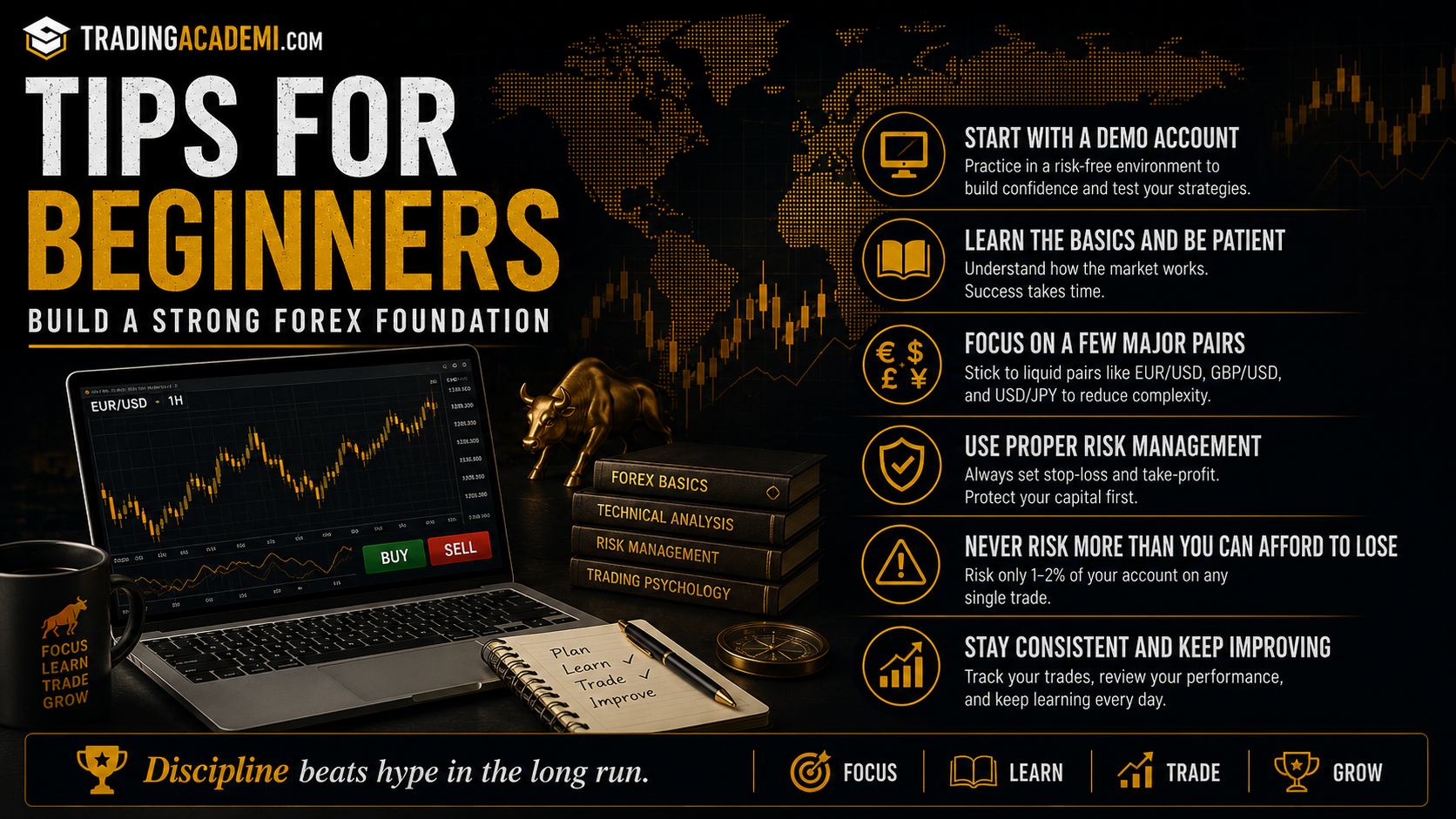
After that, it is useful to study a few major currency pairs instead of trying to trade everything.
Paper trading or demo trading can help beginners practice without risking real money, but they should still treat it seriously.
The goal is not to make fast money. The goal is to build skill and discipline.
Final Thoughts
The forex market is a global currency market that plays an important role in international trade, investment, and finance.
It allows currencies to be exchanged and gives traders the opportunity to speculate on exchange rate movements.
For beginners, the most important thing is to understand that forex is not just about charts. Currency prices are influenced by interest rates, inflation, economic data, central banks, geopolitical events, and global sentiment.
Forex can offer opportunities, but it also carries serious risk, especially when leverage is used incorrectly.
A smart trader learns the basics first, respects risk, follows a plan, and understands that protecting capital is more important than chasing every move.
Educational Disclaimer
This article is for educational purposes only and should not be considered financial advice. Trading forex and other financial markets involves risk, including the possible loss of capital. Always do your own research or consult a qualified financial professional before making financial decisions.