 By Anzo Trader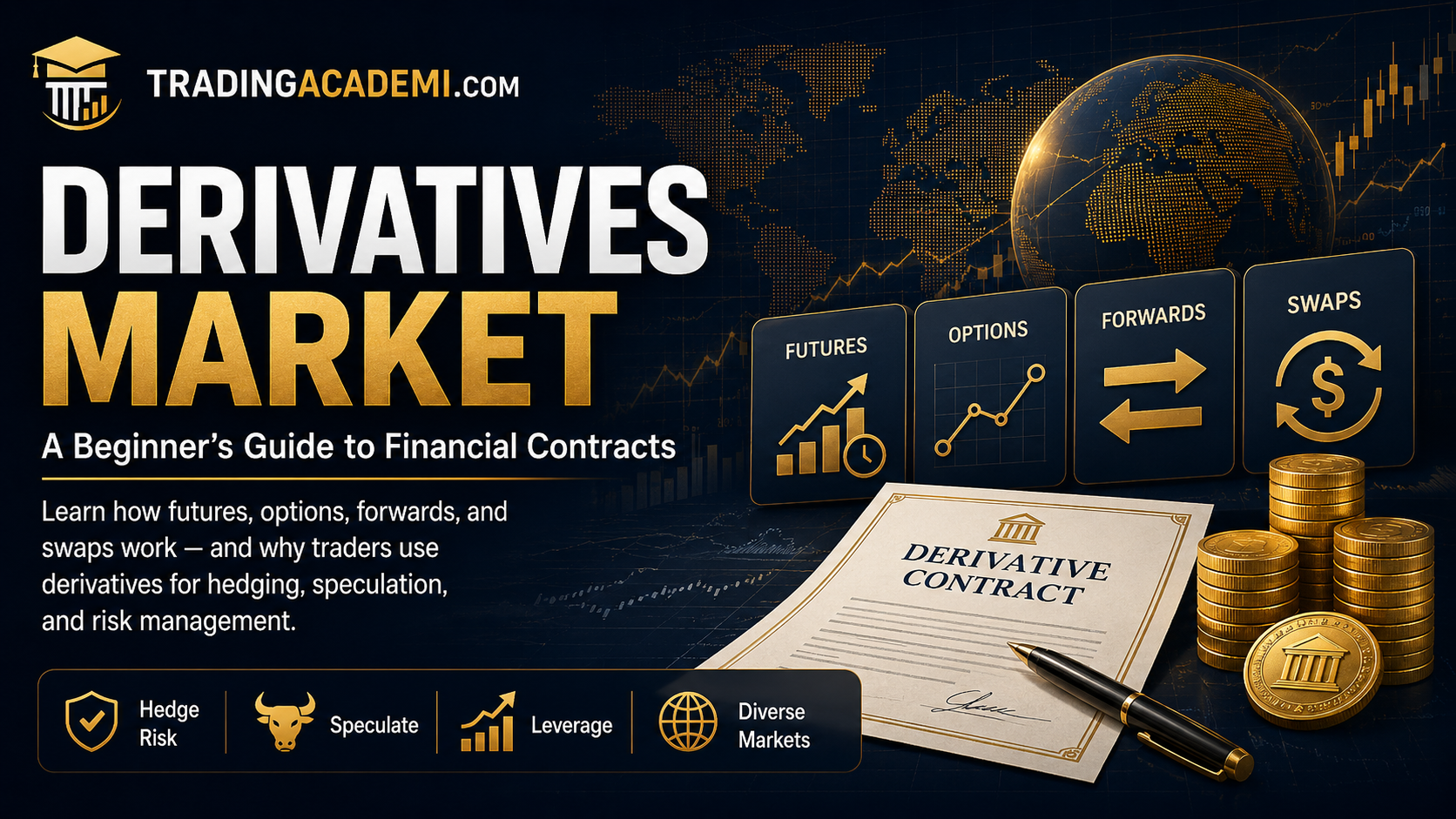
The derivatives market is one of the most important and powerful parts of the financial system. It is used by banks, hedge funds, companies, institutions, professional traders, and even some retail traders to manage risk, speculate on price movements, and gain exposure to different financial markets.
For beginners, derivatives can sound complicated because they are not simple assets like stocks, bonds, or commodities. When you buy a stock, you own a small part of a company. When you buy a bond, you are lending money to an issuer. But when you trade a derivative, you are trading a financial contract whose value depends on something else.
That “something else” is called the underlying asset.
The underlying asset can be a stock, stock index, commodity, currency, bond, interest rate, or even another financial instrument.
Derivatives can be useful tools, but they can also be risky if they are misunderstood. Many beginners enter derivatives markets because they hear about leverage, fast profits, options trading, or futures trading, but they do not fully understand how these contracts work.
In this guide, we will explain what the derivatives market is, how derivatives work, the main types of derivatives, why traders and institutions use them, what makes prices move, and the key risks every beginner should understand.
What Is the Derivatives Market?
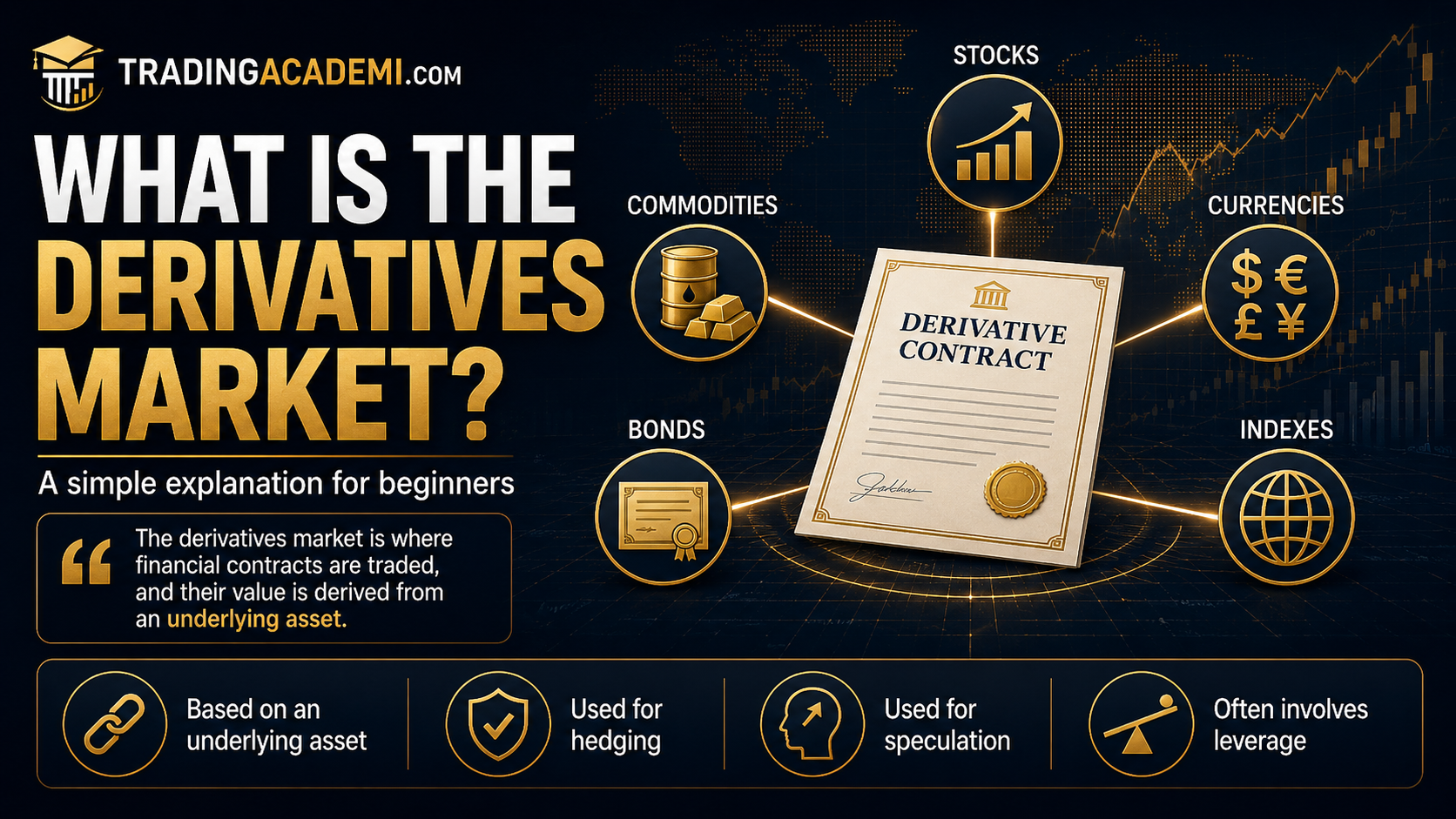
The derivatives market is a financial market where people trade contracts whose value is based on an underlying asset.
These contracts are called derivatives because their price is derived from another asset.
For example, an oil futures contract gets its value from the price of crude oil. A stock option gets its value from the price of a stock. A currency forward contract gets its value from an exchange rate.
Derivatives are not usually used to own the asset directly. Instead, they are used to gain exposure to price movements, hedge risk, or create specific financial strategies.
In simple words:
A derivative is a contract linked to the price of something else.
That is the core idea.
Why Does the Derivatives Market Exist?
The derivatives market exists because businesses, investors, and traders need ways to manage uncertainty.
Financial markets are always changing. Stock prices move. Interest rates change. Currency values fluctuate. Oil, gold, wheat, and other commodities rise and fall. These movements can create risk for businesses and investors.
Derivatives allow market participants to transfer, manage, or take on that risk.
For example, an airline may use fuel derivatives to protect itself from rising oil prices. A farmer may use futures contracts to lock in a price for crops before harvest. A company that does business internationally may use currency derivatives to reduce exchange rate risk. A trader may use options to speculate on a stock’s future movement.
This is why derivatives are used for both hedging and speculation.
They can help reduce risk, but they can also increase risk when used improperly.
How Do Derivatives Work?
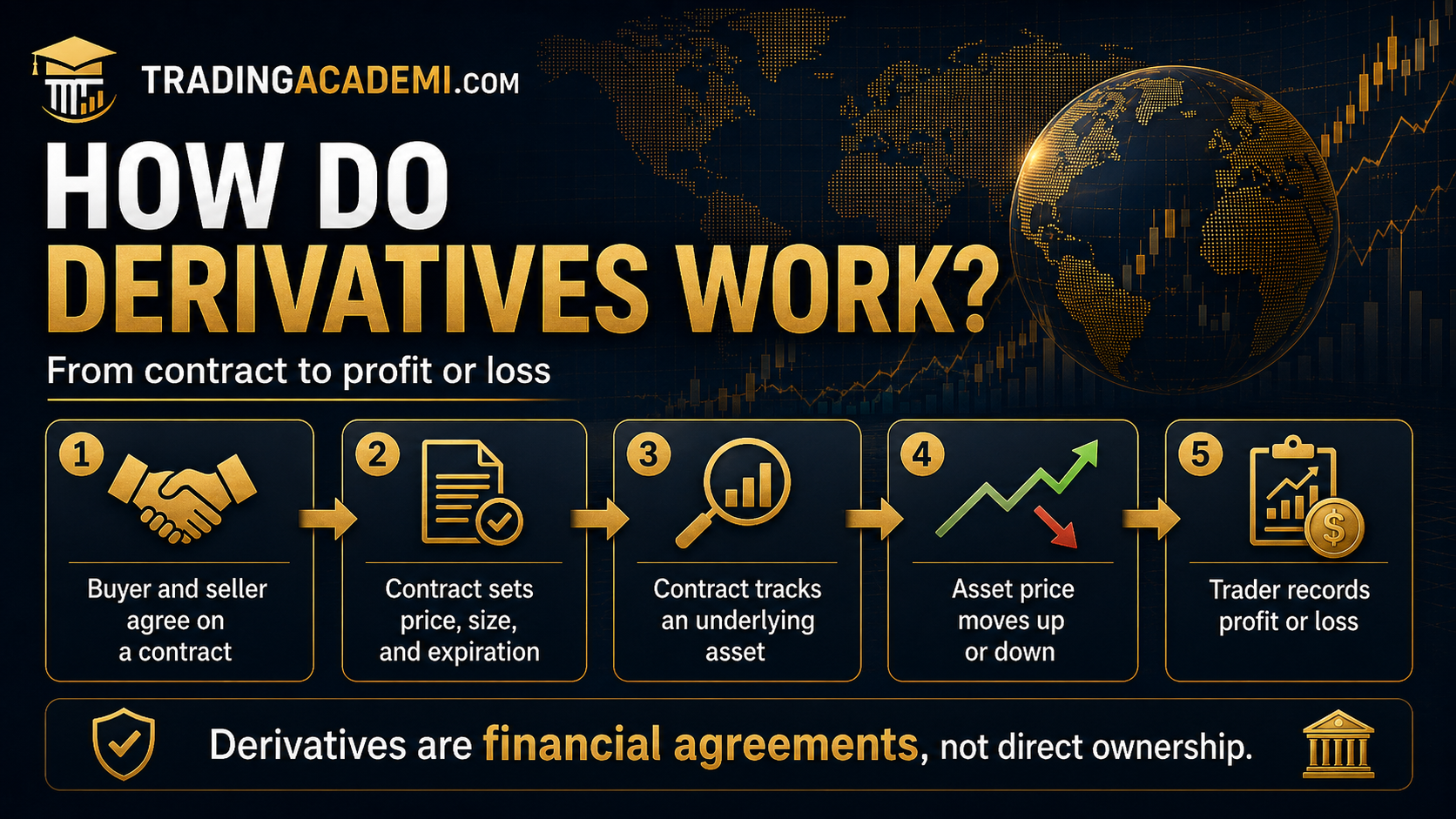
Derivatives work through contracts between buyers and sellers.
The contract defines important details such as:
The underlying asset
The price or strike price
The expiration date
The contract size
The obligations or rights of each party
The settlement method
For example, a futures contract may require the buyer and seller to exchange an asset at a future date and price.
An options contract may give the buyer the right, but not the obligation, to buy or sell an asset at a specific price before expiration.
The value of the derivative changes as the price of the underlying asset changes.
If the underlying asset moves in the expected direction, the derivative may gain value. If it moves against the position, the derivative may lose value.
What Is an Underlying Asset?
The underlying asset is the asset or market that a derivative contract is based on.
Common underlying assets include:
Stocks
Stock indexes
Bonds
Currencies
Interest rates
Commodities
Cryptocurrencies
Market volatility
For example:
An S&P 500 futures contract is based on the S&P 500 index.
A gold futures contract is based on the price of gold.
A EUR/USD currency option is based on the euro-dollar exchange rate.
A stock option on Apple is based on Apple’s stock price.
Understanding the underlying asset is essential because the derivative’s value depends on it.
A beginner should never trade a derivative without understanding what asset it is linked to.
Main Types of Derivatives
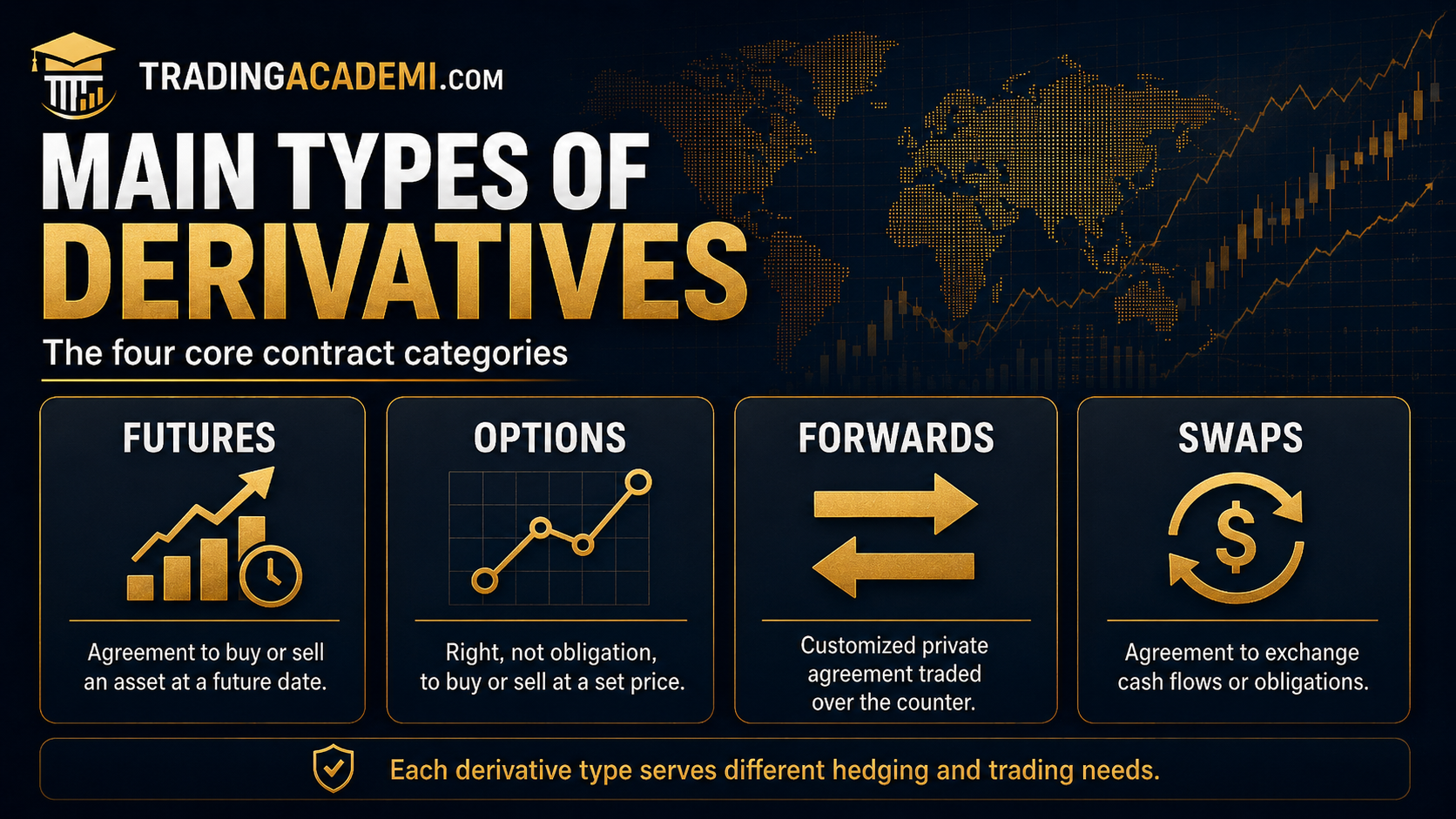
There are several types of derivatives, but beginners should start with the most common categories: futures, options, forwards, and swaps.
1. Futures Contracts
A futures contract is an agreement to buy or sell an asset at a specific price on a future date.
Futures are standardized contracts traded on exchanges. This means the contract size, expiration date, and other terms are defined by the exchange.
Futures are commonly used in markets such as:
Stock indexes
Crude oil
Gold
Natural gas
Currencies
Agricultural commodities
Interest rates
For example, a crude oil futures contract allows traders to buy or sell oil at a future date at a predetermined price.
Futures are used by both hedgers and speculators.
A company may use futures to reduce price risk. A trader may use futures to profit from price movements.
2. Options Contracts
An options contract gives the buyer the right, but not the obligation, to buy or sell an underlying asset at a specific price before or at expiration.
There are two main types of options:
Call options
A call option gives the buyer the right to buy the underlying asset.
Put options
A put option gives the buyer the right to sell the underlying asset.
For example, if a trader believes a stock may rise, they may buy a call option. If they believe a stock may fall, they may buy a put option.
Options can be used for speculation, income strategies, hedging, or risk management. However, options can be complex because their prices are affected by several factors, not only the underlying asset price.
3. Forward Contracts
A forward contract is an agreement between two parties to buy or sell an asset at a specific price on a future date.
Forwards are similar to futures, but they are usually private agreements and are not standardized like exchange-traded futures.
Forwards are commonly used by businesses and financial institutions.
For example, a company that expects to receive euros in the future may use a forward contract to lock in an exchange rate against the U.S. dollar.
This helps the company reduce currency risk.
Because forwards are private agreements, they can be customized. But they also involve counterparty risk, meaning one party may fail to meet its obligation.
4. Swaps
A swap is a derivative contract where two parties agree to exchange cash flows or financial obligations.
Swaps are often used by banks, corporations, and institutions.
One common type is an interest rate swap. In this contract, one party may exchange a fixed interest rate payment for a floating interest rate payment.
Companies may use swaps to manage interest rate risk.
Another type is a currency swap, where parties exchange payments in different currencies.
Swaps can be useful for risk management, but they are usually more complex than futures or basic options.
Derivatives Market vs Stock Market
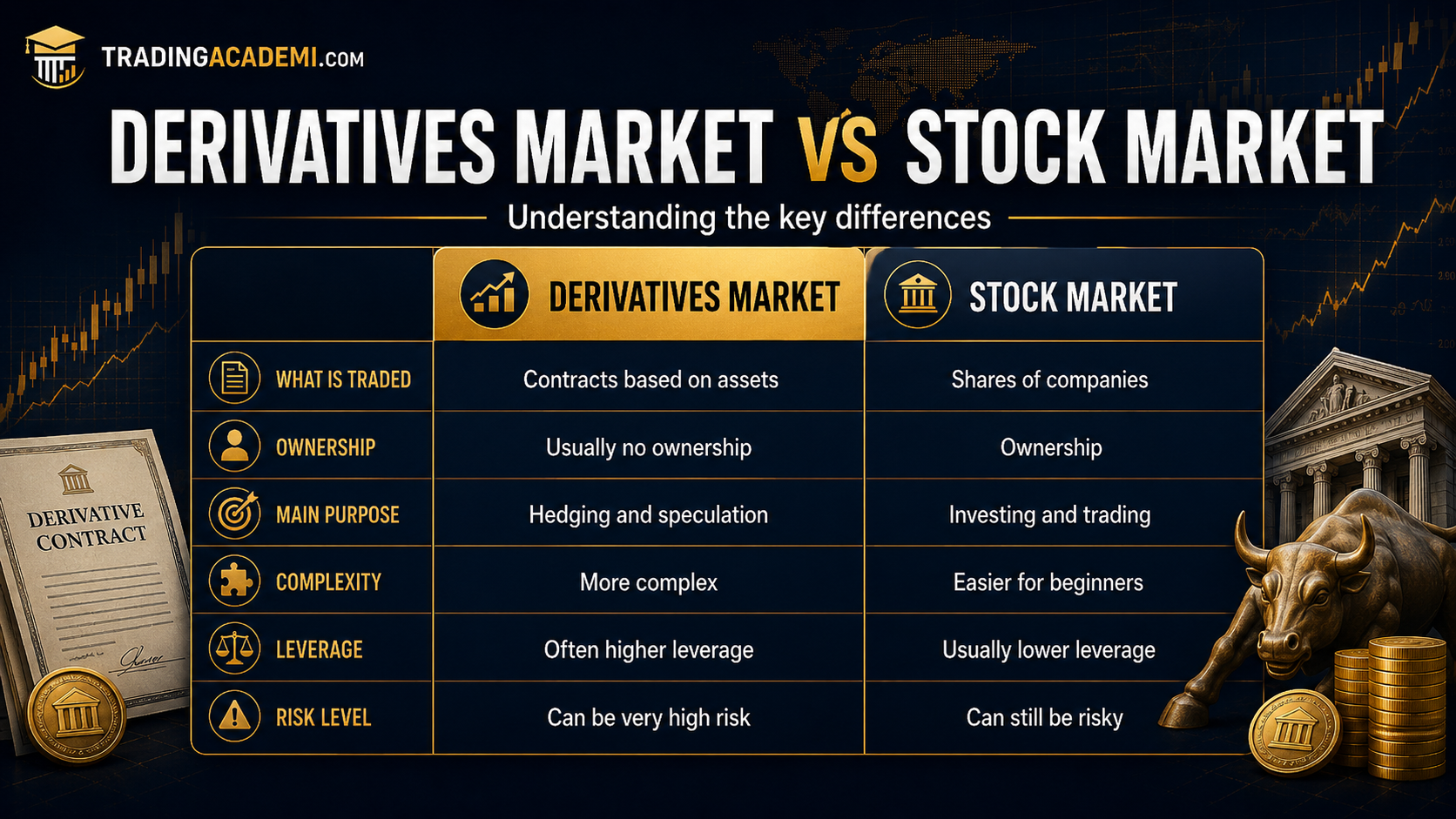
The derivatives market is different from the stock market.
In the stock market, investors buy and sell ownership shares of companies.
In the derivatives market, traders buy and sell contracts based on the value of another asset.
Here is a simple comparison:
| Feature | Stock Market | Derivatives Market |
|---|---|---|
| What is traded | Shares of companies | Financial contracts |
| Ownership | Can represent ownership | Usually no ownership |
| Main purpose | Investing, trading, capital raising | Hedging, speculation, risk management |
| Complexity | Easier for beginners | More complex |
| Leverage | Usually lower unless margin is used | Often higher |
| Risk level | Can be high | Can be very high if misused |
Derivatives are not automatically bad. They are tools. The risk depends on how they are used.
Why Do Traders Use Derivatives?
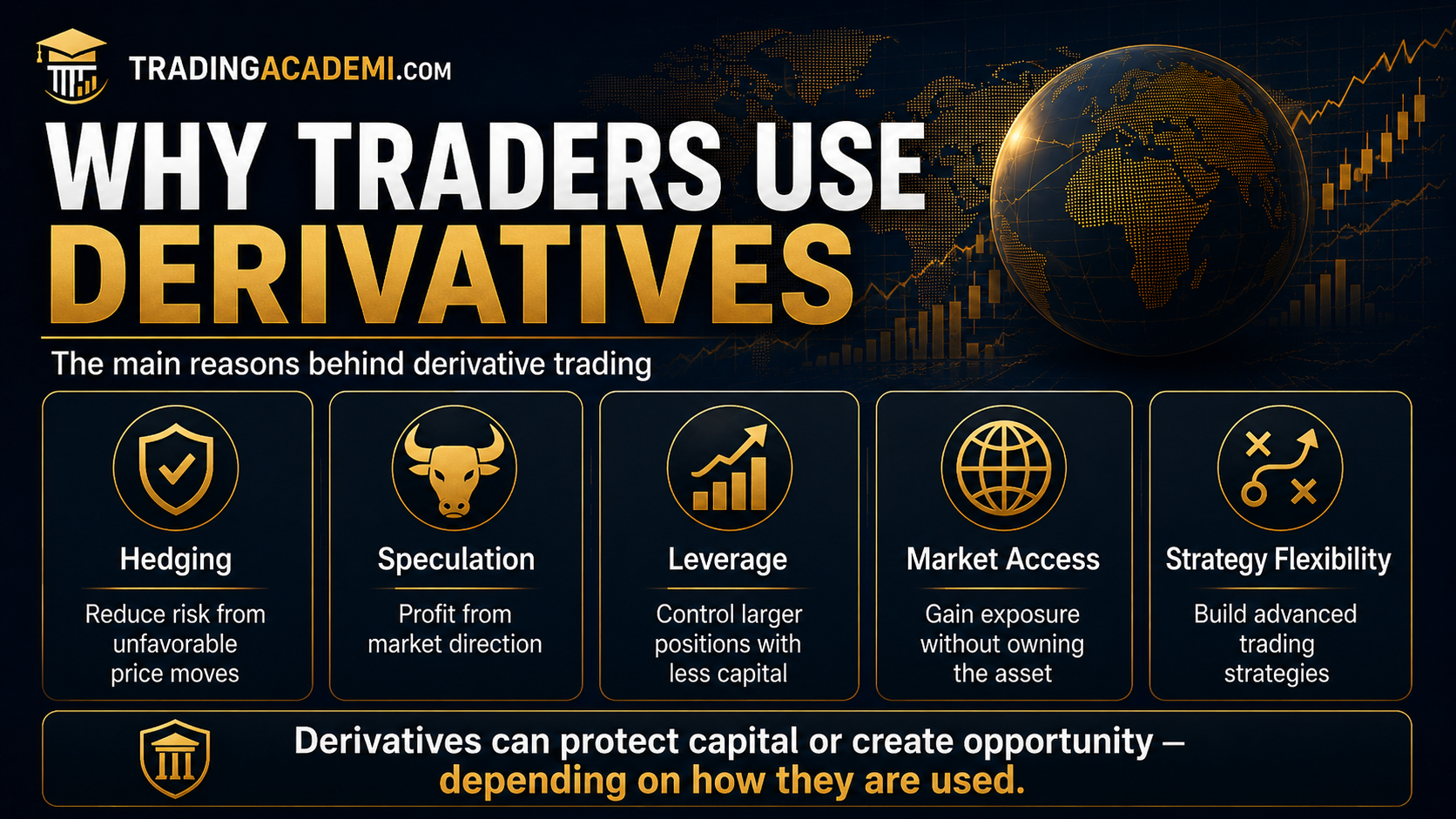
Traders and investors use derivatives for several reasons.
1. Hedging
Hedging means trying to reduce risk.
For example, a farmer may use futures to lock in a selling price for crops. This helps protect against falling crop prices.
An investor who owns stocks may use options to protect against a market decline.
A company may use currency forwards to reduce exchange rate risk.
2. Speculation
Speculation means trying to profit from price movements.
A trader may buy a futures contract if they expect an index to rise. Another trader may buy a put option if they expect a stock to fall.
Speculation can create opportunity, but it also involves risk.
3. Leverage
Derivatives often allow traders to control a larger position with less capital.
This can increase potential returns, but it can also increase losses.
Leverage is one of the main reasons derivatives are powerful and dangerous at the same time.
4. Market Access
Derivatives can give traders exposure to markets that may be difficult to access directly.
For example, a trader may use futures to gain exposure to oil, gold, or stock indexes without owning the physical commodity or buying all the underlying stocks.
5. Strategy Flexibility
Options and other derivatives can be used to create many strategies.
Some strategies focus on direction. Others focus on volatility, income, protection, or time decay.
This flexibility is useful, but it also makes derivatives more complex.
How Derivatives Are Priced
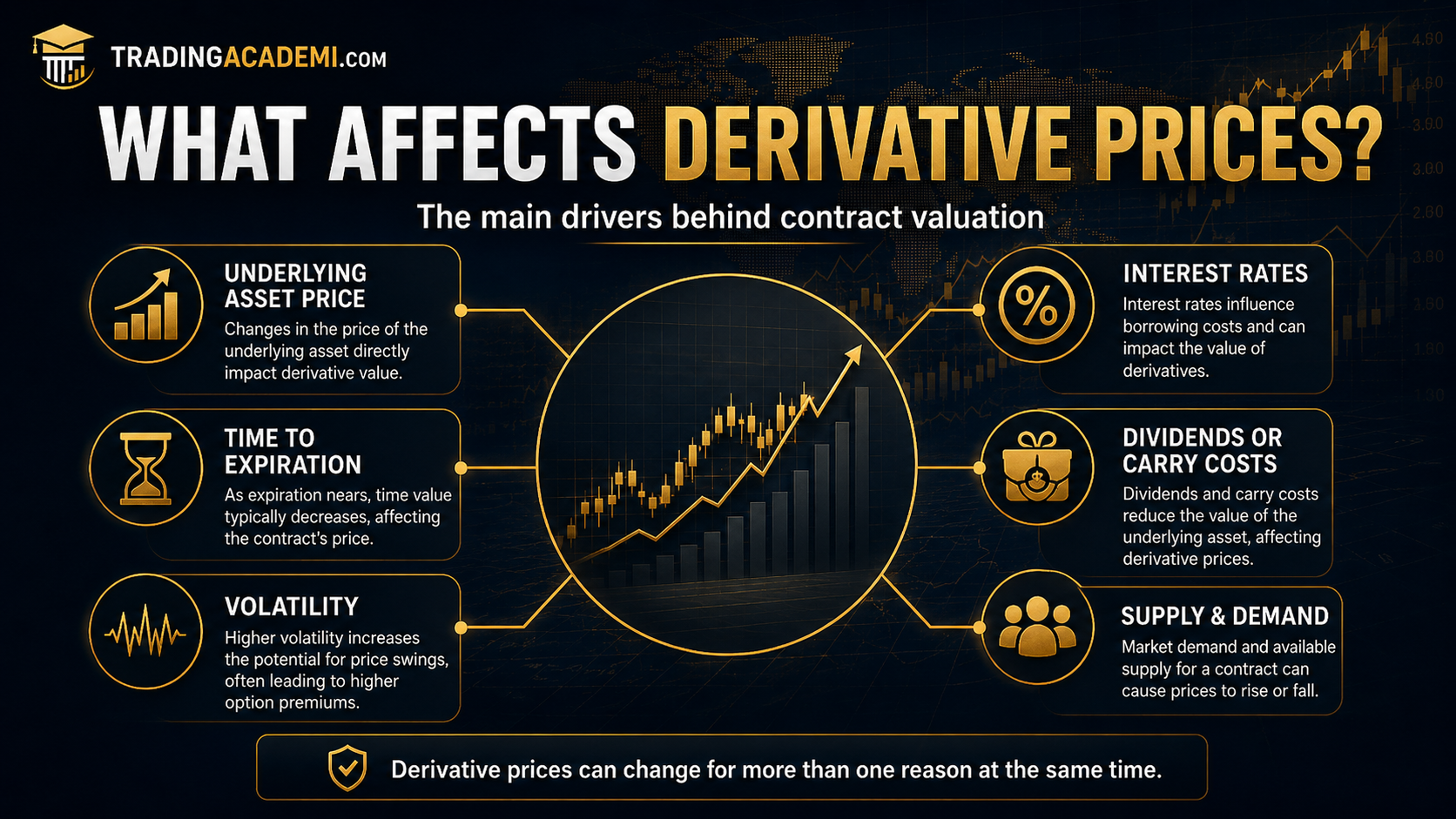
Derivative prices are influenced by several factors.
The most important factor is the price of the underlying asset. But it is not the only factor.
For options, prices may be affected by:
Underlying asset price
Strike price
Time until expiration
Volatility
Interest rates
Dividends
Supply and demand
For futures, prices may be affected by:
Spot price
Interest rates
Storage costs
Dividends or income
Supply and demand
Market expectations
This is why derivatives can be difficult for beginners. The price may not move exactly as expected, even if the underlying asset moves.
For example, an option can lose value over time because of time decay, even if the underlying stock does not move much.
What Is Expiration?
Many derivatives have an expiration date.
The expiration date is the last date when the contract is valid.
After expiration, the contract is settled, exercised, or becomes worthless depending on the type of derivative.
For example, an options contract may expire worthless if it is not profitable to exercise.
A futures contract may require settlement or rollover before expiration.
Beginners must pay attention to expiration because derivatives are time-sensitive.
A stock can be held for years. But many derivatives have a limited life.
What Is Leverage in Derivatives?
Leverage allows traders to control a larger position with less capital.
For example, a futures contract may give exposure to a large amount of an asset while requiring only a smaller margin deposit.
This can make profits larger if the trade goes well. But it can also make losses larger if the trade goes wrong.
Leverage is one of the most important risks in derivatives trading.
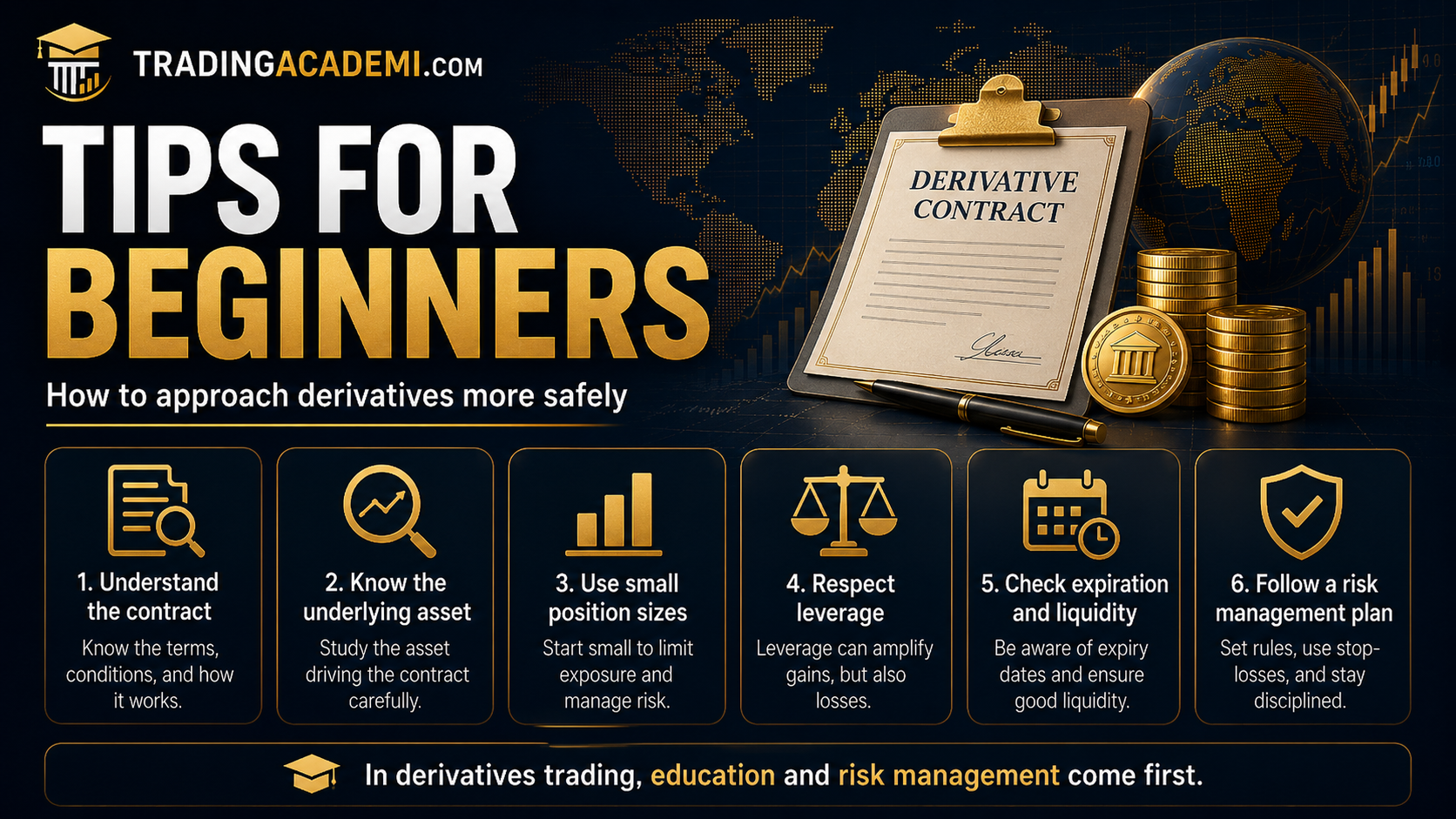
A beginner should never use leverage without understanding margin, position size, stop-losses, and worst-case scenarios.
What Is Margin?
Margin is the amount of money required to open or maintain a leveraged position.
In futures trading, margin acts like a performance deposit. It is not the full value of the contract.
If the market moves against the position, the trader may need to add more money. This is called a margin call.
If the account does not have enough funds, the broker may close the position.
This is why futures and leveraged derivatives require serious risk management.
Hedging Example With Futures
Imagine a farmer expects to harvest wheat in three months.
The farmer is worried that wheat prices may fall before the harvest is ready.
To reduce this risk, the farmer can sell wheat futures contracts today.
If wheat prices fall later, the farmer may lose money on the physical wheat but gain on the futures position. This helps offset the loss.
This is an example of hedging.
The goal is not always to make a huge profit. The goal is to reduce uncertainty.
Speculation Example With Options
Imagine a trader believes a stock currently trading at $100 may rise over the next month.
Instead of buying the stock directly, the trader buys a call option.
If the stock rises strongly, the call option may increase in value.
If the stock does not rise enough before expiration, the option may lose value or expire worthless.
This shows how options can provide exposure to price movement, but also why timing matters.
Being right about direction is not always enough. The move must happen before expiration and be large enough to overcome the cost of the option.
Derivatives and Risk Management
Derivatives can be used to manage risk, but they can also create risk.
This is why risk management is essential.
A trader should understand:
The contract size
The maximum possible loss
The margin requirement
The expiration date
The liquidity of the contract
The volatility of the underlying asset
The purpose of the trade
The exit plan
No derivative trade should be entered only because the potential profit looks attractive.
The first question should always be:
How much can I lose if I am wrong?
Main Risks of the Derivatives Market
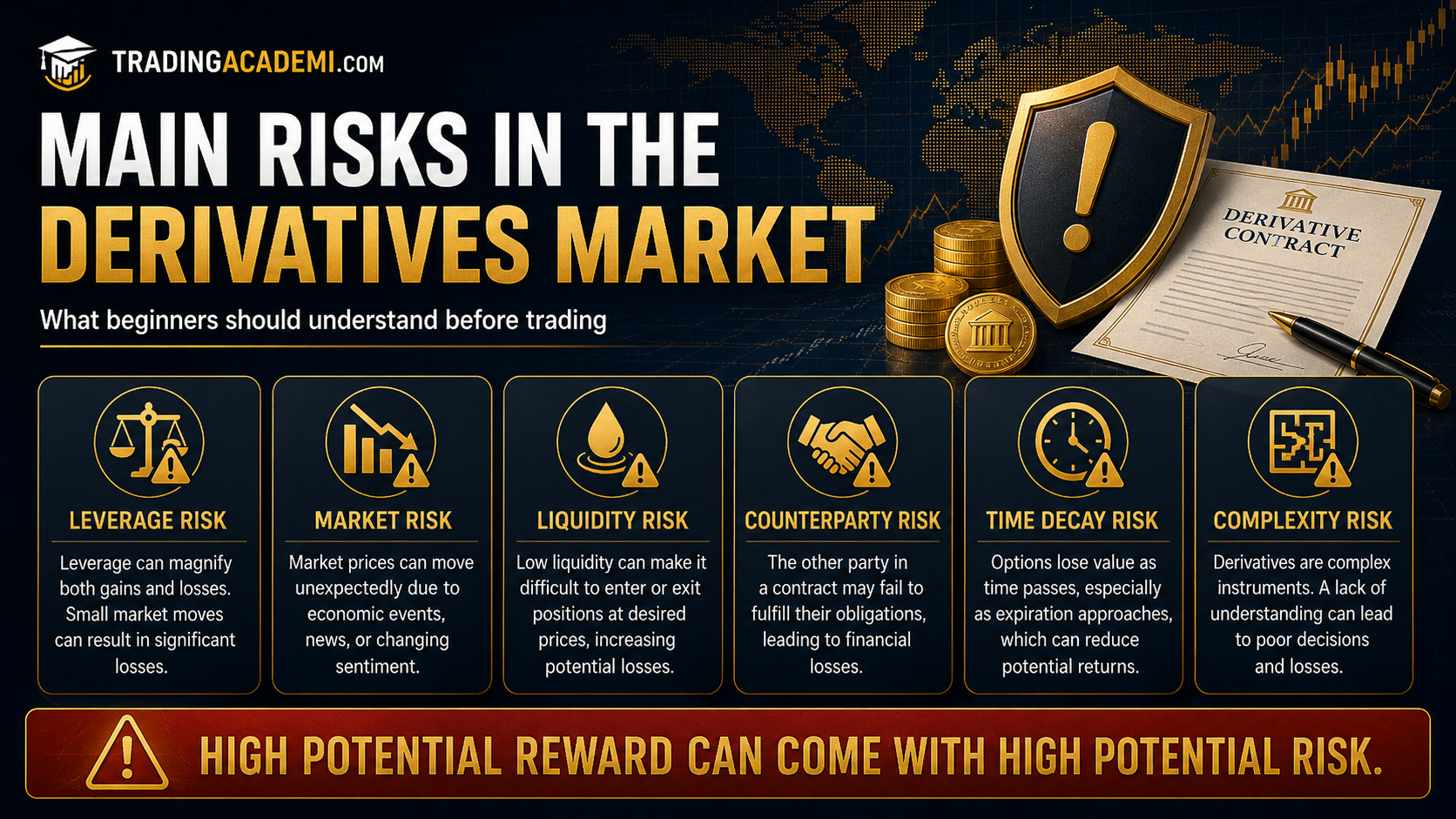
The derivatives market has several important risks.
1. Leverage Risk
Leverage can magnify gains and losses. A small move in the underlying asset can create a large change in the derivative position.
2. Market Risk
If the underlying asset moves against the position, the derivative can lose value.
3. Liquidity Risk
Some derivatives are actively traded, while others may have low liquidity. Low liquidity can make it harder to enter or exit positions at a fair price.
4. Counterparty Risk
In private derivatives such as forwards and some swaps, one party may fail to meet its obligations.
5. Time Decay
Options lose value as expiration approaches, especially if the underlying asset does not move enough.
6. Complexity Risk
Derivatives can be difficult to understand. Beginners may underestimate how contract size, margin, volatility, and expiration affect results.
7. Emotional Risk
Because derivatives can move quickly, traders may panic, overtrade, revenge trade, or use too much size.
Common Mistakes Beginners Make With Derivatives
One common mistake is trading derivatives before understanding the underlying asset.
Another mistake is focusing only on potential profit and ignoring maximum loss.
Some beginners use too much leverage because the required margin looks small compared to the full contract value.
Many options beginners buy cheap options without understanding time decay, volatility, and probability.
Another common mistake is holding contracts too close to expiration without a clear plan.
Beginners also sometimes trade complex strategies they found online without understanding how the strategy behaves in different market conditions.
Derivatives require patience, education, and discipline.
Are Derivatives Good for Beginners?
Derivatives can be educational, but they are not the easiest place for beginners to start.
Before trading derivatives, a beginner should first understand basic markets such as stocks, bonds, forex, or commodities.
They should also understand:
Order types
Risk management
Position sizing
Leverage
Margin
Volatility
Market behavior
Technical and fundamental analysis
Derivatives are powerful tools, but they should be approached carefully.
For many beginners, it is better to study them first, practice with small risk or demo accounts, and avoid complex strategies at the beginning.
Derivatives Market vs Commodities Market
The commodities market deals with physical raw materials such as oil, gold, wheat, coffee, and natural gas.
The derivatives market can include contracts based on commodities, but it is broader.
For example, crude oil futures are derivatives based on oil. Gold options are derivatives based on gold.
So, derivatives can be connected to commodities, but derivatives are contracts, while commodities are underlying assets.
Recommended reading:
What Is the Commodities Market?
Derivatives Market vs Forex Market
Forex involves exchanging currencies. Derivatives can also be based on currencies.
For example, currency futures, currency options, and currency forwards are derivatives linked to exchange rates.
A company may use currency forwards to protect itself from exchange rate changes. A trader may use currency futures to speculate on currency movements.
Recommended reading:
What Is the Forex Market?
Final Thoughts
The derivatives market is a major part of the financial system. It allows traders, investors, companies, and institutions to manage risk, speculate on price movements, and access different markets through contracts.
Derivatives include futures, options, forwards, and swaps. Each type has a different structure, purpose, and risk level.
For beginners, the most important thing is to understand that derivatives are not simple assets. They are contracts linked to an underlying asset, and their value can change quickly.
Derivatives can be useful, but they can also be dangerous when used without knowledge, planning, and risk control.
A smart trader does not use derivatives only because they offer leverage or fast opportunities. A smart trader first understands the contract, the underlying asset, the risks, and the possible loss.
In derivatives trading, education and risk management are not optional. They are the foundation.
Educational Disclaimer
This article is for educational purposes only and should not be considered financial advice. Trading derivatives, futures, options, and other financial instruments involves risk, including the possible loss of capital. Derivatives can be complex and may not be suitable for all investors. Always do your own research or consult a qualified financial professional before making financial decisions.