
 By Anzo Trader
The cryptocurrency market is one of the newest and most talked-about areas in finance. Unlike traditional markets such as stocks, bonds, commodities, or forex, the crypto market is built around digital assets that exist on blockchain networks.
For beginners, crypto can feel exciting and confusing at the same time. Prices can move quickly, new projects appear constantly, and words like Bitcoin, Ethereum, blockchain, wallets, exchanges, stablecoins, DeFi, NFTs, and altcoins can make the market look more complicated than it really is.
At its core, the cryptocurrency market is a place where people buy, sell, trade, and invest in digital assets. Some people see crypto as a new financial technology. Others trade it for price movement. Some use it for payments, decentralized applications, or long-term speculation.
But while the crypto market can offer opportunities, it also comes with serious risks. Prices can be extremely volatile, scams exist, regulation can change, and beginners can lose money quickly if they enter without understanding how the market works.
In this guide, we will explain what the cryptocurrency market is, how it works, the main types of digital assets, what moves crypto prices, how beginners can access the market, and the most important risks to understand before investing or trading.

What Is the Cryptocurrency Market?
The cryptocurrency market is a digital financial market where cryptocurrencies and other blockchain-based assets are bought and sold.
A cryptocurrency is a digital asset that uses cryptography and blockchain technology to record transactions and manage ownership.
Unlike traditional money issued by governments, many cryptocurrencies are not controlled by a central bank. Instead, they operate on networks maintained by computers around the world.
The most well-known cryptocurrency is Bitcoin. Bitcoin introduced the idea of a digital asset that can be transferred between people without relying on a traditional bank. Since then, thousands of other cryptocurrencies have been created, each with different purposes, technologies, and risks.
The cryptocurrency market includes assets such as:
Bitcoin
Ethereum
Stablecoins
Altcoins
Utility tokens
Governance tokens
DeFi tokens
Exchange tokens
NFT-related tokens
Not all cryptocurrencies are the same. Some are designed as digital money. Some power blockchain applications. Some are used for trading, governance, gaming, or decentralized finance. Others may have little real use and exist mainly for speculation.
Why Does the Cryptocurrency Market Exist?
The cryptocurrency market exists because blockchain technology created a new way to transfer and store digital value.
Traditional financial systems depend on banks, payment processors, brokers, clearing houses, and other intermediaries. Crypto networks try to allow digital transactions to happen directly between users, depending on the blockchain design.
The market also exists because people and institutions want exposure to digital assets.
Some participants buy crypto because they believe blockchain technology will grow over time. Some trade crypto because of volatility. Others use crypto for decentralized applications, international transfers, digital ownership, or financial experimentation.
The crypto market connects developers, users, traders, investors, miners, validators, exchanges, and blockchain projects.
It is not only a trading market. It is also connected to technology, software, cybersecurity, digital infrastructure, and online communities.

How Does the Cryptocurrency Market Work?
The cryptocurrency market works through digital exchanges, wallets, blockchain networks, buyers, and sellers.
A beginner usually accesses crypto through a cryptocurrency exchange. An exchange allows users to buy and sell digital assets using traditional money or other cryptocurrencies.
For example, someone may buy Bitcoin using U.S. dollars, euros, or another local currency. They may also trade Bitcoin against Ethereum, stablecoins, or other crypto assets.
When a crypto transaction happens, ownership is recorded on a blockchain. A blockchain is a public or distributed ledger that keeps track of transactions.
Depending on the cryptocurrency, transactions may be verified by miners, validators, or other network participants.
The price of a cryptocurrency changes based on supply and demand. If more people want to buy than sell, the price may rise. If more people want to sell than buy, the price may fall.
This sounds simple, but crypto prices can move much faster than traditional markets because the market is global, active around the clock, and often highly speculative.
What Is Blockchain?
Blockchain is the technology behind many cryptocurrencies.
A blockchain is a digital ledger that records transactions in blocks. These blocks are linked together in chronological order, creating a chain of records.
Instead of being stored in one central location, many blockchains are maintained by a network of computers. This can make the system more transparent and resistant to certain types of manipulation.
For example, when someone sends Bitcoin to another person, the transaction is recorded on the Bitcoin blockchain.
Blockchain can be used for more than digital money. It can also support smart contracts, decentralized applications, digital ownership, tokenized assets, and other financial or technological use cases.
However, blockchain technology does not automatically make every crypto project valuable. The quality, security, adoption, and real-world use of each project matter.
What Is Bitcoin?
Bitcoin is the first and most widely recognized cryptocurrency.
It was created as a digital form of money that can be transferred without a central bank or traditional financial intermediary.
Bitcoin has a limited supply, which is one reason many people compare it to digital gold. Some investors see it as a store of value. Others trade it because of price volatility.
Bitcoin is important because it started the cryptocurrency market and remains one of the main reference points for the entire crypto space.
When Bitcoin moves strongly, many other cryptocurrencies often react as well.
However, Bitcoin is still volatile and risky. Its price can rise or fall sharply based on market sentiment, liquidity, regulation, macroeconomic conditions, and investor behavior.
What Is Ethereum?
Ethereum is a blockchain network that allows developers to build decentralized applications and smart contracts.
A smart contract is a piece of code that can automatically execute actions when certain conditions are met.
Ethereum is different from Bitcoin because it is not only designed as digital money. It also supports applications such as decentralized finance, NFTs, tokens, and blockchain-based services.
The native cryptocurrency of the Ethereum network is called Ether, often written as ETH.
Ethereum is one of the most important blockchain platforms because many crypto projects, tokens, and applications have been built on or connected to it.
However, like all crypto assets, Ethereum also carries risk. Its price can be volatile, and the network faces competition, technical challenges, regulatory questions, and market cycles.
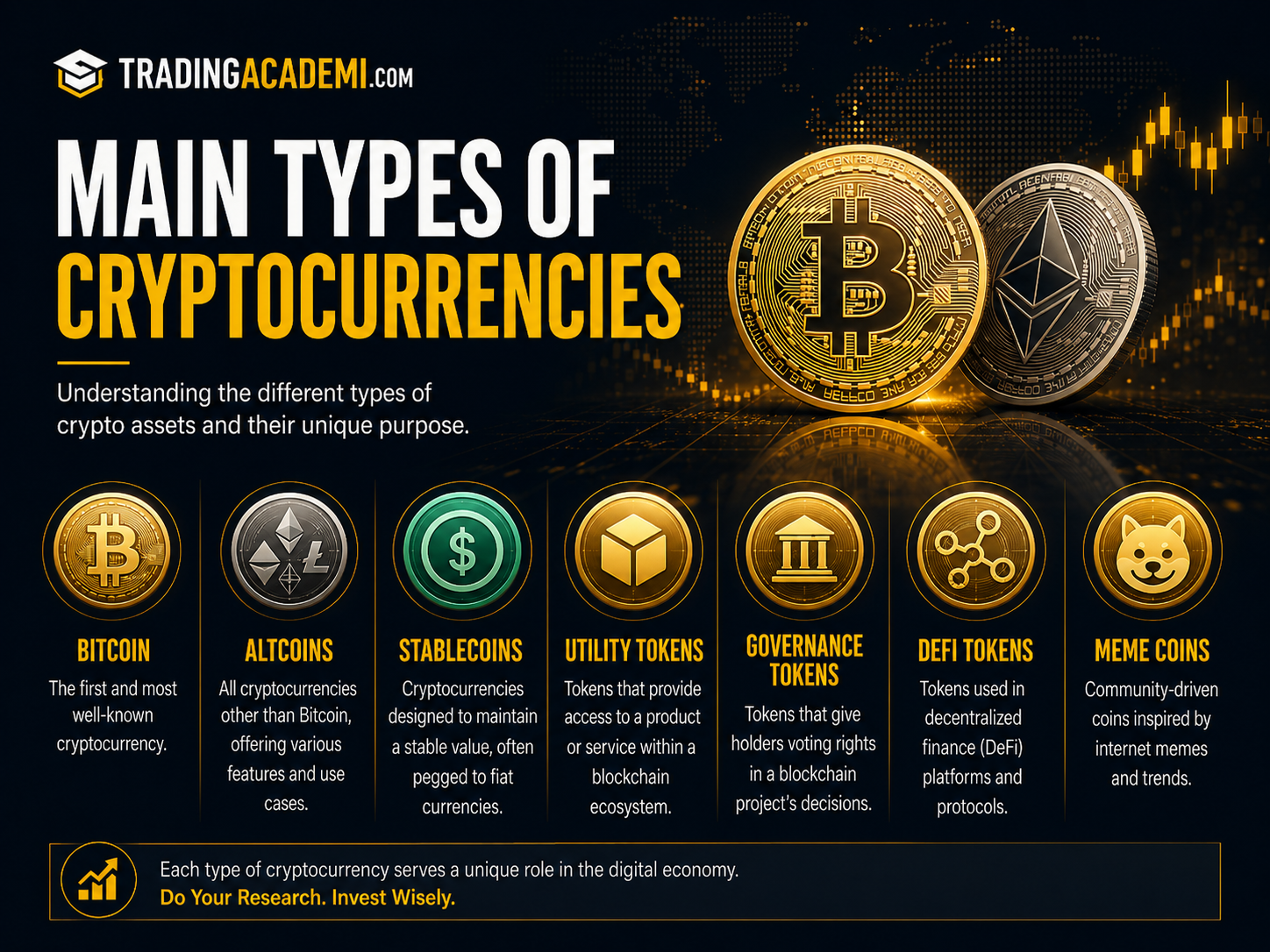
Main Types of Cryptocurrencies
The cryptocurrency market includes different categories of digital assets. Understanding these categories helps beginners avoid treating every coin the same.
1. Bitcoin
Bitcoin is often viewed as the main cryptocurrency and the benchmark for the crypto market.
It is commonly used as a long-term speculative asset, a trading asset, and a reference point for crypto market sentiment.
When people say “crypto market,” Bitcoin is usually the first asset that comes to mind.
2. Altcoins
Altcoins are cryptocurrencies other than Bitcoin.
The word “altcoin” comes from “alternative coin.”
Some altcoins are serious blockchain projects with active development and real use cases. Others may be highly speculative or weak projects.
Examples of altcoins can include blockchain platform tokens, payment coins, gaming tokens, DeFi tokens, and exchange-related tokens.
Beginners should be careful with altcoins because many of them are more volatile than Bitcoin.
3. Stablecoins
Stablecoins are cryptocurrencies designed to maintain a stable value, often linked to a traditional currency such as the U.S. dollar.
For example, a stablecoin may aim to stay close to $1.
Traders often use stablecoins to move money between crypto assets without converting back to traditional currency.
Stablecoins can be useful, but they are not risk-free. Their safety depends on reserves, transparency, regulation, issuer quality, and market confidence.
4. Utility Tokens
Utility tokens are designed to be used within a specific blockchain ecosystem or platform.
They may give access to services, pay network fees, or support certain functions inside an application.
A token having “utility” does not automatically make it a good investment. The project still needs real demand, security, adoption, and long-term sustainability.
5. Governance Tokens
Governance tokens allow holders to participate in decisions related to a blockchain protocol or decentralized application.
For example, token holders may vote on changes to a platform’s rules, fees, or development direction.
Governance tokens can be important in decentralized finance, but they can also be speculative and risky.
6. DeFi Tokens
DeFi stands for decentralized finance.
DeFi tokens are connected to financial applications built on blockchain networks. These applications may involve lending, borrowing, trading, liquidity pools, or yield strategies.
DeFi can be innovative, but it can also be complex and risky. Smart contract bugs, hacks, liquidity problems, and unstable yields can create major losses.
7. Meme Coins
Meme coins are cryptocurrencies often created around internet culture, jokes, communities, or viral trends.
Some meme coins can rise quickly because of hype and social media attention, but they can also fall sharply.
Beginners should be very careful with meme coins because many have limited utility and extreme volatility.
Crypto Exchanges
A crypto exchange is a platform where users can buy, sell, and trade cryptocurrencies.
There are two main types of exchanges: centralized exchanges and decentralized exchanges.
Centralized Exchanges
Centralized exchanges are run by companies. They usually offer user accounts, customer support, trading interfaces, fiat deposits, and many listed assets.
They are easier for beginners to use, but users must trust the exchange to manage funds and security properly.
Decentralized Exchanges
Decentralized exchanges allow users to trade directly from crypto wallets without relying on a central company to hold funds.
They can give users more control, but they also require more technical understanding. Mistakes with wallets, wrong networks, or smart contracts can be costly.
Beginners should learn carefully before using decentralized exchanges.
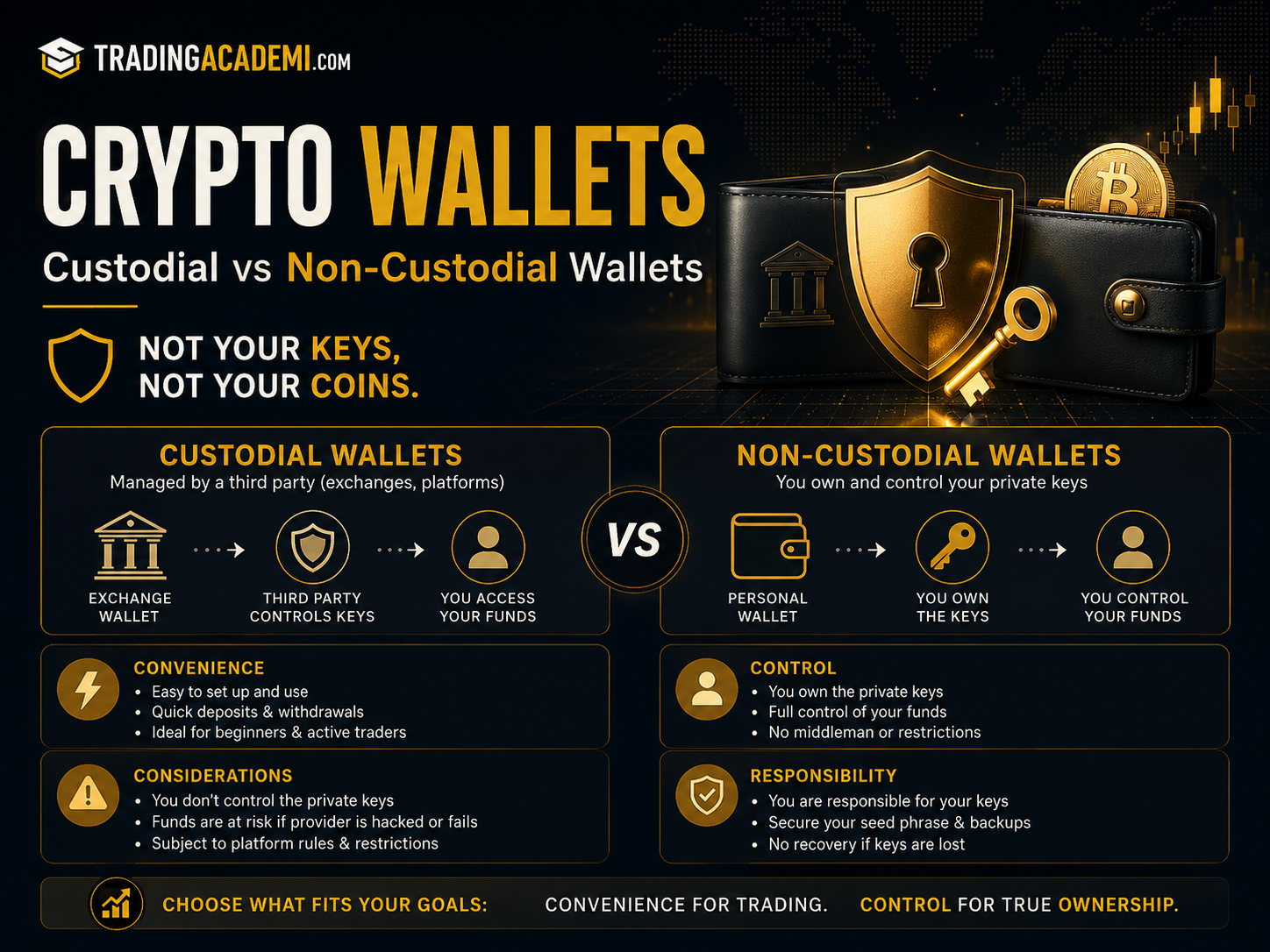
Crypto Wallets Explained
A crypto wallet is used to store and manage digital assets.
There are two main types of wallets: custodial wallets and non-custodial wallets.
Custodial Wallets
A custodial wallet means a third party, such as an exchange, controls the private keys for the user.
This can be easier for beginners, but it means the user depends on the platform.
Non-Custodial Wallets
A non-custodial wallet gives the user control of the private keys or recovery phrase.
This provides more control, but also more responsibility.
If a user loses the recovery phrase, they may lose access to the funds permanently.
This is one of the most important lessons in crypto:
Control gives freedom, but it also creates responsibility.

What Makes Crypto Prices Move?
Crypto prices are driven by supply and demand, but many factors influence that balance.
1. Market Sentiment
Crypto is heavily influenced by emotion, hype, fear, and optimism.
When traders are confident, prices may rise quickly. When fear spreads, prices can fall sharply.
2. Bitcoin Price Movement
Bitcoin often influences the wider crypto market.
When Bitcoin rises strongly, altcoins may attract more attention. When Bitcoin falls sharply, many altcoins may fall even harder.
3. Regulation
Government rules, lawsuits, exchange restrictions, tax policies, and regulatory announcements can move crypto prices.
Because the crypto industry is still developing, regulation remains an important risk factor.
4. Technology and Network Updates
Blockchain upgrades, security improvements, new features, or technical problems can affect investor confidence.
A successful upgrade may support a project. A hack or network failure may damage trust.
5. Adoption
If more users, developers, companies, or institutions use a crypto network, demand may increase.
However, adoption should be real and measurable, not only marketing hype.
6. Liquidity
Low liquidity can make prices move quickly in either direction.
Small crypto assets can be especially risky because large trades may cause sharp price swings.
7. Macroeconomic Conditions
Interest rates, inflation, risk appetite, and global financial conditions can affect crypto.
When investors are willing to take more risk, crypto may perform better. When markets become cautious, crypto can suffer.
Crypto Market vs Stock Market
The crypto market and stock market are very different.
In the stock market, investors buy ownership shares of companies. Stocks are connected to businesses, earnings, products, cash flow, and management.
In the crypto market, investors buy digital assets that may represent a network, protocol, token, or digital use case.
Stocks are usually more regulated than crypto. Crypto trades around the clock and can be more volatile.
Here is a simple comparison:
| Feature | Crypto Market | Stock Market |
|---|---|---|
| What is traded | Digital assets and tokens | Shares of companies |
| Market hours | 24/7 | Usually fixed exchange hours |
| Regulation | Still developing | More established |
| Volatility | Often very high | Varies, but usually lower |
| Ownership | Depends on token type | Company ownership |
| Main drivers | Sentiment, adoption, liquidity, regulation | Earnings, valuation, economy, company news |
Both markets carry risk, but crypto can move faster and behave more unpredictably.
Recommended reading:
What Is the Stock Market?
Crypto Market vs Forex Market
The crypto market and forex market are both global and digital, but they are not the same.
Forex involves currencies issued by countries. Crypto involves digital assets created on blockchain networks.
Forex is strongly influenced by central banks, interest rates, inflation, and economic data.
Crypto is influenced by technology, adoption, regulation, liquidity, Bitcoin sentiment, and risk appetite.
Forex is usually more liquid and more established. Crypto is newer and often more volatile.
Recommended reading:
What Is the Forex Market?
Advantages of the Cryptocurrency Market
The crypto market has several potential advantages.
It is open 24 hours a day, seven days a week.
It allows global access to digital assets.
It supports new financial technologies and blockchain applications.
It can offer strong trading opportunities because of volatility.
It gives users access to digital ownership, decentralized applications, and alternative financial systems.
However, advantages do not remove risk. In crypto, opportunity and risk often appear together.

Risks of the Cryptocurrency Market
The cryptocurrency market can be very risky, especially for beginners.
Price Volatility
Crypto prices can rise or fall sharply within short periods.
A coin can gain value quickly and then lose a large portion of that value just as fast.
Regulatory Risk
Crypto regulation can change. New laws or restrictions can affect exchanges, stablecoins, DeFi platforms, or specific tokens.
Security Risk
Hacks, phishing attacks, fake websites, wallet mistakes, and stolen private keys are serious risks.
Scam Risk
The crypto industry has many scams, fake projects, pump-and-dump schemes, and misleading promotions.
Beginners should be extremely cautious of guaranteed returns or pressure to invest quickly.
Liquidity Risk
Some crypto assets may be hard to sell without moving the price significantly.
Stablecoin Risk
Stablecoins may lose trust if their reserves, issuer, or structure are questioned.
Technology Risk
Smart contract bugs, network failures, coding errors, or protocol weaknesses can cause losses.
Emotional Risk
Because crypto moves quickly, traders may panic, chase pumps, revenge trade, or invest more than they can afford to lose.

Common Mistakes Beginners Make in Crypto
One common mistake is buying a coin only because it is trending on social media.
Another mistake is investing without understanding the project, token supply, use case, liquidity, or risks.
Some beginners keep all funds on an exchange without understanding custody risk.
Others send crypto to the wrong wallet address or wrong network, which can result in permanent loss.
Many beginners also chase low-priced coins thinking they are “cheap,” without understanding market capitalization.
A coin priced at $0.01 is not automatically cheaper or better than a coin priced at $1,000. Supply matters.
Another common mistake is ignoring risk management. Crypto can move fast, and emotional decisions can be expensive.

What Is Market Capitalization in Crypto?
Market capitalization, or market cap, is a way to estimate the size of a cryptocurrency.
It is calculated as:
Token price × circulating supply
For example, if a token is priced at $10 and has 100 million tokens in circulation, its market cap is $1 billion.
Market cap helps investors compare crypto assets more realistically than price alone.
A low token price does not always mean a project has more upside. If the supply is very large, the market cap may already be high.
This is an important concept for beginners.
How Beginners Can Start Learning Crypto
Beginners should start slowly and focus on understanding the basics before risking real money.
Important topics include:
Blockchain
Bitcoin
Ethereum
Wallets
Private keys
Stablecoins
Exchanges
Market capitalization
Liquidity
Volatility
Security
Risk management
It is also helpful to study how scams work, how wallets work, and how to protect accounts.
In crypto, knowledge is not only about making better trades. It is also about protecting yourself from avoidable mistakes.
Is Crypto Good for Beginners?
Crypto can be interesting for beginners, but it is not automatically beginner-friendly.
The market is open all the time, prices move fast, and mistakes can be difficult or impossible to reverse.
A beginner should not enter crypto only because of hype or fear of missing out.
Crypto may be suitable for people willing to learn, manage risk, and accept high volatility.
It may not be suitable for people who cannot handle large price swings or who need stable short-term savings.
The best approach is education first, small exposure if appropriate, and strong risk control.
Final Thoughts
The cryptocurrency market is a fast-moving digital asset market built around blockchain technology. It includes Bitcoin, Ethereum, stablecoins, altcoins, DeFi tokens, governance tokens, and many other types of digital assets.
Crypto can offer opportunities, but it also carries serious risks. Volatility, scams, regulation, security problems, liquidity issues, and emotional trading can all lead to losses.
For beginners, the most important thing is to understand what you are buying, why it has value, how it works, and what could go wrong.
A smart crypto participant does not chase every trend. They learn the basics, protect their wallet, manage risk, and avoid investing money they cannot afford to lose.
The crypto market may be new compared to traditional finance, but the old rules still matter: education, patience, discipline, and risk management.
Educational Disclaimer
This article is for educational purposes only and should not be considered financial advice. Cryptocurrency trading and investing involve high risk, including the possible loss of capital. Digital assets can be volatile and may not be suitable for all investors. Always do your own research or consult a qualified financial professional before making financial decisions.