
 By Anzo Trader
The stock market is one of the most important parts of the financial world. Every day, millions of investors and traders buy and sell shares of companies through stock exchanges and online trading platforms.
For beginners, the stock market can look complicated at first. You may hear words like shares, stocks, dividends, IPOs, exchanges, brokers, bull markets, bear markets, and market indexes. But once you understand the basic idea, the stock market becomes much easier to follow.
In simple terms, the stock market is a place where people can buy and sell ownership shares of publicly traded companies. When you buy a stock, you are buying a small piece of that company.
This guide explains how the stock market works, why it exists, who participates in it, how investors can make money, and what risks beginners should understand before getting started.
What Is the Stock Market?
The stock market is a financial market where shares of publicly listed companies are bought and sold.
A company becomes publicly traded when its shares are available for investors to buy through a stock exchange. These shares represent partial ownership in the company.
For example, when someone buys shares of a company like Apple, Microsoft, Tesla, Coca-Cola, or Amazon, they become a shareholder. This does not mean they control the company, but it means they own a small part of it.
The value of those shares can rise or fall depending on the company’s performance, investor expectations, economic conditions, news, and market sentiment.
Why Does the Stock Market Exist?
The stock market exists for two main reasons.
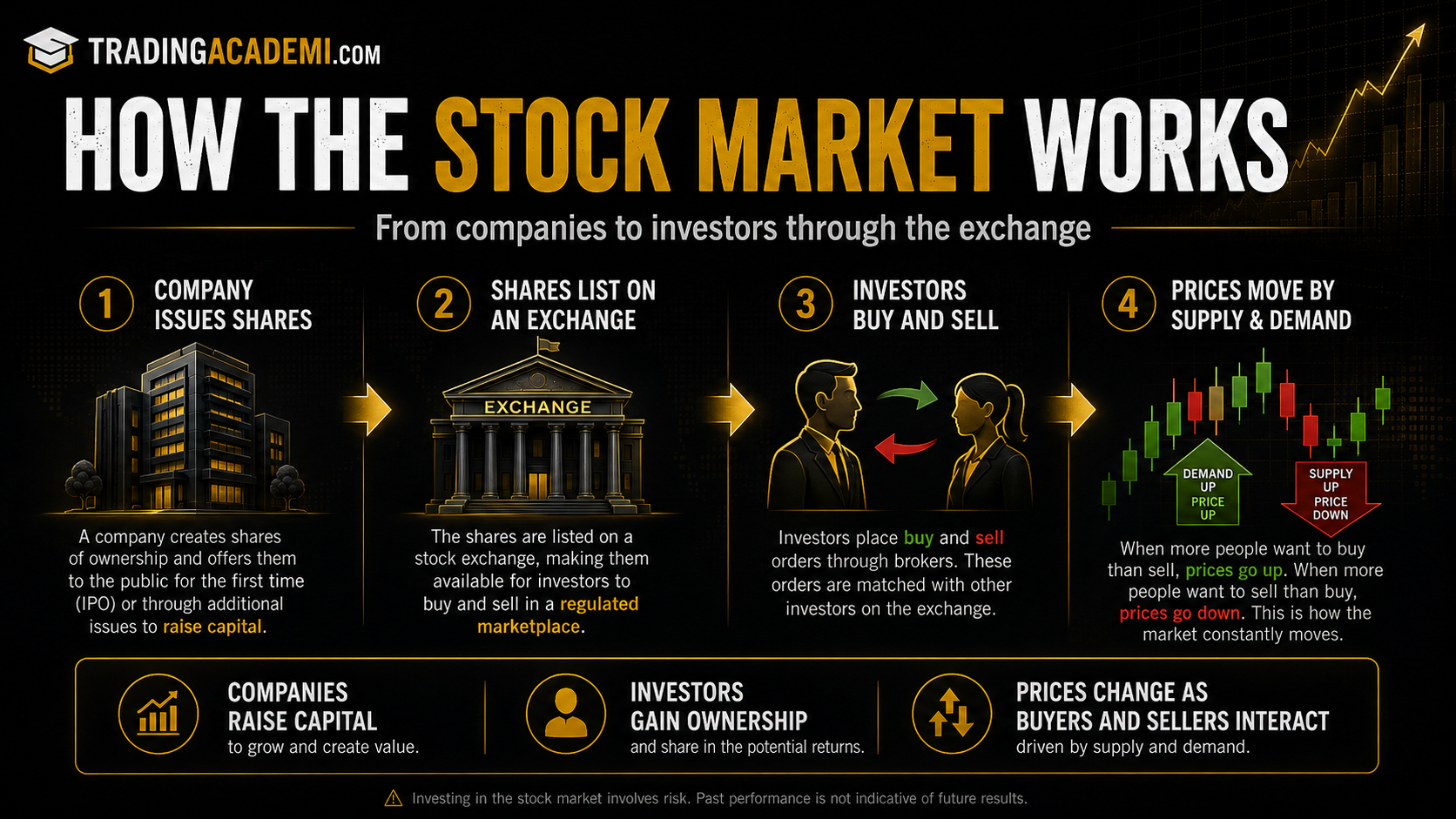
First, it helps companies raise capital. When a company wants to grow, expand, build new products, hire more employees, or enter new markets, it may need money. One way to raise that money is by selling shares to investors.
Second, it gives investors the opportunity to participate in the growth of businesses. If a company performs well over time, its stock price may increase, allowing investors to potentially profit.
This creates a connection between companies that need capital and investors who are looking for opportunities.
What Is a Stock?
A stock is a share of ownership in a company.
When you buy a stock, you are buying a small ownership claim in that business. If the company grows and becomes more valuable, your shares may also become more valuable.
Stocks are also called equities because they represent ownership equity in a company.
There are two common types of stocks:
Common stock gives shareholders ownership rights and may include voting rights.
Preferred stock usually gives shareholders priority over common shareholders when it comes to dividends, but it may not include the same voting rights.
Most beginner investors usually deal with common stocks.
How Does the Stock Market Work?
The stock market works through buyers and sellers.
When someone wants to buy a stock, they place an order through a broker or trading platform. When someone else wants to sell that stock, the market matches the buyer and seller.
The stock price changes based on supply and demand.
If many people want to buy a stock and fewer people want to sell it, the price may rise. If many people want to sell and fewer people want to buy, the price may fall.
This is why stock prices move constantly during market hours.
What Is a Stock Exchange?
A stock exchange is an organized marketplace where stocks are listed and traded.
Some of the most well-known stock exchanges include:
New York Stock Exchange
NASDAQ
London Stock Exchange
Tokyo Stock Exchange
Euronext
Companies list their shares on exchanges so investors can buy and sell them in a regulated environment.
Today, most stock trading happens electronically, even though major exchanges still represent the official marketplace where listed stocks are traded.
What Is an IPO?
IPO stands for Initial Public Offering.
An IPO happens when a private company sells its shares to the public for the first time. After the IPO, the company becomes publicly traded, and investors can buy and sell its shares on the stock market.
Companies usually go public to raise money, increase visibility, and allow early investors or founders to sell part of their ownership.
For beginners, IPOs can look exciting, but they can also be risky because newly listed companies may experience strong price volatility.
Who Participates in the Stock Market?
Many different participants are active in the stock market.
Individual investors buy stocks for long-term growth, dividends, or retirement planning.
Traders buy and sell stocks over shorter periods to profit from price movements.
Institutional investors, such as mutual funds, pension funds, hedge funds, and insurance companies, manage large amounts of capital.
Companies use the stock market to raise funds and provide liquidity for shareholders.
Market makers help provide liquidity by buying and selling shares throughout the trading day.
Each participant has different goals, strategies, and time horizons.
How Do Investors Make Money in the Stock Market?
Investors can make money in the stock market mainly in two ways: capital gains and dividends.
A capital gain happens when you buy a stock at one price and sell it later at a higher price.
For example, if you buy a stock at $50 and sell it at $70, your profit before fees and taxes is $20 per share.
Dividends are payments that some companies distribute to shareholders. Not all companies pay dividends. Some companies prefer to reinvest profits back into the business.
Long-term investors often focus on both price growth and dividend income.
What Makes Stock Prices Move?
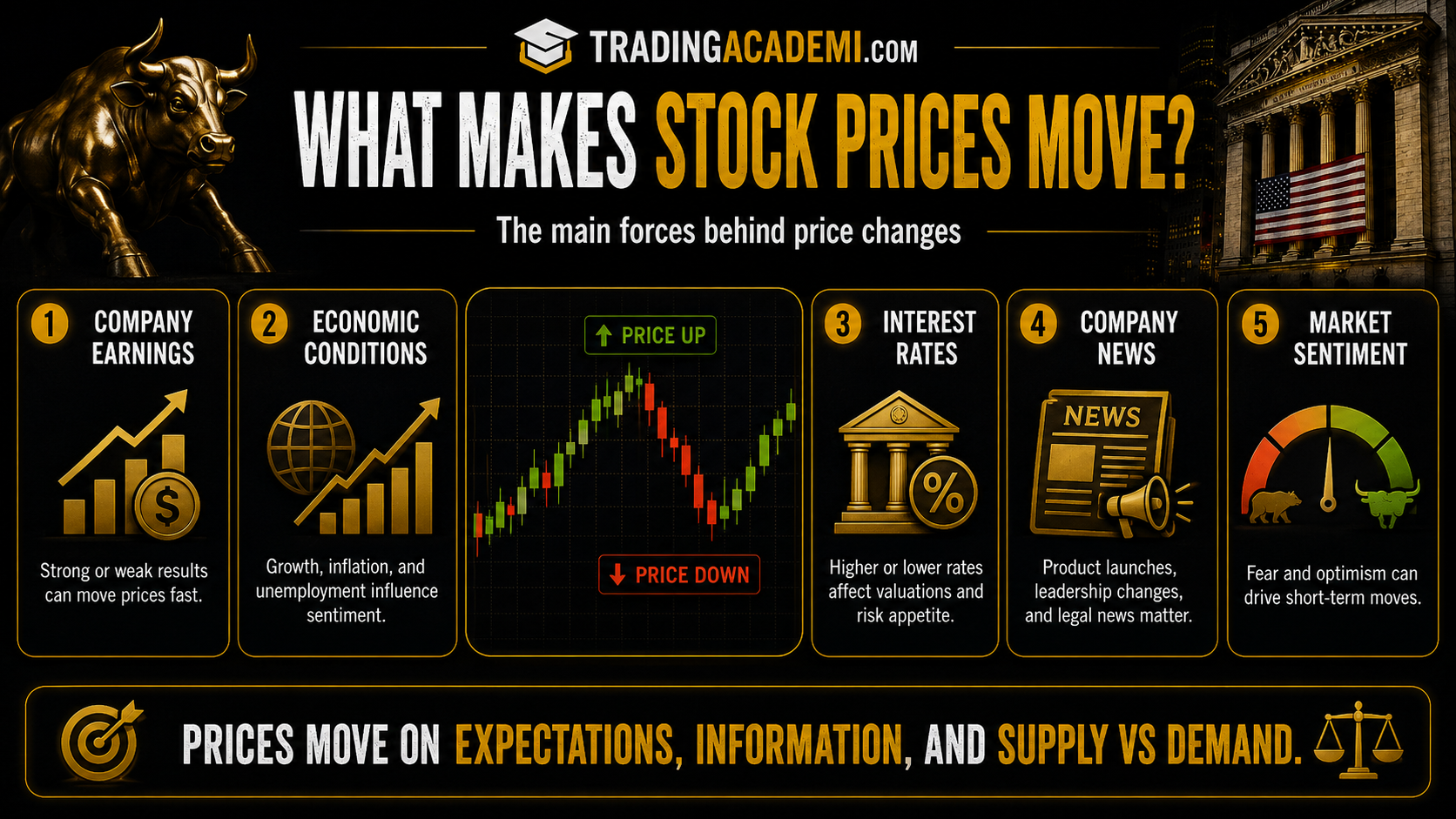
Stock prices move because of supply and demand, but many factors can influence that supply and demand.
Company earnings are one of the biggest factors. If a company reports strong revenue and profit, investors may become more interested in buying its stock.
Economic conditions also matter. Interest rates, inflation, unemployment, and economic growth can affect investor confidence.
News events can move prices quickly. Product launches, lawsuits, management changes, regulations, or global events can all influence stock prices.
Market sentiment is also important. Sometimes prices move because investors are optimistic or fearful, even before the fundamentals change.
Bull Market vs Bear Market
A bull market is a period when stock prices are generally rising. Investors are usually more confident, and demand for stocks tends to increase.
A bear market is a period when stock prices are generally falling. Investors may become more cautious, and selling pressure can increase.
Beginners should understand that both bull markets and bear markets are normal parts of the market cycle.
The stock market does not move in a straight line. Prices rise, fall, correct, recover, and sometimes move sideways for long periods.
Stock Market Indexes
A stock market index tracks the performance of a group of stocks.
Indexes help investors understand the general direction of the market or a specific sector.
Popular stock market indexes include:
S&P 500
Dow Jones Industrial Average
NASDAQ Composite
FTSE 100
Nikkei 225
For example, the S&P 500 tracks 500 large publicly traded companies in the United States. Many investors use it as a general measure of U.S. stock market performance.
Indexes are useful because they give a broader view of the market instead of focusing on only one company.
Stock Trading vs Stock Investing
Stock trading and stock investing are not the same.
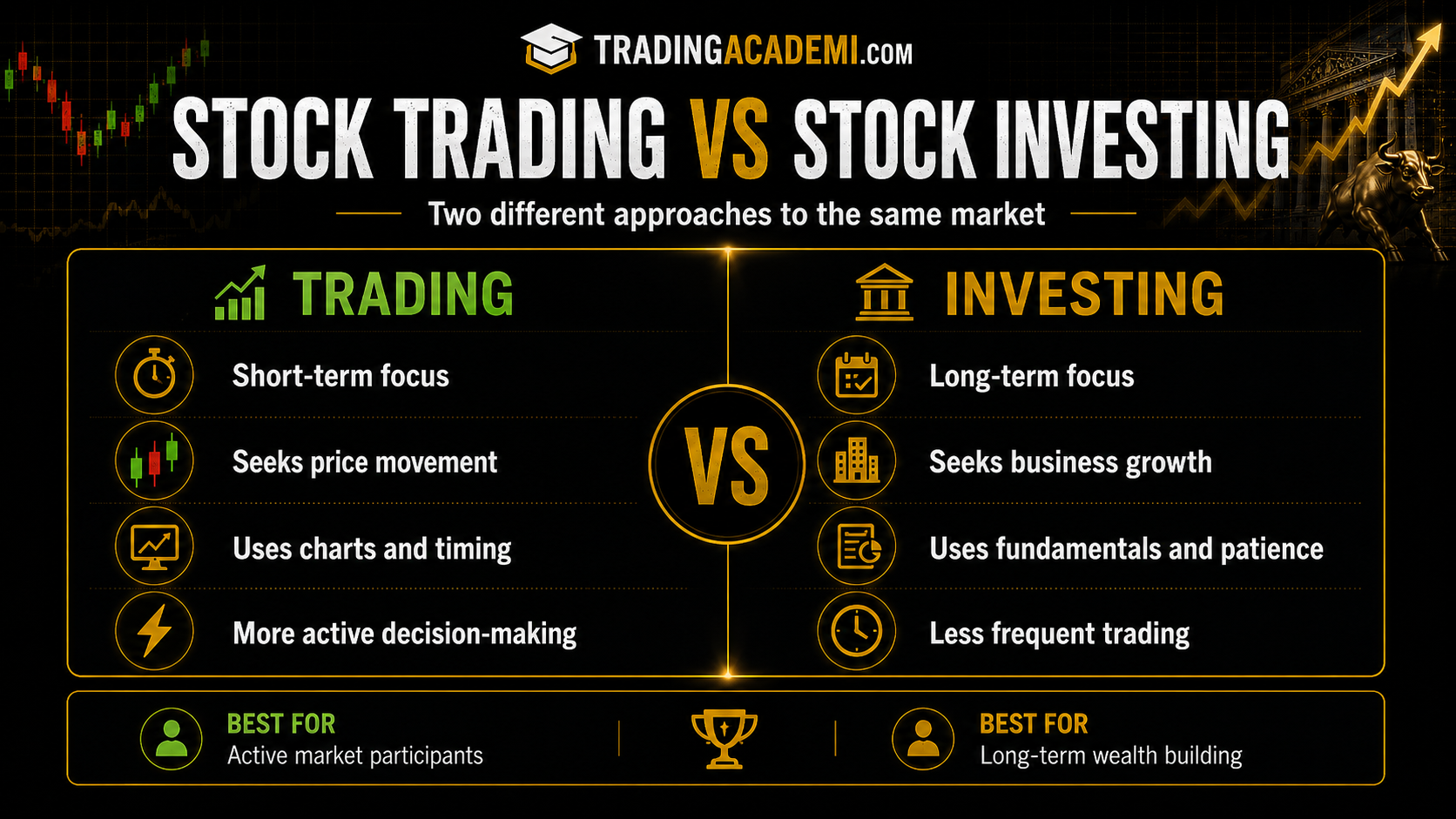
Stock investing usually focuses on the long term. Investors may buy shares of strong companies and hold them for years, hoping the company grows over time.
Stock trading is usually more short-term. Traders may buy and sell stocks within days, hours, or even minutes, depending on their strategy.
Investors often focus on company fundamentals, such as revenue, profit, debt, and business growth.
Traders often focus more on price action, charts, volume, technical analysis, and market momentum.
Both approaches can work, but they require different skills, mindsets, and risk management.
Advantages of the Stock Market
The stock market gives investors access to ownership in real companies.
It also provides liquidity, meaning investors can usually buy and sell shares easily during market hours.
Another advantage is long-term growth potential. Historically, many investors have used the stock market as a way to build wealth over time.
The stock market also offers variety. Investors can choose from different sectors, such as technology, healthcare, energy, finance, consumer goods, and industrial companies.
Risks of the Stock Market
The stock market also involves risk.
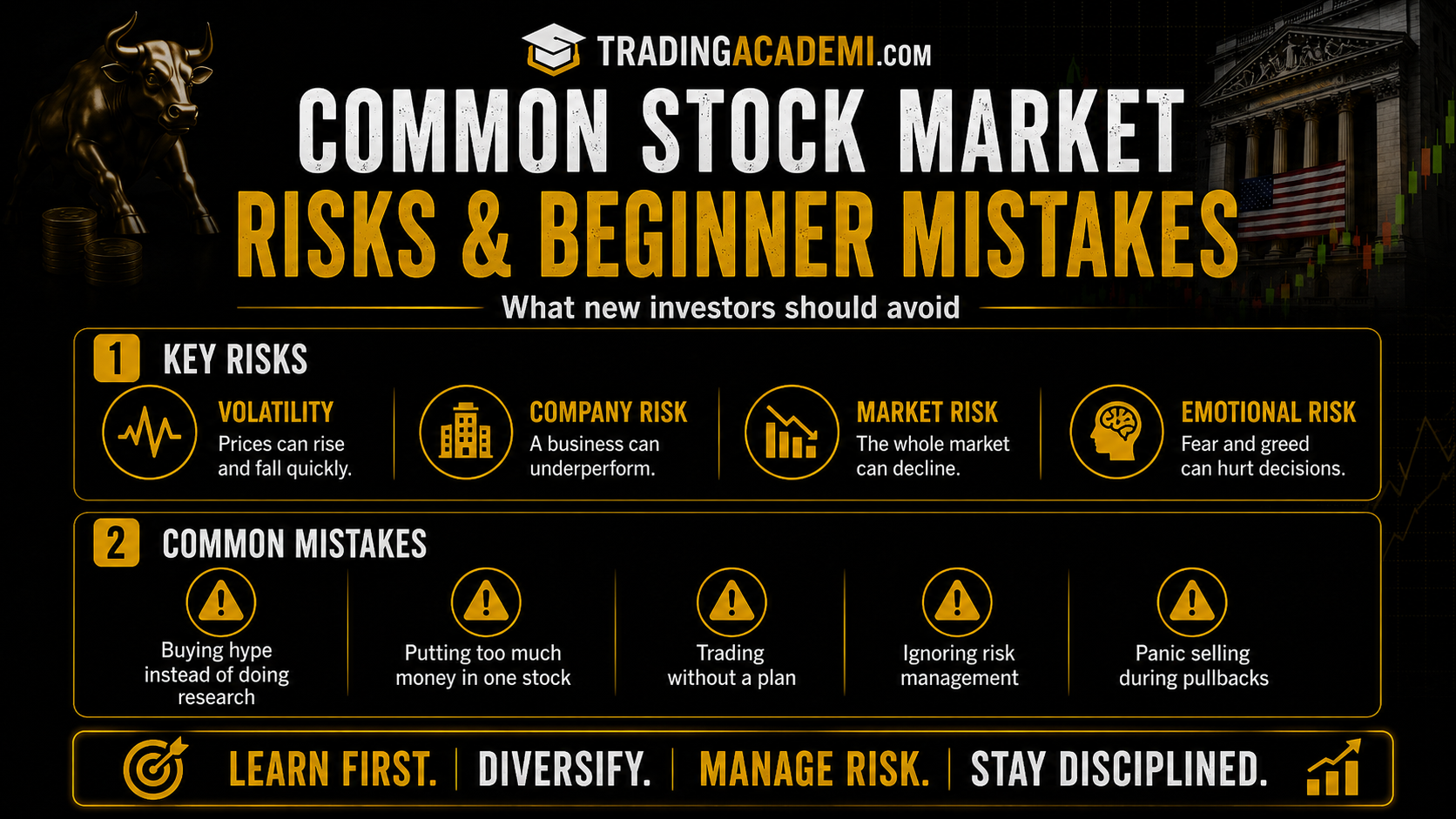
Stock prices can fall, and investors can lose money. Even strong companies can experience price declines during market corrections or economic downturns.
Individual stocks can be risky because a company may face poor earnings, bad management, strong competition, legal problems, or unexpected events.
Market volatility can also affect emotions. Many beginners make mistakes because they panic when prices fall or become greedy when prices rise.
This is why risk management is essential.
Common Mistakes Beginners Make
One common mistake is buying stocks only because they are popular. A stock being popular does not automatically make it a good investment.
Another mistake is investing without understanding the company. Beginners should know what the company does, how it makes money, and what risks it faces.
Some beginners also put too much money into one stock. This can be dangerous because one bad event can strongly affect the portfolio.
Another major mistake is trading without a plan. Before buying a stock, you should know why you are buying it, where you may take profit, and how much risk you are willing to accept.
How to Start Learning the Stock Market
The best way to start is by learning the basics before risking real money.
Beginners should understand stocks, exchanges, brokers, order types, market indexes, risk management, and basic analysis.
It is also helpful to follow the market regularly and study how prices react to earnings, news, interest rates, and economic data.
Some beginners use demo accounts or paper trading to practice without risking real capital.
Education should come before execution.
Is the Stock Market Good for Beginners?
The stock market can be suitable for beginners, but only if they take time to learn.
Compared to some other markets, stocks are often easier to understand because they are connected to real companies. However, this does not mean stock trading is easy or risk-free.
Beginners should start slowly, avoid emotional decisions, and focus on learning how the market works.
A good beginner does not need to trade every day. The goal is to build knowledge, discipline, and a clear strategy.
Stock Market vs Other Financial Markets
The stock market is only one part of the financial world.
The forex market focuses on currencies.
The commodities market focuses on raw materials like gold, oil, and wheat.
The bond market focuses on debt securities.
The derivatives market focuses on contracts such as futures and options.
The cryptocurrency market focuses on digital assets.
Each market has different risks, participants, and trading conditions.
That is why beginners should understand the differences before choosing where to trade or invest.
Recommended reading:
Types of Financial Markets
Final Thoughts
The stock market is a powerful financial system that allows companies to raise capital and gives investors the opportunity to own shares in businesses.
For beginners, the most important step is not to rush. Before buying any stock, you should understand what a stock is, how prices move, what risks are involved, and how your strategy works.
The stock market can offer opportunities, but it also requires patience, discipline, research, and risk management.
A smart investor does not buy randomly. A smart investor learns first, plans carefully, manages risk, and makes decisions based on knowledge rather than emotion.
Educational Disclaimer
This article is for educational purposes only and should not be considered financial advice. Trading and investing involve risk, including the possible loss of capital. Always do your own research or consult a qualified financial professional before making any financial decision.