 By Anzo Trader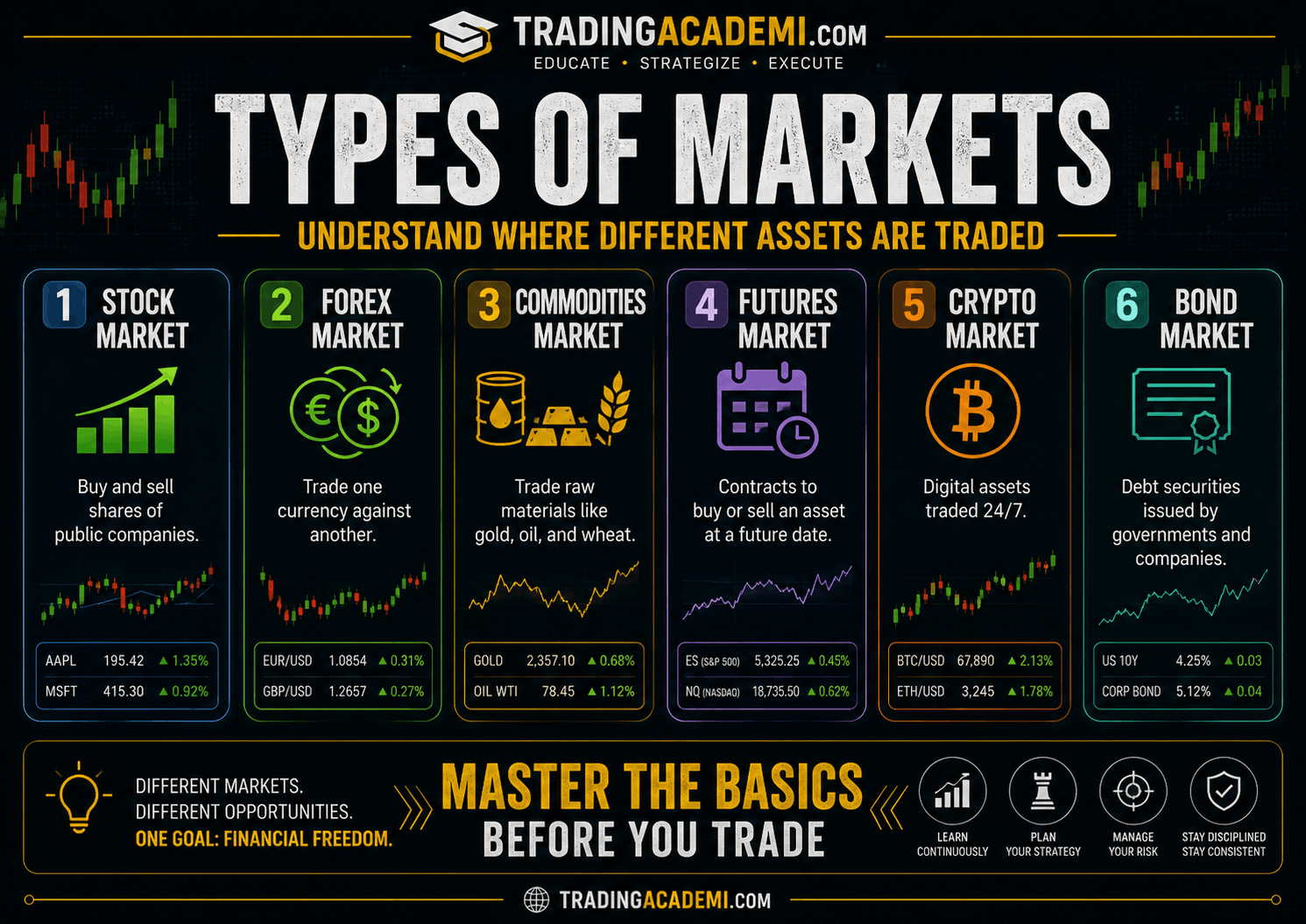
Financial markets are the foundation of the global economy. Every day, investors, traders, banks, companies, governments, and institutions use these markets to buy, sell, borrow, invest, hedge risk, and raise capital.
For beginners, the word “market” can sound simple. But in finance, there is not only one market. There are several types of markets, and each one has a different purpose.
Some markets are used to buy shares of companies. Others are used to trade currencies, commodities, bonds, derivatives, or digital assets. Understanding the difference between these markets can help you choose the right trading or investing path and avoid confusion when learning about finance.
In this guide, we will explain the main types of financial markets, how they work, who uses them, and why each market matters.

What Is a Financial Market?
A financial market is a place where financial assets are bought and sold. This place can be a physical exchange, like the New York Stock Exchange, or an online platform where trades happen electronically.
Financial markets help connect people who need money with people who want to invest money.
For example, a company may sell shares to raise capital. Investors may buy those shares hoping the company grows in value. A government may issue bonds to finance public projects. Traders may buy and sell currencies, commodities, or futures contracts to take advantage of price movements.
Without financial markets, it would be much harder for companies to grow, governments to raise funds, and investors to find opportunities.
Why Understanding Market Types Matters
Before choosing a trading strategy, you need to know what type of market you are dealing with. Each market has its own behavior, risk level, trading hours, liquidity, volatility, and participants.
For example, the stock market is different from the forex market. The bond market is different from the cryptocurrency market. Futures trading is not the same as buying shares of a company.
Understanding these differences helps you make better decisions. It also helps you avoid entering a market without knowing how it works.
A beginner should not start by asking only, “What should I trade?”
A better question is:
“Which market fits my knowledge, risk tolerance, capital, and trading style?”
1. Stock Market
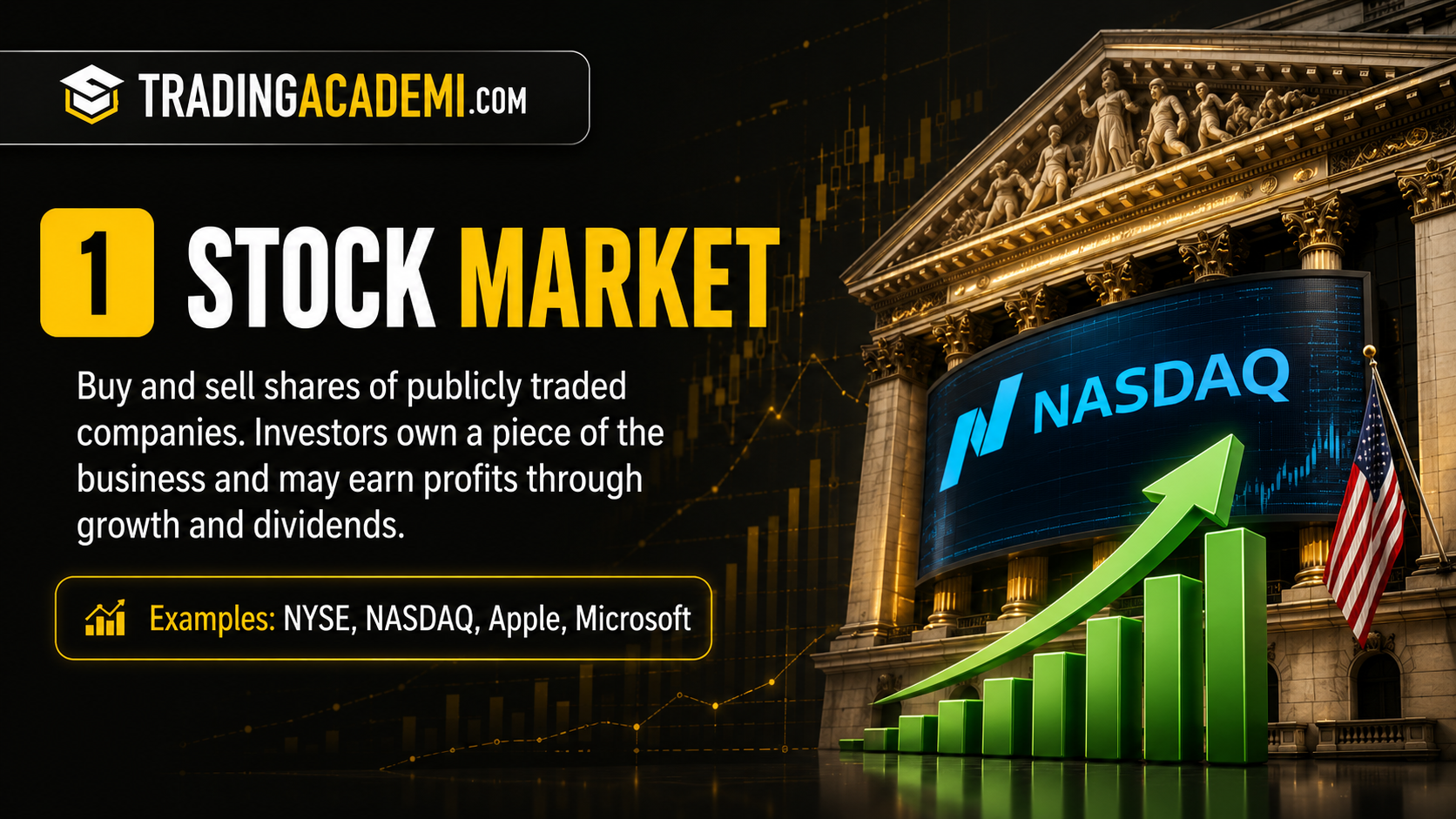
The stock market is one of the most popular financial markets. It allows investors and traders to buy and sell shares of publicly listed companies.
When you buy a stock, you are buying a small ownership share in a company. If the company performs well, the stock price may rise. Some companies also pay dividends, which are payments distributed to shareholders.
Companies use the stock market to raise capital. Investors use it to participate in the potential growth of businesses.
Example
If you buy shares of Apple, Microsoft, Tesla, or Coca-Cola, you are participating in the stock market.
Stocks are traded on exchanges such as:
New York Stock Exchange
NASDAQ
London Stock Exchange
Tokyo Stock Exchange
Who Uses the Stock Market?
The stock market is used by long-term investors, day traders, swing traders, institutions, pension funds, hedge funds, and companies.
Long-term investors may buy shares and hold them for years. Traders may buy and sell stocks over shorter periods to benefit from price movements.
Why the Stock Market Matters
The stock market is important because it helps companies raise money and gives investors a way to build wealth over time.
However, stock prices can move up and down based on earnings, news, interest rates, economic conditions, and investor sentiment.
Recommended reading:
Learn more about the Stock Market
2. Bond Market
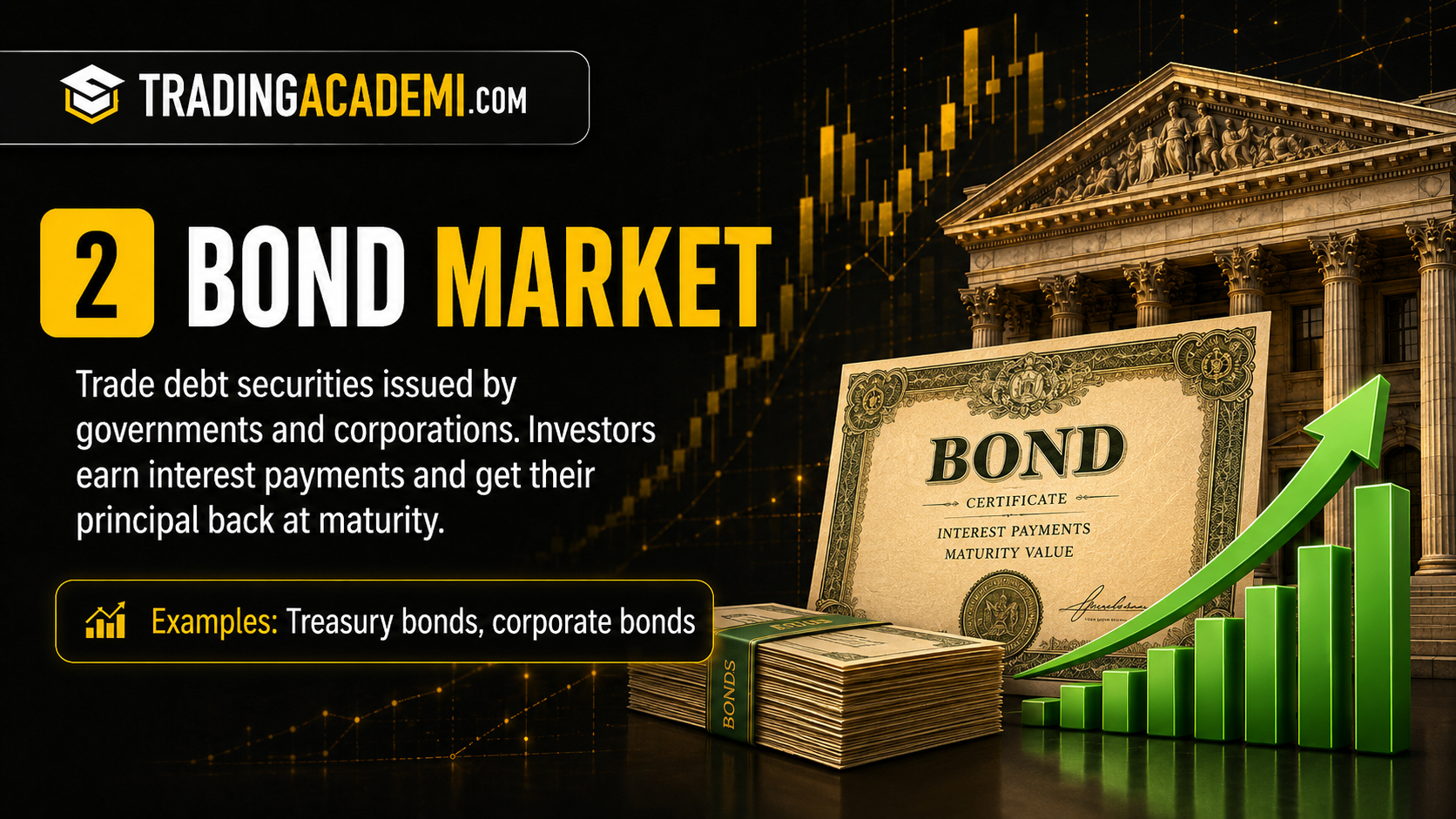
The bond market, also called the debt market, is where governments, companies, and other organizations borrow money from investors.
When you buy a bond, you are lending money to the issuer. In return, the issuer usually pays interest over time and returns the original amount at maturity.
Bonds are often considered more stable than stocks, but they still carry risk.
Example
A government may issue Treasury bonds to finance public spending. A company may issue corporate bonds to raise money for expansion, operations, or new projects.
Examples of bonds include:
U.S. Treasury Bonds
Corporate Bonds
Municipal Bonds
Government Bonds
Who Uses the Bond Market?
The bond market is used by governments, corporations, banks, insurance companies, pension funds, and investors looking for income or lower-risk investments.
Why the Bond Market Matters
The bond market plays a major role in the global economy because it helps governments and companies access funding.
Bond prices are influenced by interest rates, inflation, credit risk, and economic expectations.
When interest rates rise, bond prices often fall. When interest rates fall, bond prices often rise.
Recommended reading:
Learn more about the Bond Market
3. Commodities Market
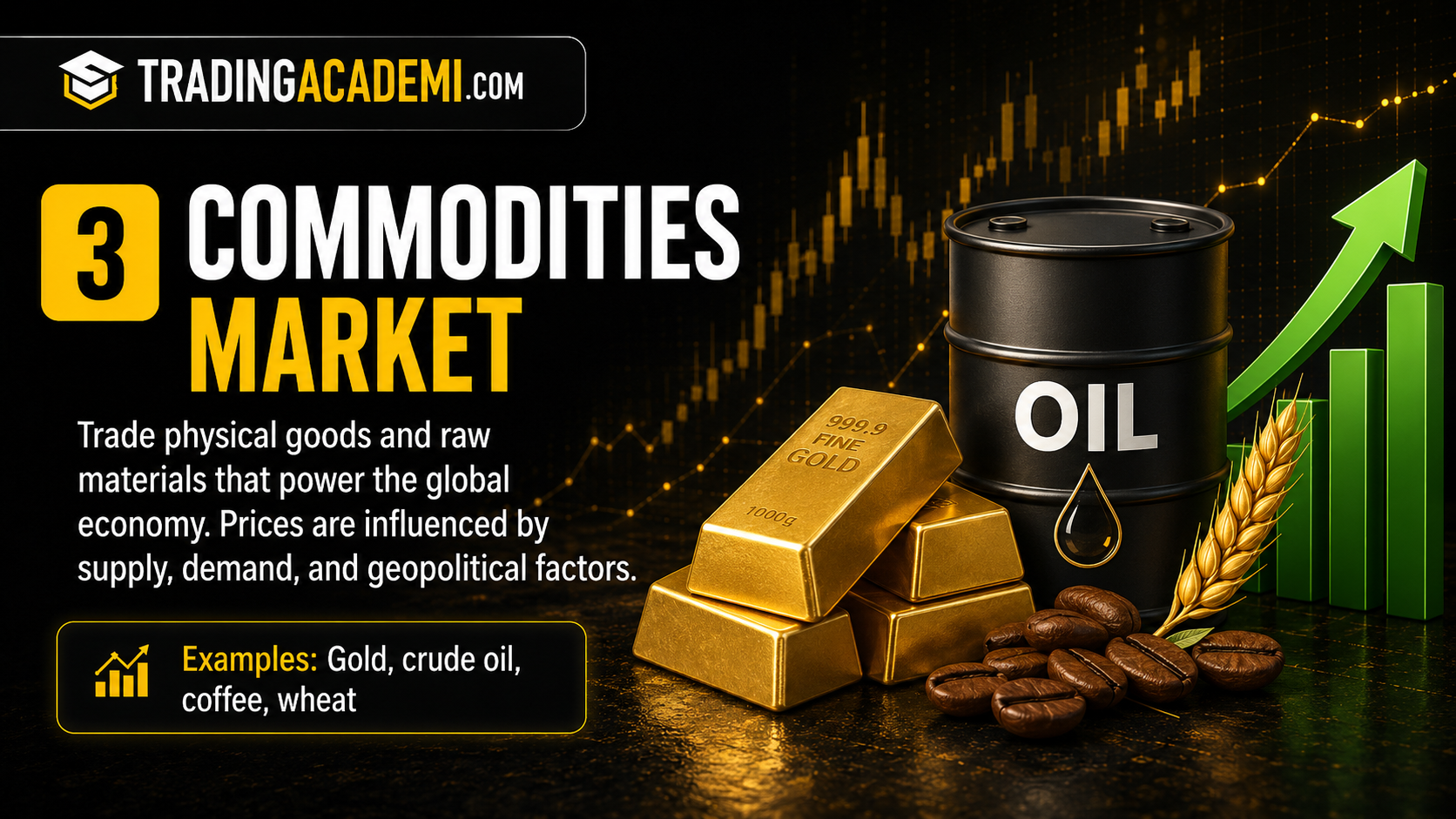
The commodities market is where raw materials and natural resources are traded. These products are usually divided into two main categories: hard commodities and soft commodities.
Hard commodities are natural resources that are mined or extracted. Soft commodities are agricultural products.
Examples of Hard Commodities
Gold
Silver
Crude oil
Natural gas
Copper
Examples of Soft Commodities
Coffee
Sugar
Wheat
Corn
Cotton
Commodities are traded on exchanges such as the Chicago Mercantile Exchange, New York Mercantile Exchange, and Intercontinental Exchange.
Who Uses the Commodities Market?
The commodities market is used by producers, manufacturers, traders, investors, and institutions.
For example, an airline may use oil futures to manage fuel price risk. A farmer may use futures contracts to lock in prices for crops. Traders may speculate on price changes in gold, oil, or agricultural products.
Why the Commodities Market Matters
Commodities affect everyday life. Oil prices influence transportation costs. Wheat and corn prices affect food prices. Gold is often watched as a safe-haven asset during uncertain times.
Commodity prices can be affected by supply and demand, weather, geopolitical events, inflation, and global economic activity.
Recommended reading:
Learn more about the Commodities Market
4. Forex Market
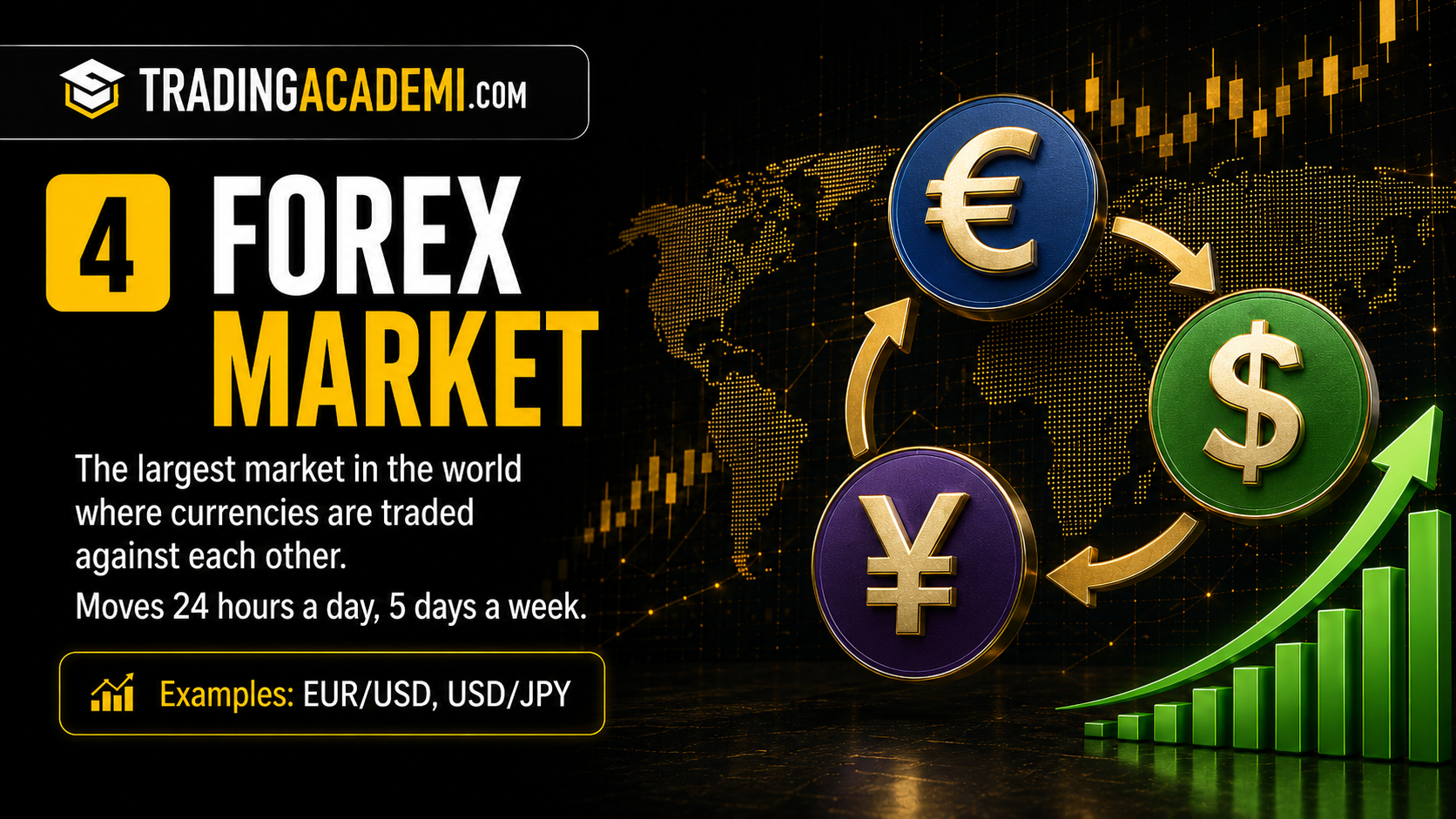
The forex market, also known as the foreign exchange market, is where currencies are traded.
It is the largest and most liquid financial market in the world. Unlike the stock market, forex does not operate from one central exchange. It is a decentralized global market where currencies are exchanged electronically.
Forex trading is based on currency pairs. When you trade forex, you are buying one currency and selling another at the same time.
Example
EUR/USD means the euro against the U.S. dollar.
USD/JPY means the U.S. dollar against the Japanese yen.
GBP/USD means the British pound against the U.S. dollar.
If a trader buys EUR/USD, they are buying euros and selling U.S. dollars.
Who Uses the Forex Market?
The forex market is used by banks, governments, central banks, multinational companies, hedge funds, travelers, importers, exporters, and retail traders.
Companies use forex to manage international payments. Traders use forex to speculate on currency movements.
Why the Forex Market Matters
Forex is important because global trade depends on currency exchange. When countries trade goods and services, currencies must be exchanged.
Forex prices can move because of interest rates, inflation, economic data, central bank decisions, geopolitical events, and market sentiment.
Recommended reading:
Learn more about the Forex Market
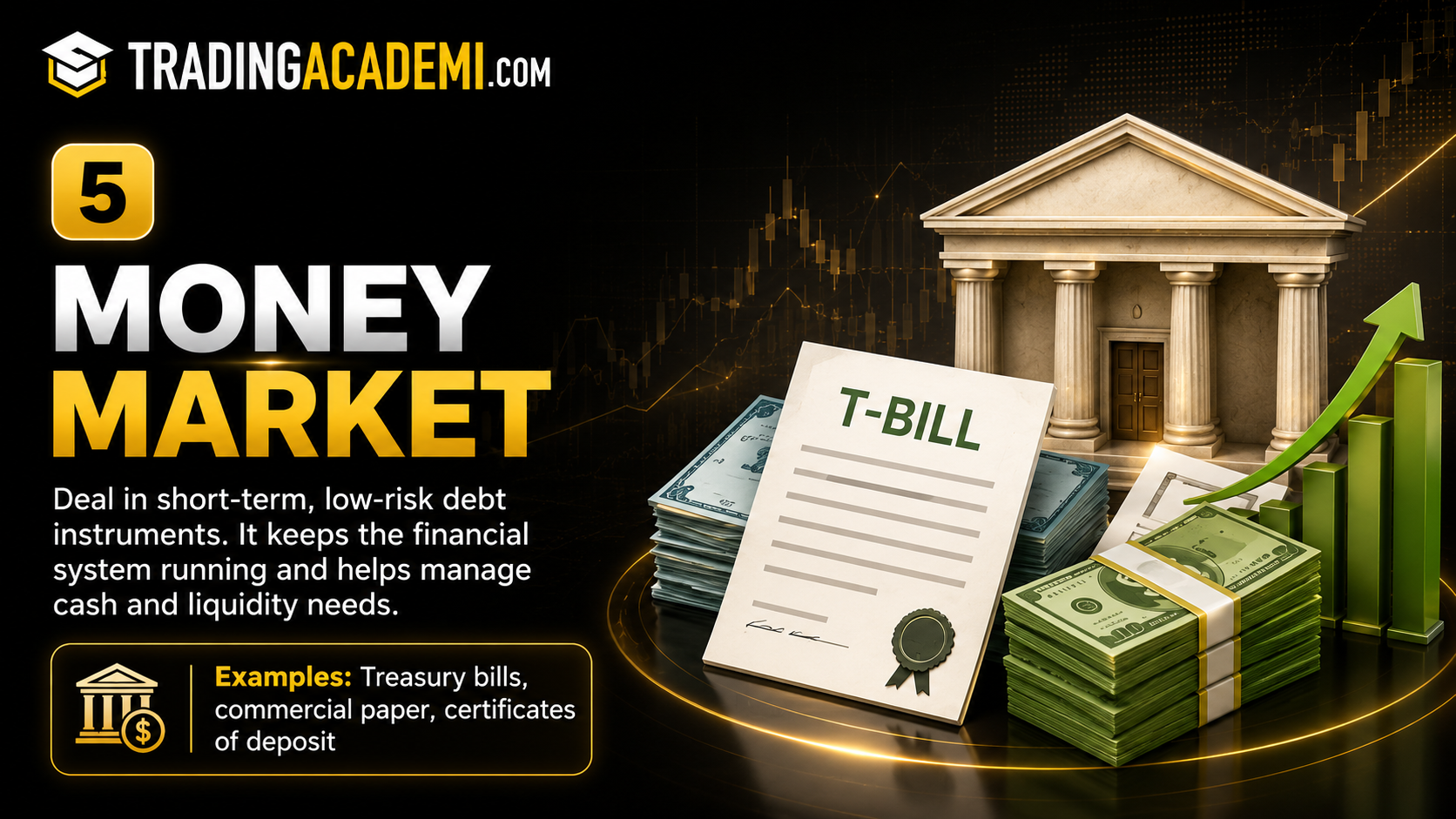
5. Money Market
The money market is a financial market for short-term borrowing and lending. The instruments traded in this market usually mature in one year or less.
This market is mainly used by governments, banks, corporations, and large institutions to manage short-term cash needs.
Examples
Treasury Bills
Commercial Paper
Certificates of Deposit
Repurchase Agreements
Treasury bills are short-term government debt securities. Commercial paper is short-term debt issued by companies to finance immediate needs.
Who Uses the Money Market?
The money market is mostly used by governments, financial institutions, corporations, and professional investors.
Retail investors may also access money market instruments through money market funds.
Why the Money Market Matters
The money market helps keep the financial system liquid. It allows institutions to borrow and lend money for short periods.
It is usually considered lower risk than many other markets, but returns are also generally lower.
Recommended reading:
Learn more about the Money Market
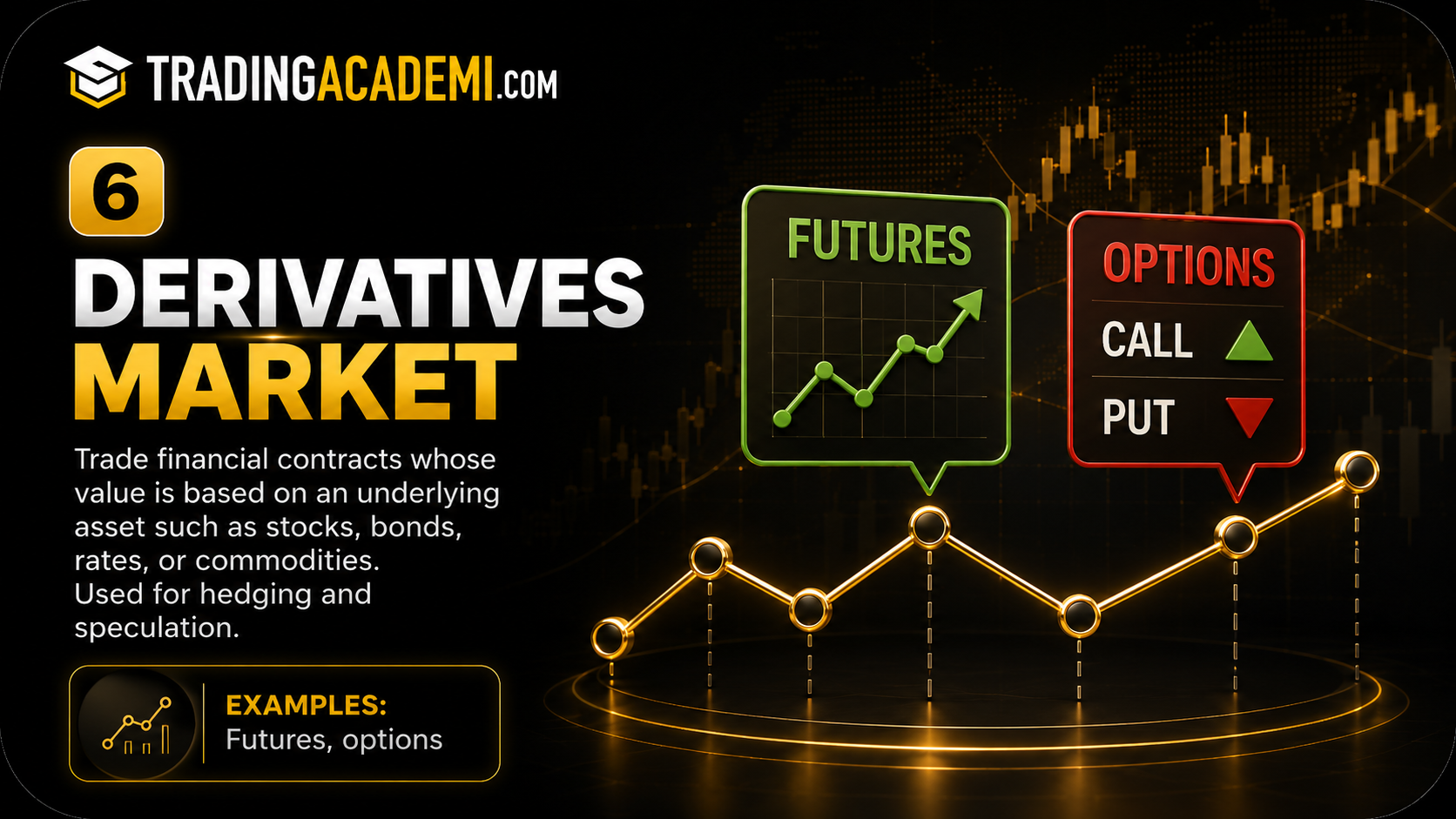
6. Derivatives Market
The derivatives market is where financial contracts are traded. These contracts get their value from an underlying asset.
The underlying asset can be a stock, index, commodity, currency, bond, or interest rate.
Derivatives are often used for hedging, speculation, and risk management.
Common Types of Derivatives
Futures contracts
Options contracts
Swaps
Forwards
Example
A crude oil futures contract allows traders or companies to buy or sell oil at a future date at a predetermined price.
An options contract gives the buyer the right, but not the obligation, to buy or sell an asset at a specific price before a certain date.
Who Uses the Derivatives Market?
The derivatives market is used by traders, hedge funds, banks, institutions, producers, corporations, and professional investors.
For example, a company may use derivatives to reduce currency risk. A trader may use options to speculate on stock price movement.
Why the Derivatives Market Matters
Derivatives can help manage risk, but they can also be complex and risky if they are not understood properly.
Many beginners enter derivatives markets too early without understanding leverage, margin, expiration dates, and contract specifications.
This is why education is very important before trading derivatives.
Recommended reading:
Learn more about the Derivatives Market
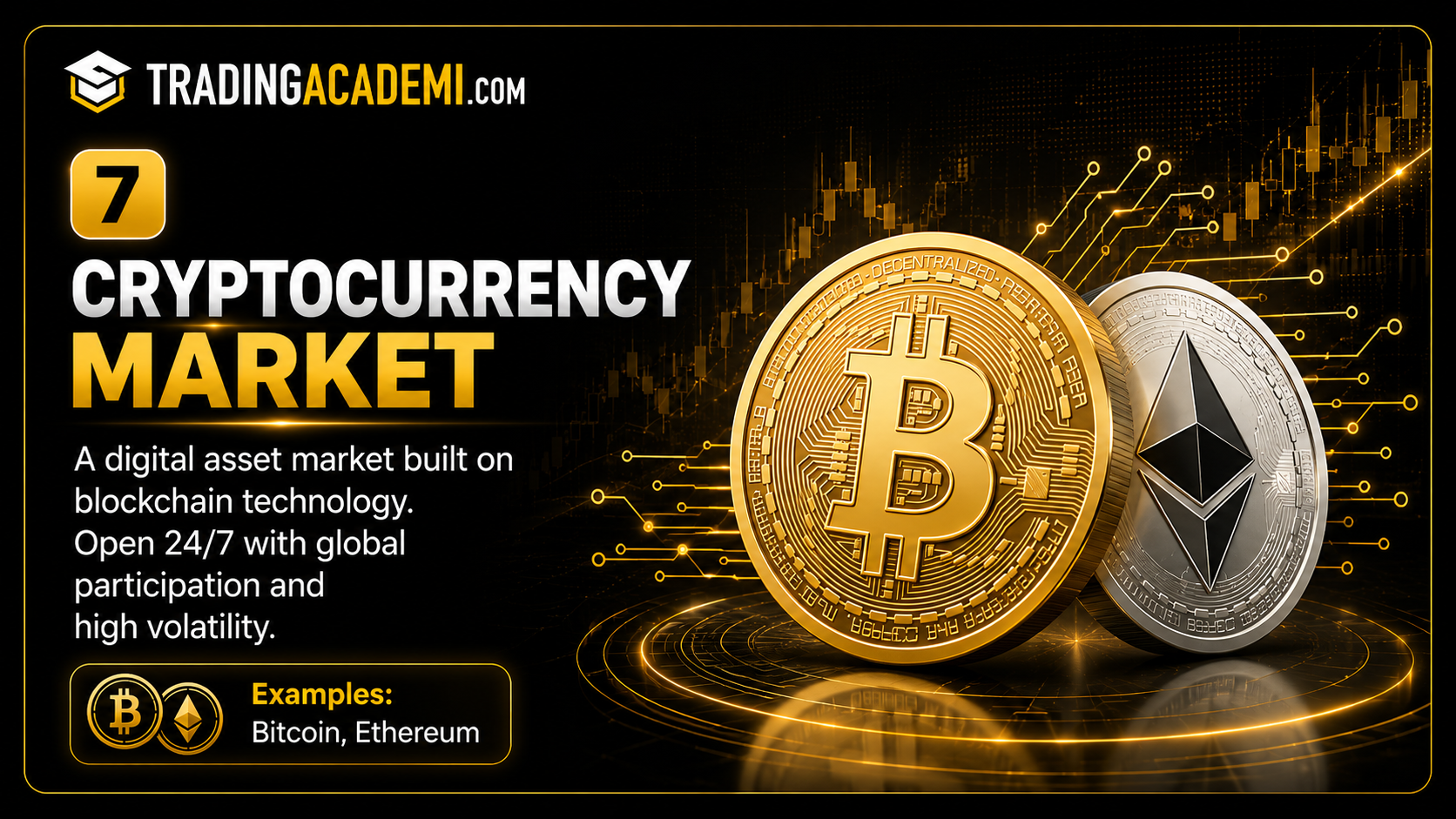
7. Cryptocurrency Market
The cryptocurrency market is where digital assets such as Bitcoin, Ethereum, and other cryptocurrencies are traded.
Unlike traditional currencies issued by governments, cryptocurrencies are usually based on blockchain technology. This market is relatively new compared to stocks, bonds, forex, and commodities.
Examples
Bitcoin
Ethereum
Solana
BNB
XRP
Cryptocurrencies can be traded on platforms such as Coinbase, Binance, Kraken, and other digital asset exchanges.
Who Uses the Cryptocurrency Market?
The crypto market is used by retail traders, long-term holders, blockchain developers, institutions, speculators, and technology-focused investors.
Some people use crypto as an investment. Others use it for decentralized applications, payments, or blockchain-based projects.
Why the Cryptocurrency Market Matters
The cryptocurrency market introduced a new type of digital financial asset. It created opportunities but also introduced new risks.
Crypto prices can be extremely volatile. They can move strongly because of news, regulations, technology updates, liquidity, market sentiment, and speculation.
Beginners should be careful and understand that crypto trading can involve high risk.
Recommended reading:
Learn more about the Cryptocurrency Market
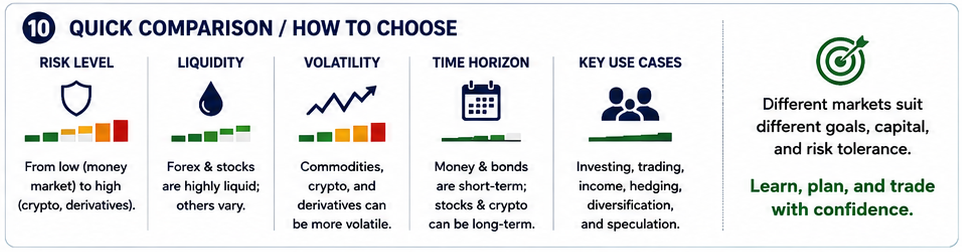
Stock Market vs Forex Market vs Crypto Market
Many beginners ask which market is better: stocks, forex, or crypto.
The answer depends on the trader.
The stock market may be better for people who want to analyze companies and invest for the long term.
The forex market may be better for traders interested in global currencies, macroeconomics, and short-term price movements.
The crypto market may attract people interested in digital assets and high volatility, but it also carries higher risk.
No market is perfect. Each one requires education, practice, risk management, and emotional control.
How to Choose the Right Market to Trade
Before choosing a market, consider these questions:
How much capital do you have?
Do you prefer long-term investing or short-term trading?
Can you handle volatility?
Do you understand the asset you are trading?
Are you interested in company analysis, currencies, commodities, or digital assets?
Do you have a clear risk management plan?
Choosing the right market is not about following hype. It is about matching the market with your goals, experience, and risk tolerance.
Common Mistakes Beginners Make
One of the biggest mistakes beginners make is jumping into a market only because it looks popular.
Some beginners start trading crypto because they see big price moves. Others enter forex because it is open almost 24 hours. Some buy stocks because they hear about a trending company.
But popularity does not mean safety.
Another common mistake is using leverage without understanding risk. This is especially dangerous in forex, futures, and derivatives markets.
Beginners should focus first on learning how the market works before risking real money.
Final Thoughts
Financial markets offer many opportunities, but each market works differently. The stock market, bond market, commodities market, forex market, money market, derivatives market, and cryptocurrency market all serve different purposes.
Understanding these market types helps you build a stronger foundation before trading or investing.
The goal is not to trade every market. The goal is to understand the differences and choose the market that fits your strategy, knowledge, and risk tolerance.
A good trader does not only look for opportunities. A good trader also understands where those opportunities come from, what risks are involved, and how to manage them properly.
Educational Disclaimer
This article is for educational purposes only and should not be considered financial advice. Trading and investing involve risk, including the possible loss of capital. Always do your own research or consult a qualified financial professional before making financial decisions.