 By Anzo Trader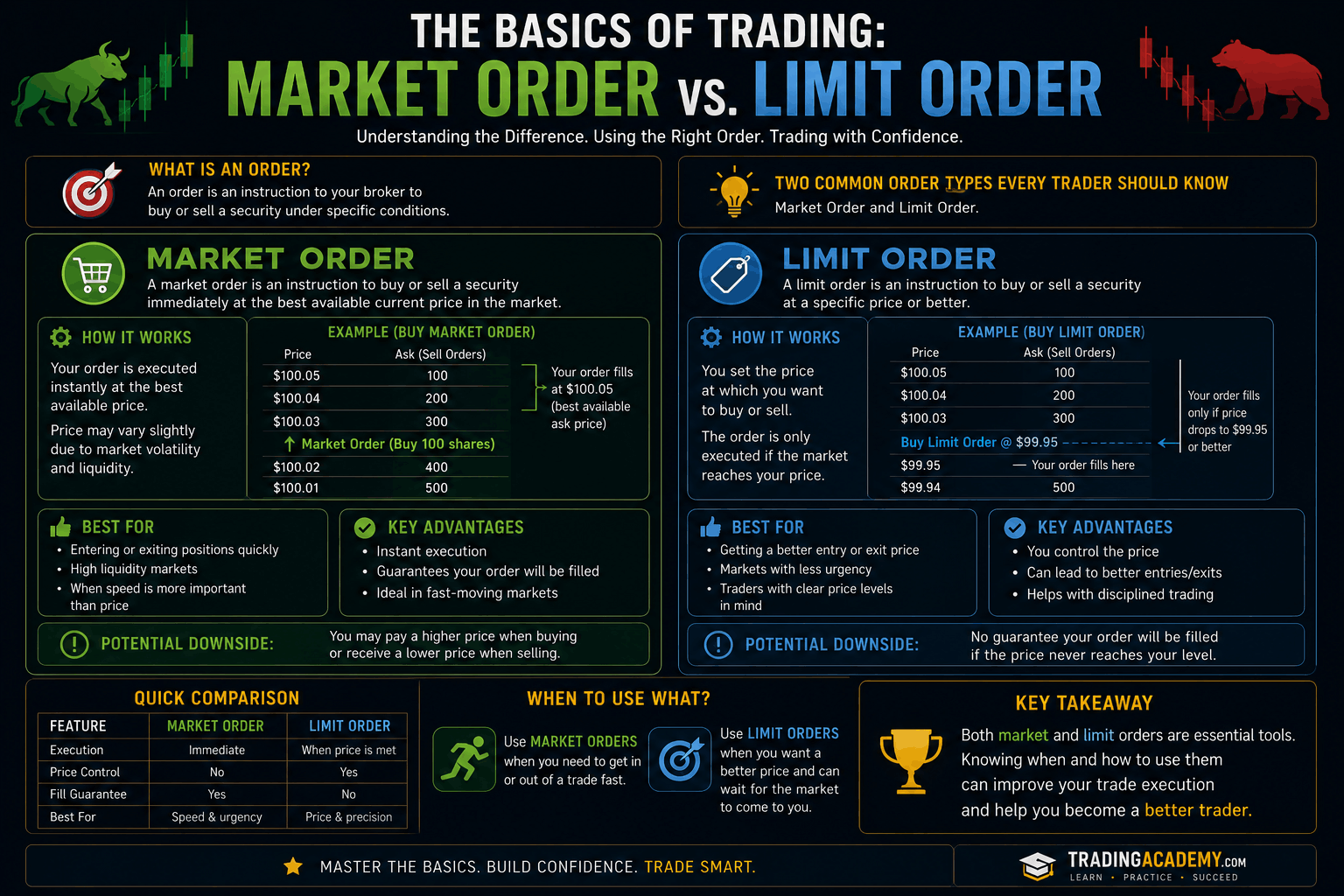
When you start trading stocks, ETFs, futures, or any other financial instrument, one of the first things you need to understand is how your order will be executed. Many beginners focus only on finding the right stock or the right trading setup, but they forget that the order type they choose can directly affect their entry price, exit price, risk, and final result.
Two of the most common order types are market orders and limit orders. They may look simple at first, but using the wrong one at the wrong time can lead to unexpected losses, poor entries, or missed opportunities.
In this guide, we will explain the difference between market orders and limit orders in a clear and practical way. You will learn how each order works, when to use it, the advantages and disadvantages, and how beginners can avoid common mistakes.
What Is a Market Order?
A market order is an instruction to buy or sell a financial asset immediately at the best available price in the market.
In simple words, when you place a market order, you are telling your broker:
“Buy or sell this asset now, at the current available market price.”
The main goal of a market order is speed. You want the trade to be executed as quickly as possible, even if the final price is slightly different from what you saw on the screen.
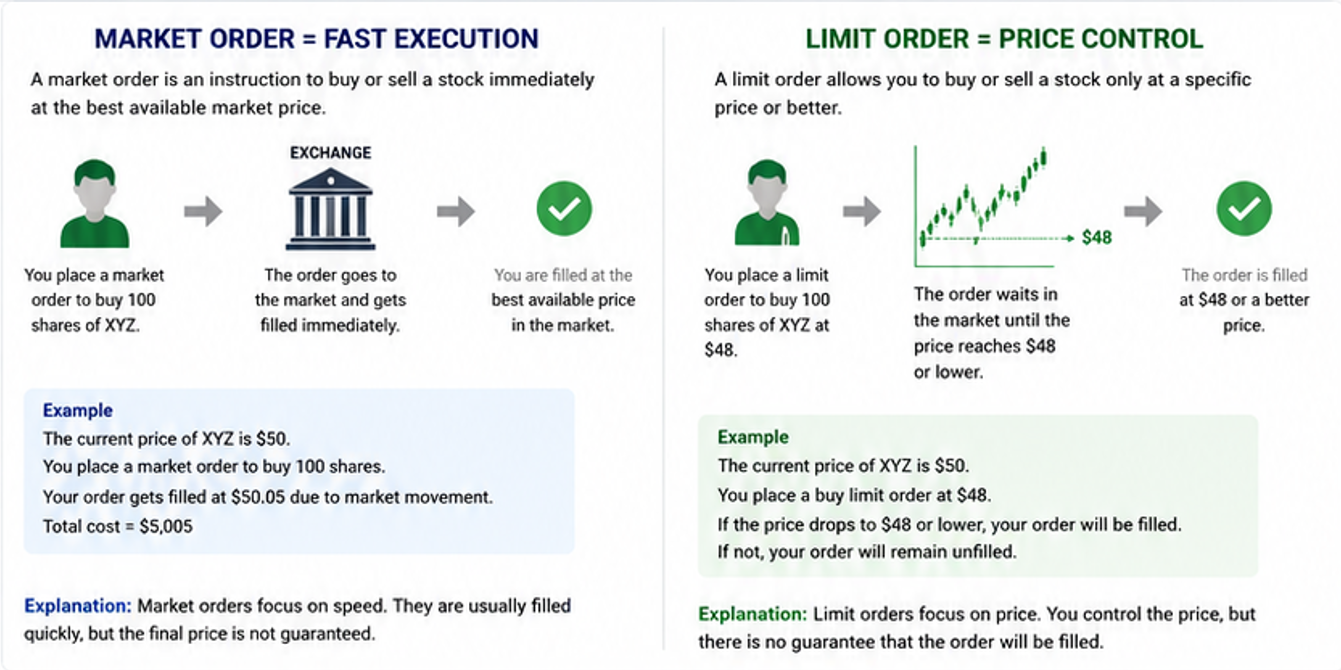
For example, imagine that a stock is currently trading around $50. You place a market order to buy 100 shares. Your broker will try to fill your order immediately at the best available ask price. If the market is liquid and stable, you may get filled close to $50. However, if the price is moving quickly, your final execution price could be slightly higher.
Does a Market Order Guarantee the Price?
No. A market order usually gives you a high chance of execution, but it does not guarantee the exact price.
This is an important point that many beginners misunderstand.
A market order can be useful when you want to enter or exit a trade quickly, but the final price depends on market conditions, liquidity, spread, and volatility. In a calm market, the difference may be very small. In a fast-moving market, the difference can be much larger.
This difference between the expected price and the actual execution price is often called slippage.
Example of a Market Order
Let’s say you want to buy 100 shares of a company called XYZ.
The last traded price is $50, so you expect to pay around:
100 shares × $50 = $5,000
You place a market order.
If the stock is liquid and the spread is small, your order may fill at $50 or very close to it. But if the price suddenly moves, you might get filled at $50.10, $50.25, or even higher.
That difference may not seem big for a small trade, but for larger positions or fast-moving assets, it can have a real impact on your trading results.
When Should You Use a Market Order?
A market order can be useful when immediate execution is more important than getting a specific price.
For example, traders may use market orders when:
They are trading highly liquid assets, such as major stocks or popular ETFs.
They need to enter or exit quickly.
They are closing a position to manage risk.
The spread between the bid and ask price is very small.
They are trading during normal market hours with enough volume.
However, market orders should be used carefully in volatile markets, low-volume stocks, pre-market or after-hours trading, and situations where prices are moving very quickly.
Advantages of Market Orders
The biggest advantage of a market order is fast execution. If there are enough buyers and sellers, your order is usually filled almost instantly.
Market orders are also simple to use. Beginners often understand them quickly because they do not require choosing a specific price.
They can also be useful when you want to avoid missing a move. For example, if a stock is breaking out strongly and you want to enter immediately, a market order may get you into the trade faster than a limit order.
Disadvantages of Market Orders
The main disadvantage of a market order is that you do not control the exact execution price.
This can be risky in volatile markets. The price you see on your screen may not be the price you receive. Even a small delay can result in a different fill price.
Market orders can also be dangerous in thinly traded stocks. If there are not enough buyers or sellers, your order may be filled at a much worse price than expected.
For this reason, many experienced traders avoid using market orders on illiquid stocks, penny stocks, or assets with wide spreads.
What Is a Limit Order?
A limit order is an instruction to buy or sell an asset only at a specific price or better.
With a limit order, you are not saying, “Buy or sell immediately.” Instead, you are saying:
“Buy or sell only if the market reaches my price.”
This gives you more control over the price of your trade.
For example, if a stock is trading at $50, but you only want to buy it at $48, you can place a buy limit order at $48. Your order will only execute if the stock price reaches $48 or lower.
Buy Limit Order Explained
A buy limit order is used when you want to buy at a specific price or lower.
For example, if a stock is currently trading at $50 and you place a buy limit order at $48, your order will not execute unless the price drops to $48 or below.
This is useful when you believe the current price is too high and you want to wait for a better entry.
A buy limit order helps you avoid overpaying, but there is one important risk: the price may never reach your limit level. In that case, your order will remain unfilled.
Sell Limit Order Explained
A sell limit order is used when you want to sell at a specific price or higher.
For example, if you own shares of a stock currently trading at $50 and you want to sell only if the price reaches $55, you can place a sell limit order at $55.
If the market reaches $55, your broker will try to execute the order at $55 or better.
This type of order is often used to take profits at a planned target price.
Example of a Limit Order
Imagine that you want to buy 100 shares of XYZ, but you believe $50 is too expensive. You decide that $48 is a better entry price.
You place a buy limit order at $48.
If the stock drops to $48 or lower, your order may execute. If the stock never reaches $48, your order will not be filled.
This gives you price control, but it does not guarantee that you will enter the trade.
That is the main difference between market and limit orders:
A market order focuses on execution.
A limit order focuses on price.
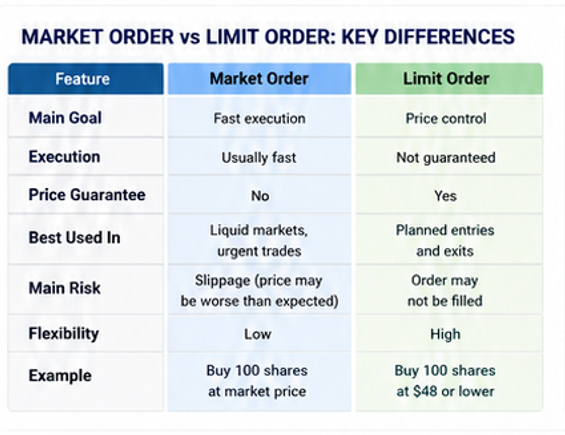
Market Order vs Limit Order: Main Difference
The main difference between a market order and a limit order is the priority.
A market order prioritizes speed. You want the order filled quickly, but the final price can change.
A limit order prioritizes price. You choose the maximum price you are willing to pay or the minimum price you are willing to accept, but the order may not be filled.
Here is a simple comparison:
| Feature | Market Order | Limit Order |
|---|---|---|
| Main goal | Fast execution | Price control |
| Execution | Usually fast | Not guaranteed |
| Price | Not guaranteed | Controlled |
| Best for | Liquid markets and urgent trades | Planned entries and exits |
| Main risk | Slippage | Missing the trade |
What Is Slippage?
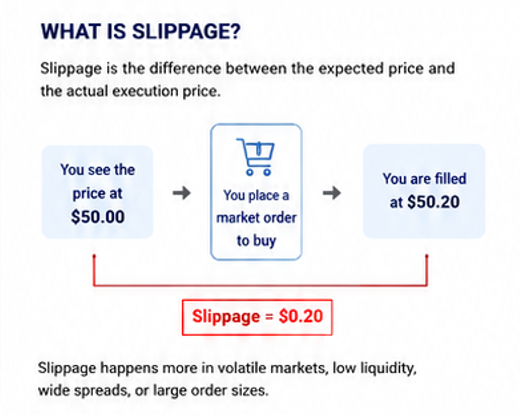
Slippage happens when your trade is executed at a different price than expected.
For example, you see a stock at $50 and place a market order, but your order fills at $50.30. That $0.30 difference is slippage.
Slippage can happen for several reasons:
The market is moving quickly.
The asset has low liquidity.
The spread between bid and ask is wide.
The order size is large compared to available volume.
There is high volatility after news or earnings.
Slippage is one of the main reasons why traders must understand order types before placing trades.
What Is the Bid-Ask Spread?
To understand market and limit orders better, you also need to understand the bid-ask spread.
The bid is the highest price buyers are currently willing to pay.
The ask is the lowest price sellers are currently willing to accept.
The difference between the bid and ask is called the spread.
For example:
Bid: $49.95
Ask: $50.00
The spread is $0.05.
If you place a market buy order, you will usually buy near the ask price. If you place a market sell order, you will usually sell near the bid price.
In liquid stocks, the spread is usually small. In illiquid stocks, the spread can be wide, which makes market orders more risky.
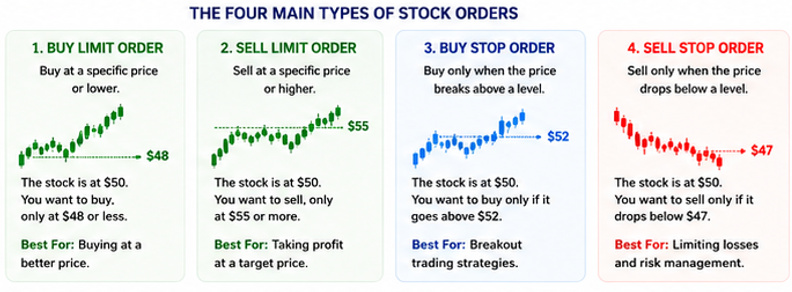
The Four Common Stock Order Types
Besides basic market and limit orders, traders often use different variations depending on their strategy.
1. Buy Limit Order
A buy limit order allows you to buy at a specific price or lower.
Example:
A stock is trading at $100. You want to buy it only if it drops to $95. You place a buy limit order at $95.
This order is useful when you want a better entry price.
2. Sell Limit Order
A sell limit order allows you to sell at a specific price or higher.
Example:
You bought a stock at $100 and want to take profit at $110. You place a sell limit order at $110.
This order is useful when you already have a profit target.
3. Buy Stop Order
A buy stop order is placed above the current market price. It becomes active only when the market reaches the stop price.
Example:
A stock is trading at $50. You believe that if it breaks above $52, it may continue higher. You place a buy stop order at $52.
This type of order is often used by breakout traders.
4. Sell Stop Order
A sell stop order is placed below the current market price. It is often used to protect against losses.
Example:
You bought a stock at $50 and want to limit your risk if the price drops. You place a sell stop order at $47.
If the price reaches $47, the sell stop order is triggered.
Many traders use sell stop orders as part of their risk management strategy.
Market Order Example in Real Trading
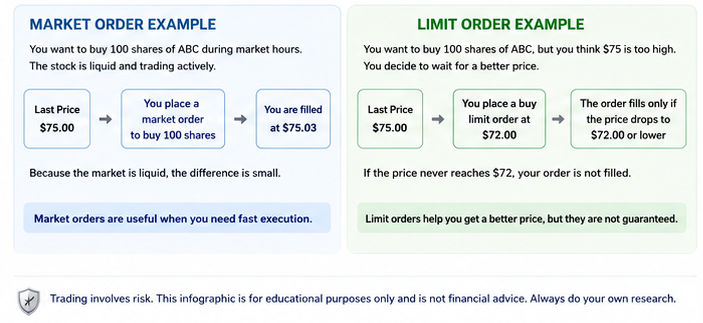
Let’s imagine that a trader wants to buy shares of a large technology company during regular market hours.
The stock is highly liquid, the spread is only a few cents, and there is strong trading volume.
In this case, a market order may be acceptable because the difference between the expected price and the execution price is likely to be small.
However, if the same trader places a market order during a major news event, the result can be very different. The price may move quickly, and the order may be filled at a worse price than expected.
This is why market conditions matter.
A market order is not automatically bad. It simply needs to be used in the right situation.
Limit Order Example in Real Trading
Now imagine a trader wants to buy a stock that is trading at $75. The trader likes the company but believes the current price is too high.
Instead of buying immediately, the trader places a buy limit order at $70.
If the stock drops to $70, the order may be filled. If the stock never reaches that level, the trader does not enter the position.
This approach can help traders avoid emotional buying. It forces them to wait for the price they planned in advance.
However, the disadvantage is clear: sometimes the price moves higher without ever filling the limit order.
Which Order Type Is Better for Beginners?
There is no single best order type for every situation. Market orders and limit orders both have advantages and disadvantages.
For beginners, limit orders are often safer because they provide more control over the execution price. They help traders avoid paying much more than expected or selling much lower than planned.
However, market orders can still be useful when trading very liquid assets and when quick execution is necessary.
A beginner should not ask only, “Which order is better?”
A better question is:
“What is more important for this trade: execution speed or price control?”
If speed matters more, a market order may be suitable.
If price matters more, a limit order may be better.
Common Mistakes Beginners Make With Market Orders
One common mistake is using market orders in low-volume stocks. This can lead to bad fills because there may not be enough liquidity.
Another mistake is placing market orders during high volatility, such as right after earnings reports, economic news, or major market announcements.
Some beginners also place market orders outside regular trading hours without understanding that spreads can be wider and liquidity can be lower.
A market order should never be placed blindly. Before using it, check the spread, volume, and market conditions.
Common Mistakes Beginners Make With Limit Orders
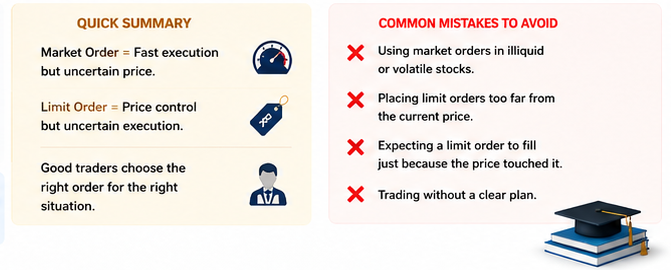
Limit orders also have risks. One common mistake is placing a limit order too far from the current market price and expecting it to fill quickly.
Another mistake is assuming that touching the limit price always guarantees execution. In reality, the market may reach your price briefly, but your order may still not fill if there are not enough shares available or if other orders have priority.
Some traders also use limit orders without a clear plan. They keep adjusting their price emotionally, chasing the market instead of following a strategy.
A limit order is useful, but it should be part of a clear trading plan.
Market Orders vs Limit Orders in Volatile Markets
Volatile markets can move very quickly. Prices may jump up or down within seconds.
In these conditions, market orders can result in unexpected execution prices. This is especially true during major news events, earnings releases, Federal Reserve announcements, or market openings.
Limit orders can help control price, but they may not fill if the market moves too fast.
For this reason, traders should be extra careful during high volatility. Sometimes the best decision is not to trade until the market becomes more stable.
Practical Tips Before Placing an Order
Before placing any order, ask yourself a few important questions:
What price am I willing to accept?
Is the asset liquid?
How wide is the bid-ask spread?
Am I entering because of a plan or because of emotion?
What is my risk if the trade goes against me?
Do I need immediate execution, or can I wait?
These questions can help you choose the right order type and avoid unnecessary mistakes.
Market Order vs Limit Order: Simple Rule
A simple way to remember the difference is this:
Use a market order when you care more about getting filled quickly.
Use a limit order when you care more about the price.
This does not mean one is always better than the other. It means each one has a different purpose.
Good traders do not choose orders randomly. They choose the order type that matches their strategy, risk tolerance, and market conditions.
Final Thoughts
Understanding market orders and limit orders is one of the basic skills every trader and investor should learn. These order types may seem simple, but they can have a major impact on your trading results.
A market order can help you enter or exit quickly, but you may not get the exact price you expected. A limit order gives you more control over price, but your trade may not be executed.
For beginners, the safest approach is to slow down, plan the trade before placing it, and understand the trade-off between speed and price control.
Before you click the buy or sell button, always know what type of order you are using and why you are using it. In trading, small details can make a big difference over time
Educational Disclaimer
This article is for educational purposes only and should not be considered financial advice. Trading and investing involve risk, and you should always do your own research or consult a qualified financial professional before making any financial decision.