
 By Anzo Trader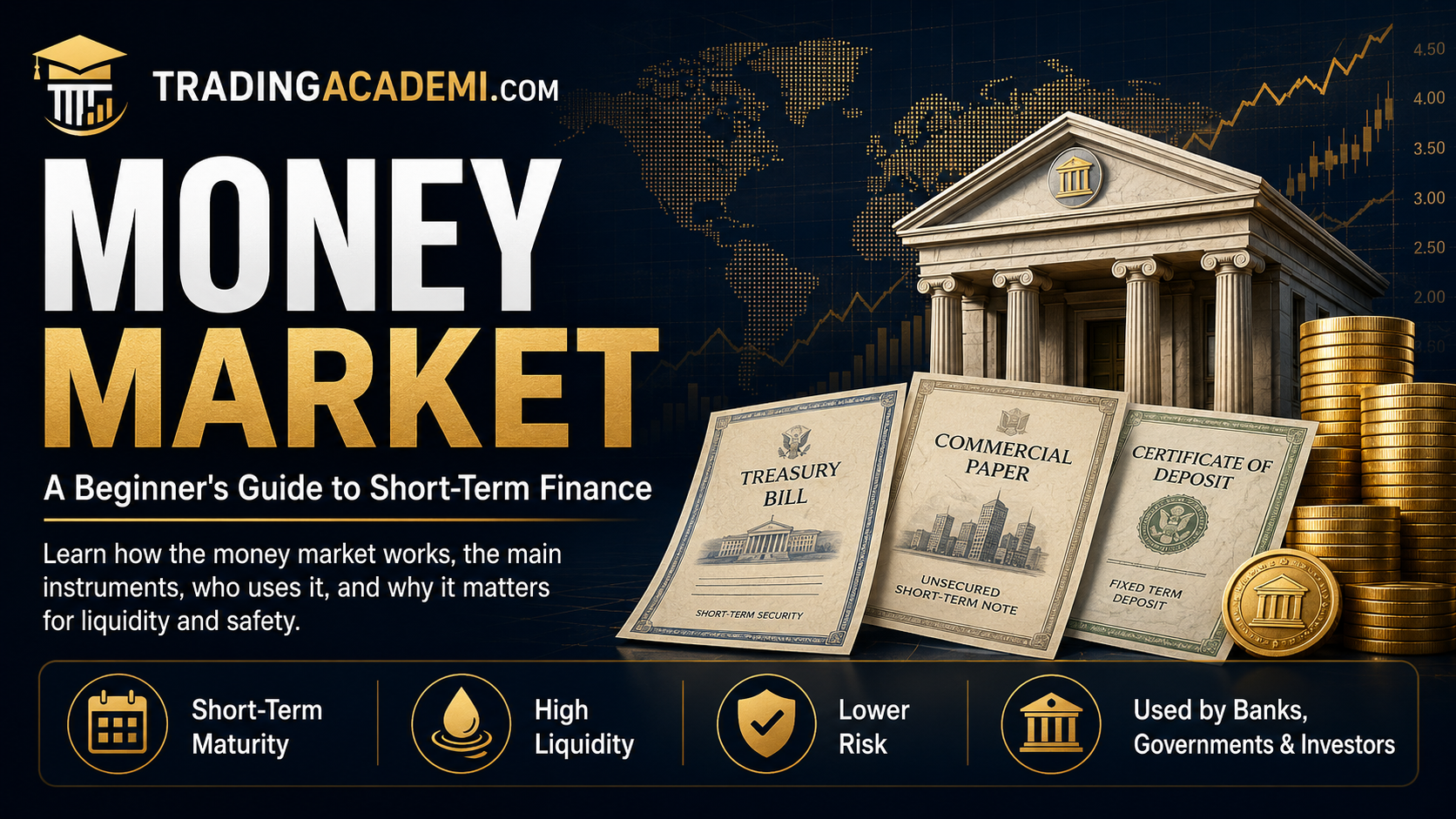
When people hear the word “financial markets,” they usually think about stocks, forex, crypto, commodities, or bonds. These markets get most of the attention because their prices move visibly and they are often discussed in the news.
But there is another important part of the financial system that works quietly in the background: the money market.
The money market is not about buying shares of companies or trading currencies for quick price movements. Instead, it focuses on short-term borrowing and lending. It helps governments, banks, companies, and financial institutions manage cash, maintain liquidity, and finance short-term needs.
For beginners, the money market may sound less exciting than the stock market or forex market, but it plays a major role in keeping the financial system stable. Without it, many businesses, banks, and governments would have a harder time managing their daily funding needs.
In this guide, we will explain what the money market is, how it works, who uses it, the main money market instruments, why it matters, and what risks beginners should understand.
What Is the Money Market?
The money market is a financial market where short-term debt instruments are bought and sold.
These instruments usually mature in one year or less. This means they are designed for short-term funding rather than long-term investment.
In simple terms, the money market allows large institutions to borrow and lend money for short periods of time.
For example, a government may issue short-term Treasury bills to raise cash. A company may issue commercial paper to cover short-term expenses. A bank may use money market instruments to manage liquidity.
The money market is often considered one of the more stable areas of finance because it focuses on short maturities and high-quality borrowers. However, this does not mean it is completely risk-free.
Why Does the Money Market Exist?
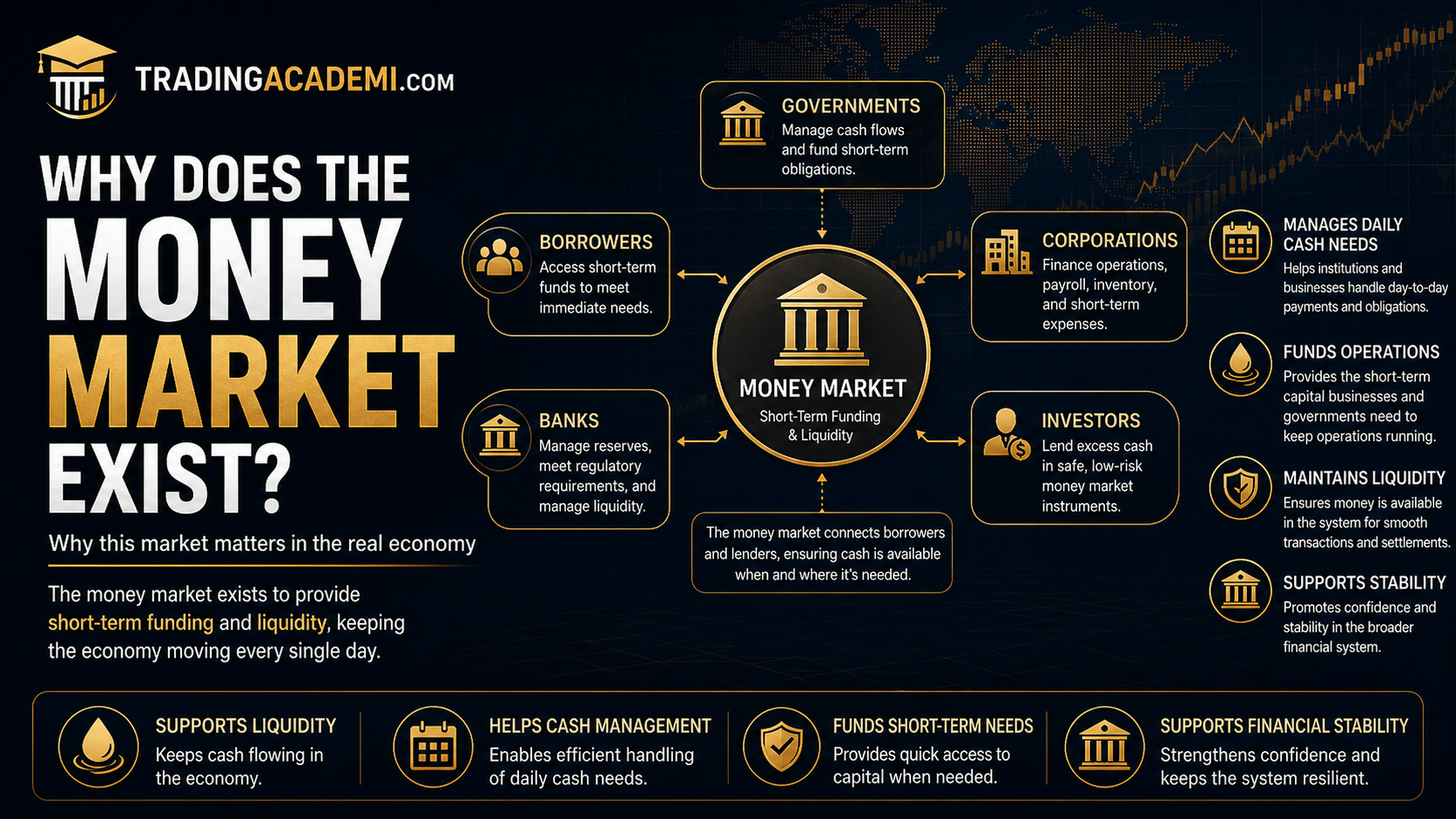
The money market exists because businesses, governments, and financial institutions constantly need short-term cash.
A company may have money coming in next month but needs cash today to pay suppliers, payroll, or operating costs.
A bank may need short-term liquidity to meet withdrawal demand or regulatory requirements.
A government may need temporary funding before tax revenue arrives.
Instead of taking long-term loans for short-term needs, these institutions can use the money market.
The money market helps money move efficiently between those who have extra cash and those who need short-term funding.
This supports liquidity, stability, and confidence in the financial system.
How Does the Money Market Work?
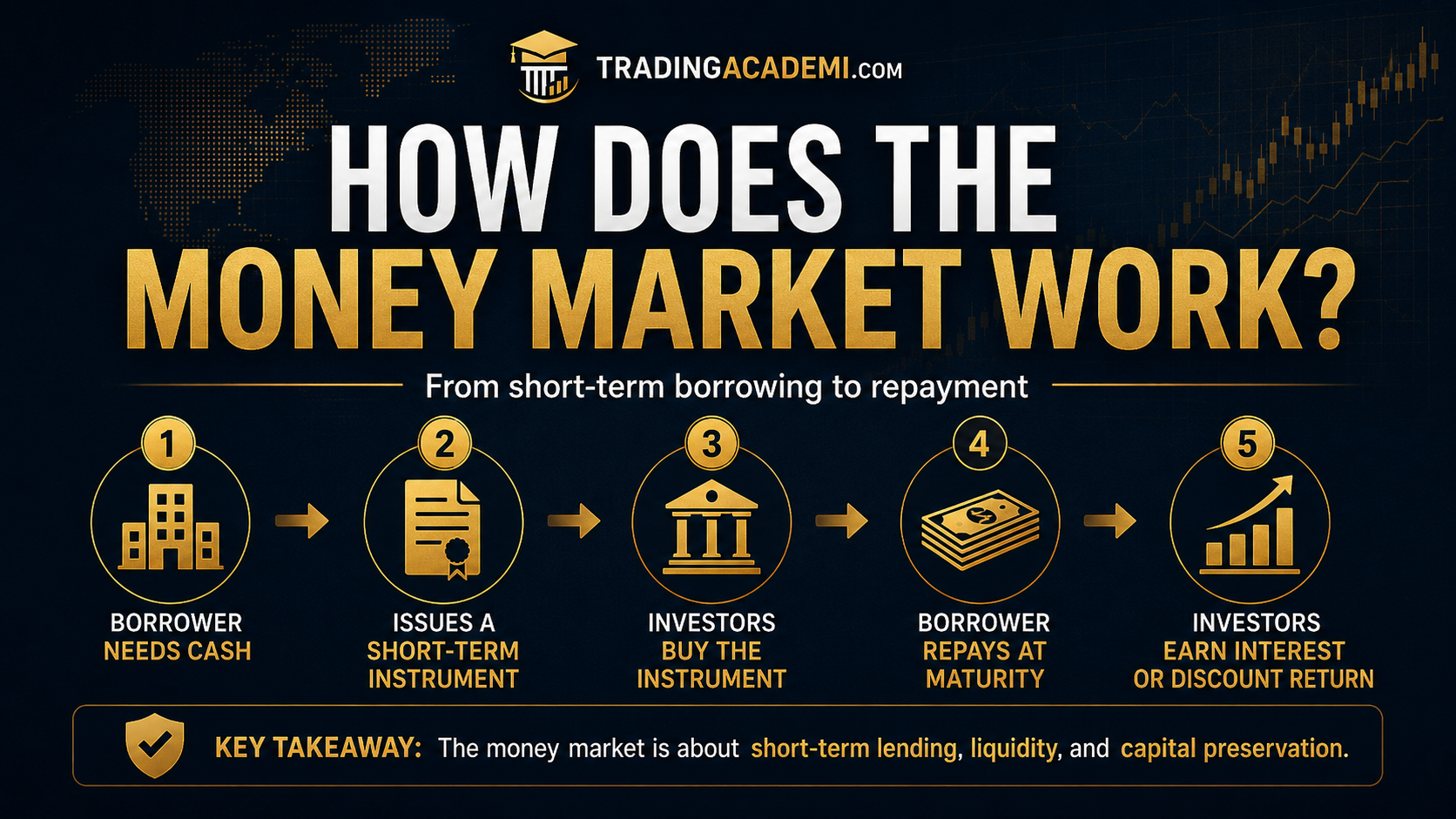
The money market works through short-term borrowing and lending.
One party needs cash for a short period. Another party has cash available and wants a relatively safe place to earn a small return.
The borrower issues a short-term debt instrument. The lender or investor buys that instrument. At maturity, the borrower repays the amount, sometimes with interest or at a higher value than the purchase price.
For example, if an investor buys a Treasury bill at a discount and receives the full face value at maturity, the difference becomes the investor’s return.
Unlike stocks, money market instruments do not represent ownership. They represent short-term debt.
The goal is usually not aggressive growth. The goal is liquidity, capital preservation, and short-term income.
Money Market vs Capital Market
To understand the money market better, it helps to compare it with the capital market.
The money market deals with short-term financial instruments that usually mature in one year or less.
The capital market deals with long-term financial instruments such as stocks and bonds.
Stocks, long-term bonds, and long-term investment products belong to the capital market. Treasury bills, commercial paper, certificates of deposit, and repurchase agreements belong to the money market.
Here is a simple comparison:
| Feature | Money Market | Capital Market |
|---|---|---|
| Time horizon | Short-term | Long-term |
| Maturity | Usually one year or less | More than one year |
| Instruments | Treasury bills, commercial paper, CDs | Stocks, bonds |
| Main goal | Liquidity and safety | Growth and long-term financing |
| Risk level | Usually lower | Usually higher |
| Main users | Banks, governments, corporations | Investors, companies, institutions |
Both markets are important, but they serve different purposes.
Main Features of the Money Market
The money market has several important characteristics.
1. Short-Term Maturity
Money market instruments are usually short-term. Most mature within days, weeks, or months, and generally within one year.
This short maturity helps reduce some risks compared to longer-term debt.
2. High Liquidity
Liquidity means how easily an asset can be bought or sold without significantly affecting its price.
Money market instruments are often highly liquid, especially government-backed instruments.
This makes them useful for institutions that need quick access to cash.
3. Lower Risk Compared to Many Markets
The money market is often considered lower risk because it usually involves high-quality borrowers and short-term instruments.
However, lower risk does not mean zero risk. Credit risk, liquidity risk, and interest rate risk can still exist.
4. Lower Returns
Because money market instruments are generally safer and shorter-term, their returns are usually lower than stocks, high-yield bonds, or riskier assets.
Investors often use the money market for stability rather than high growth.
Main Money Market Instruments
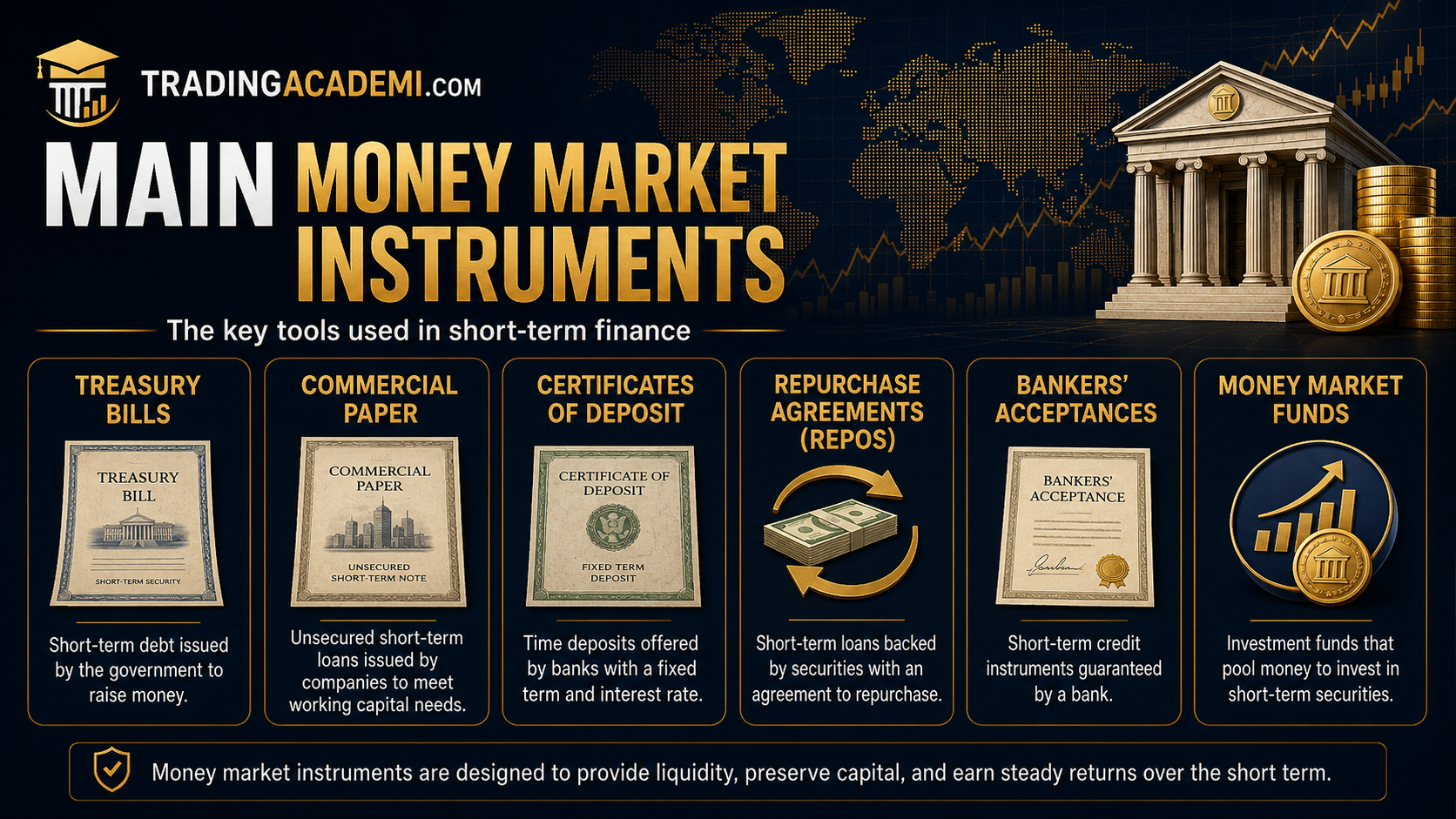
The money market includes several types of short-term financial instruments. Beginners should understand the most common ones.
1. Treasury Bills
Treasury bills, often called T-bills, are short-term debt securities issued by governments.
They are used to raise money for government operations and short-term funding needs.
T-bills usually mature in a few weeks, a few months, or up to one year.
Instead of paying regular interest like some bonds, many T-bills are sold at a discount and mature at face value.
For example, an investor may buy a T-bill for $980 and receive $1,000 at maturity. The $20 difference is the investor’s return.
T-bills issued by stable governments are often considered among the safer money market instruments.
2. Commercial Paper
Commercial paper is short-term debt issued by companies.
Large corporations may use commercial paper to raise cash for short-term needs such as payroll, inventory, accounts payable, or daily operations.
Commercial paper usually has short maturities, often ranging from a few days to several months.
Because it is typically unsecured, the credit quality of the company is very important.
Strong companies may issue commercial paper at lower rates. Weaker companies may struggle to access this market or may have to pay higher rates.
3. Certificates of Deposit
A certificate of deposit, or CD, is a time deposit offered by banks.
When someone buys a CD, they agree to leave money with the bank for a specific period. In return, the bank pays interest.
CDs can have different maturities, such as one month, three months, six months, or one year.
They are often used by investors who want a predictable return and do not need immediate access to the money.
However, withdrawing money early may involve penalties, depending on the bank and the product.
4. Repurchase Agreements
A repurchase agreement, often called a repo, is a short-term borrowing arrangement.
In a repo transaction, one party sells securities to another party and agrees to buy them back later at a slightly higher price.
The difference between the sale price and the repurchase price represents the cost of borrowing.
Repos are widely used by banks, financial institutions, and central banks to manage liquidity.
Although repos are usually short-term and often backed by collateral, they still require trust in the quality of the securities and the counterparty.
5. Bankers’ Acceptances
A banker’s acceptance is a short-term instrument often used in international trade.
It is a promise by a bank to pay a certain amount at a future date.
Businesses may use banker’s acceptances to reduce payment risk when trading goods across borders.
Because the bank guarantees the payment, banker’s acceptances can be more trusted than a promise from an unknown buyer.
6. Money Market Funds
Money market funds are investment funds that invest in short-term, high-quality debt instruments.
They may hold Treasury bills, commercial paper, certificates of deposit, and other money market securities.
Retail investors often access the money market through money market funds because buying individual instruments directly can be less practical.
Money market funds aim to provide liquidity and stability, but they are still investment products and may carry risk depending on what they hold.
Who Uses the Money Market?
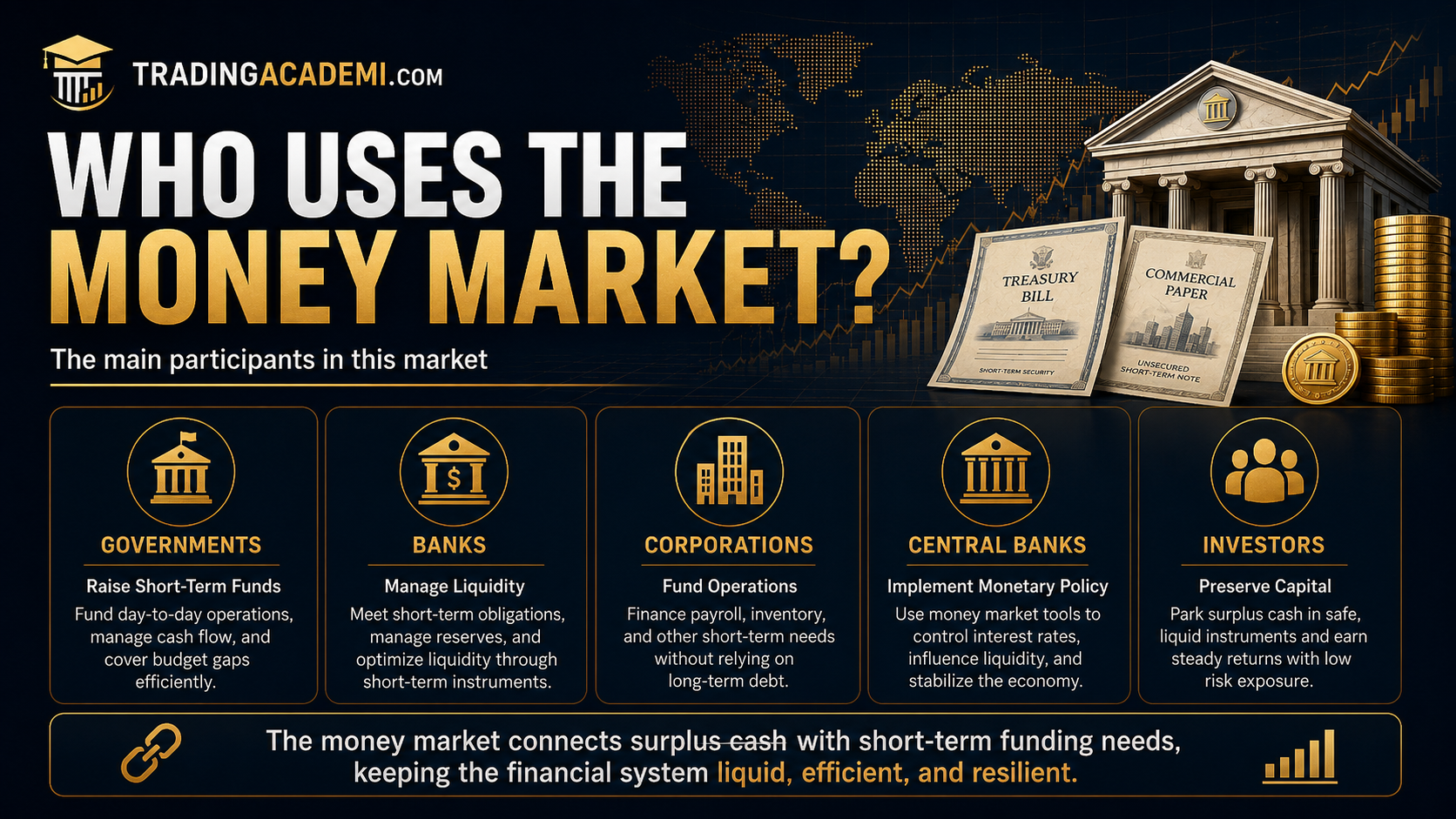
The money market is mainly used by large institutions, but individual investors can also participate indirectly.
Governments
Governments use the money market to raise short-term funds and manage temporary cash needs.
Treasury bills are a common example.
Banks
Banks use the money market to manage liquidity, meet short-term obligations, and lend or borrow from other institutions.
Corporations
Companies use the money market to finance short-term operating needs.
Commercial paper is one of the most common tools for large corporations.
Central Banks
Central banks use money market operations to influence liquidity, interest rates, and monetary conditions.
Their actions can affect short-term interest rates and the broader financial system.
Investors
Investors may use money market funds or short-term instruments to preserve capital, earn income, or keep cash available for future opportunities.
Why the Money Market Matters
The money market plays a major role in the financial system.
It helps businesses pay short-term expenses.
It helps governments manage cash flow.
It helps banks stay liquid.
It helps investors park cash safely.
It helps central banks implement monetary policy.
When the money market works properly, financial institutions can access short-term funding smoothly.
When the money market becomes stressed, it can create problems across the wider economy.
This is why central banks and financial regulators pay close attention to money market conditions.
How Investors Earn Money in the Money Market
Investors earn money in the money market mainly through interest or discount returns.
Some instruments pay interest directly. Others are sold at a discount and mature at face value.
For example, a Treasury bill may not pay regular interest. Instead, the investor buys it below face value and receives the full face value at maturity.
Money market returns are usually lower than returns from riskier assets because the instruments are short-term and generally lower risk.
The main attraction is not high growth. It is liquidity, stability, and predictable short-term income.
What Affects Money Market Rates?
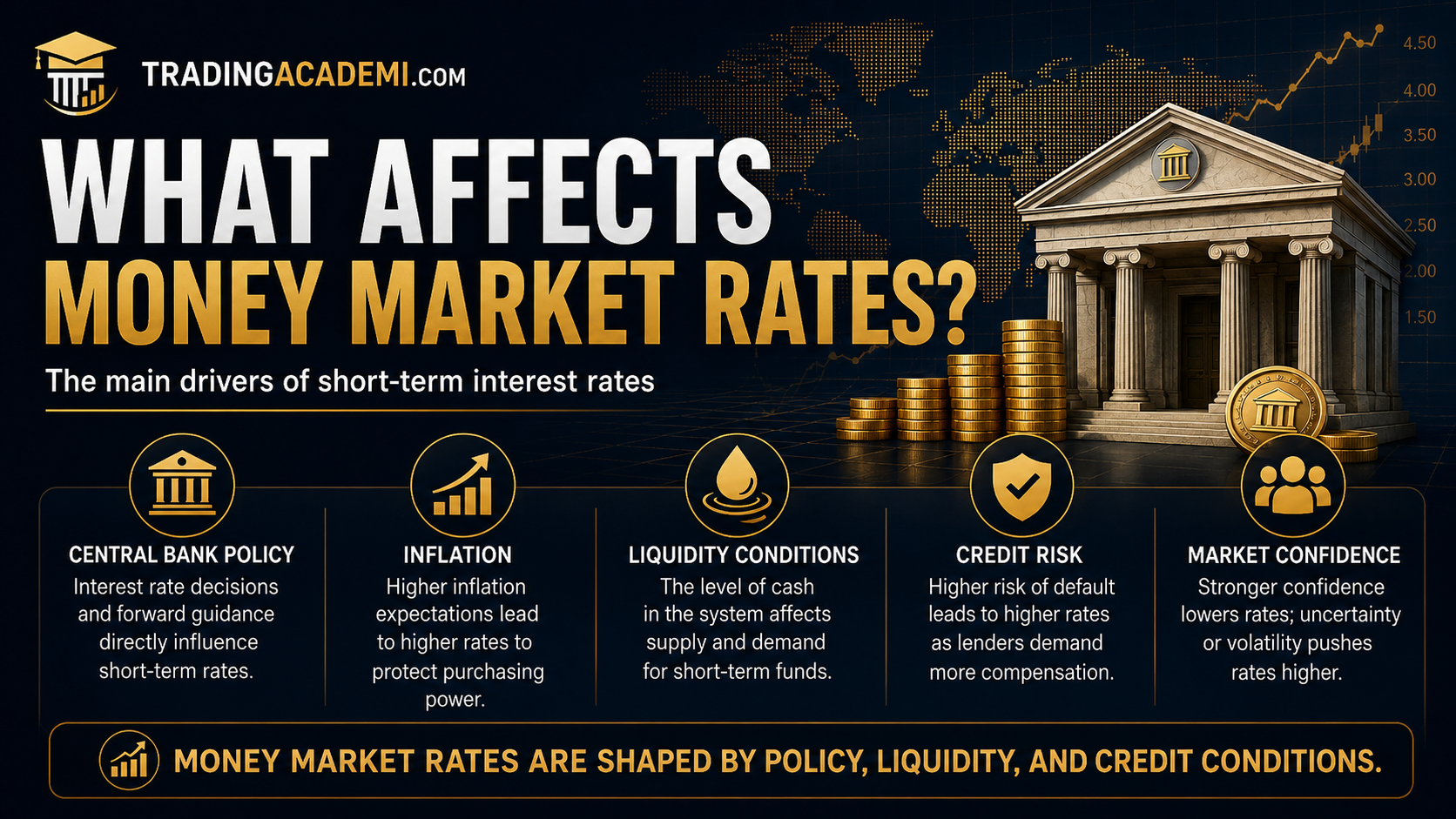
Money market rates are influenced by several factors.
Central Bank Policy
Central banks play a major role in short-term interest rates.
When a central bank raises rates, money market yields usually rise. When it lowers rates, yields usually fall.
Inflation
Higher inflation can push interest rates higher because investors want compensation for the loss of purchasing power.
Liquidity Conditions
If cash is easy to access, short-term rates may stay lower. If liquidity tightens, rates may rise.
Credit Risk
Borrowers with stronger credit quality can usually borrow at lower rates. Borrowers with weaker credit may need to pay more.
Market Confidence
During uncertain times, investors may prefer safer instruments, such as government bills, and avoid riskier short-term debt.
Money Market vs Bond Market
The money market and bond market are related because both involve debt instruments. The main difference is maturity.
The money market focuses on short-term debt, usually one year or less.
The bond market includes medium-term and long-term debt, often lasting several years or decades.
For example, a 3-month Treasury bill belongs to the money market. A 10-year Treasury bond belongs to the bond market.
Money market instruments are often used for liquidity and short-term cash management. Bonds are often used for income, financing, and longer-term investment planning.
Recommended reading:
What Is the Bond Market?
Money Market vs Stock Market
The money market and stock market serve very different purposes.
The stock market allows investors to buy ownership in companies. Stock prices can rise or fall significantly based on company performance, market sentiment, and economic conditions.
The money market focuses on short-term lending and borrowing. It is usually used for liquidity and capital preservation.
Stocks may offer higher growth potential, but they come with higher volatility. Money market instruments usually offer lower returns but greater stability.
Recommended reading:
What Is the Stock Market?
Advantages of the Money Market
The money market has several advantages.
Liquidity
Many money market instruments can be converted to cash quickly.
Stability
Short-term instruments are usually less volatile than long-term bonds or stocks.
Capital Preservation
Investors often use the money market to protect capital while still earning some return.
Short-Term Income
Money market instruments may provide interest or discount-based returns.
Useful Cash Management
Businesses, banks, governments, and investors use the money market to manage cash efficiently.
Risks of the Money Market
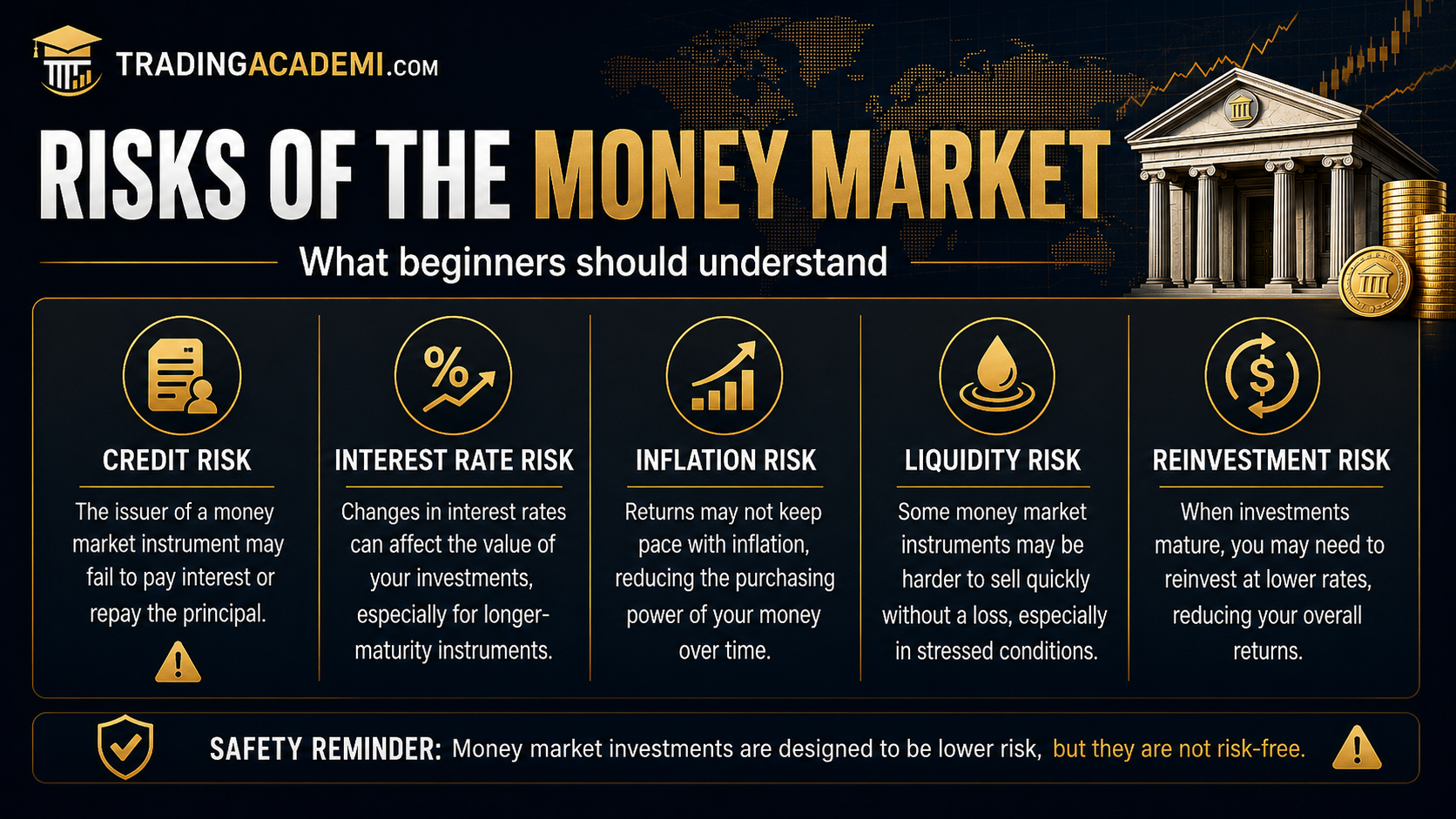
The money market is often considered lower risk, but it is not risk-free.
Credit Risk
The borrower may fail to repay.
This risk is usually lower with high-quality government instruments and higher with weaker corporate issuers.
Interest Rate Risk
Money market instruments are short-term, so they are less sensitive to interest rates than long-term bonds. Still, changing rates can affect returns.
Inflation Risk
If inflation is higher than the return earned, the real value of money can decline.
Liquidity Risk
Some instruments may be harder to sell quickly during stressed market conditions.
Reinvestment Risk
When an instrument matures, the investor may have to reinvest at a lower rate if market rates have fallen.
Common Mistakes Beginners Make
One common mistake is thinking that money market instruments are exactly the same as a savings account.
They can be stable, but they are still financial instruments or investment products, depending on how they are accessed.
Another mistake is chasing the highest yield without checking the issuer quality. Higher return may come with higher risk.
Some beginners also ignore inflation. If the return is low and inflation is high, the investor may lose purchasing power even if the account balance increases slightly.
Another mistake is not understanding fees, liquidity terms, or early withdrawal penalties.
Before using any money market product, investors should understand how it works, what it holds, and what risks are involved.
Is the Money Market Good for Beginners?
The money market can be useful for beginners who want to understand safer and shorter-term parts of finance.
It can be helpful for parking cash, learning about interest rates, or managing short-term savings.
However, it is not designed for aggressive growth. Beginners should understand that lower risk usually means lower return.
The money market may fit investors who prioritize stability, liquidity, and capital preservation over high returns.
How to Start Learning the Money Market
A beginner should start with the basic terms:
Treasury bills
Commercial paper
Certificates of deposit
Repurchase agreements
Money market funds
Maturity
Yield
Liquidity
Credit risk
Central bank policy
Understanding these terms will make it easier to understand how short-term finance works.
The money market may look simple, but it is closely connected to interest rates, central banks, banks, and the overall financial system.
Final Thoughts
The money market is one of the most important but least understood parts of finance. It helps governments, banks, companies, and investors manage short-term cash needs.
It may not be as exciting as stocks, crypto, forex, or commodities, but it plays a critical role in keeping the financial system liquid and stable.
For beginners, the key idea is simple: the money market is about short-term borrowing and lending.
It is often used for liquidity, capital preservation, and short-term income. But like every financial market, it still carries risks.
A smart investor does not only look for high returns. A smart investor also understands where to keep cash, how interest rates work, and how short-term markets support the larger economy.
Educational Disclaimer
This article is for educational purposes only and should not be considered financial advice. Investing and trading involve risk, including the possible loss of capital. Always do your own research or consult a qualified financial professional before making financial decisions.