 By Anzo Trader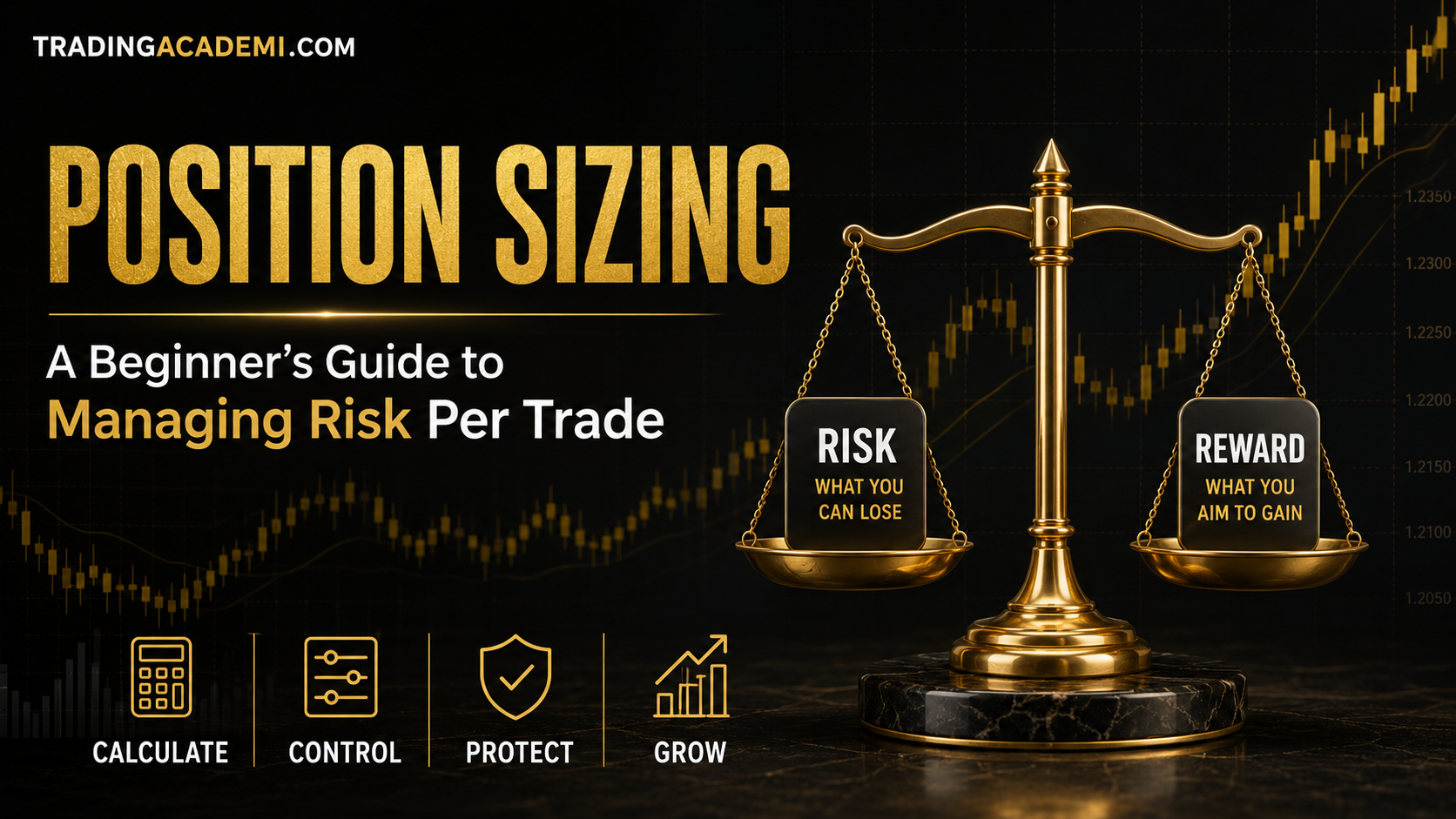
Position sizing is one of the most important parts of risk management in trading. Many beginners spend most of their time looking for the best entry, the best indicator, the best chart pattern, or the perfect trading signal. All of these things can be useful, but before entering any trade, one question matters a lot: how big should my position be?
That question is exactly what position sizing is about.
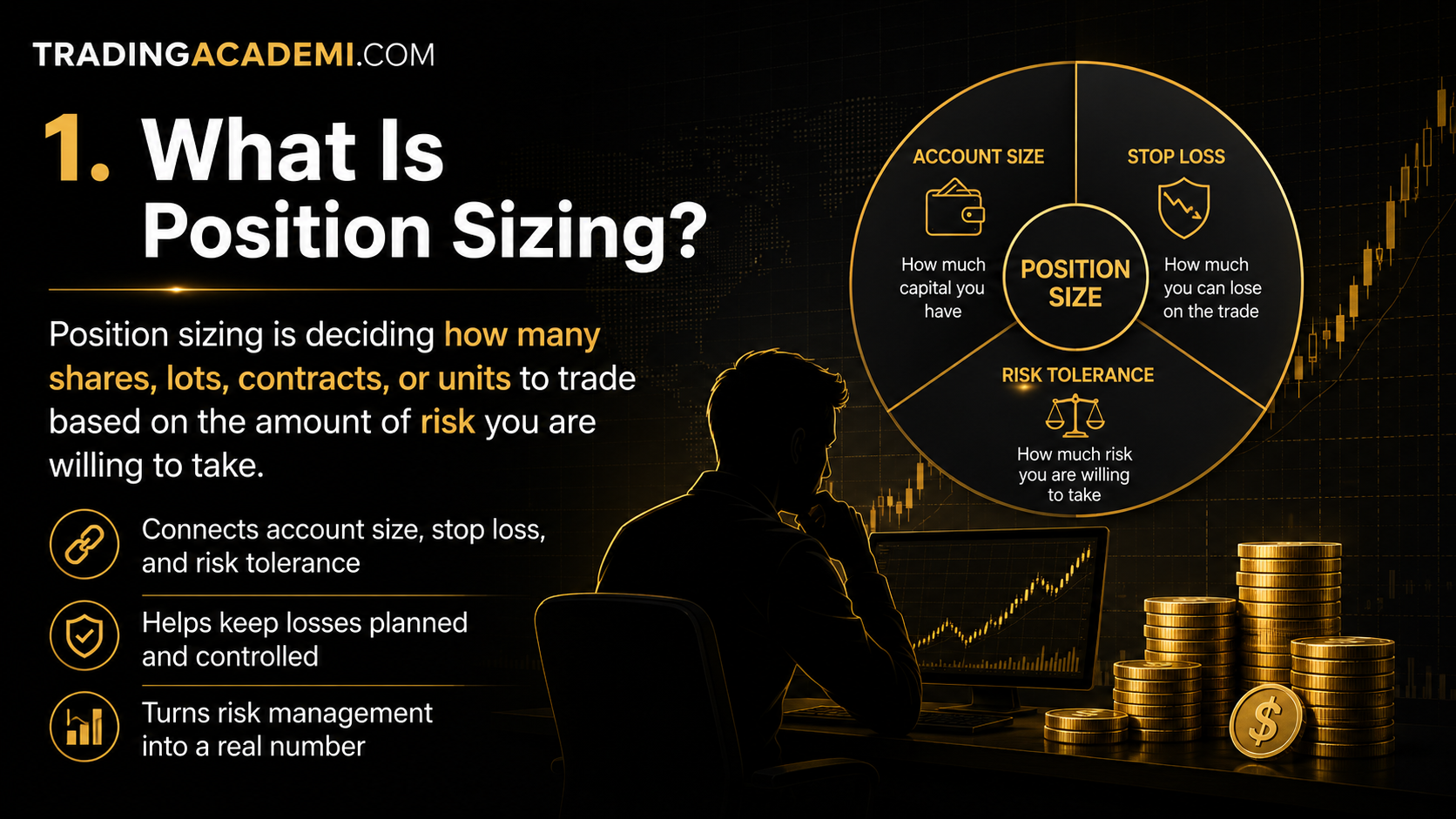
Position sizing means deciding how many shares, contracts, lots, coins, or units to trade based on the amount of risk you are willing to take. It connects your account size, stop loss, and risk tolerance into one practical decision.
Without position sizing, a trader may take positions that are too large, even when the setup looks good. One or two losing trades can then damage the account and create emotional pressure. With proper position sizing, losses become planned, controlled, and easier to manage.
A trading strategy can tell you where to enter. A stop loss can tell you where to exit if you are wrong. But position sizing tells you how much to trade so that the loss stays acceptable.
In this guide, you will learn what position sizing is, why it matters, how to calculate it, common mistakes beginners make, and how position sizing works across different markets such as stocks, forex, futures, crypto, and options.
What Is Position Sizing in Trading?
Position sizing is the process of choosing the correct trade size based on your risk. In simple terms, it answers this question: how much should I buy or sell on this trade?
The meaning of position size changes depending on the market. In stocks, it may mean how many shares you buy. In forex, it may mean how many lots you trade. In futures, it may mean how many contracts you use. In crypto, it may mean how much of a coin or token you buy. In options, it may mean how many option contracts you trade.
The goal of position sizing is not to make the biggest possible profit. The real goal is to keep your risk under control.
A trader should not choose position size randomly. It should be calculated before entering the trade. Good position sizing helps make sure that one losing trade does not cause serious damage to your account.
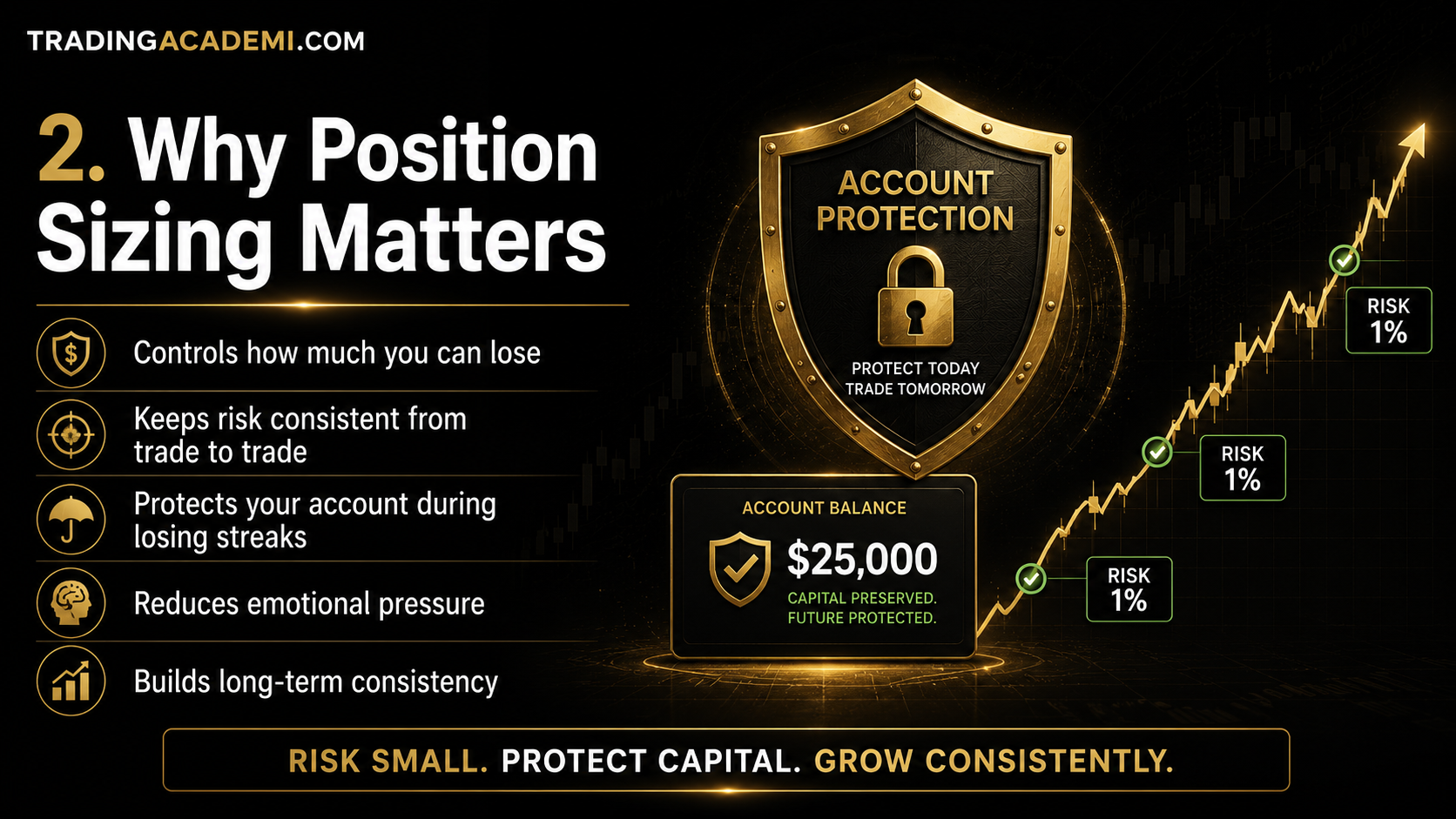
Why Position Sizing Matters
Position sizing matters because trade size directly affects how much money you can lose.
Two traders can take the same trade with the same entry and stop loss, but their results can be completely different because of position size.
Imagine two traders buy the same stock at $50 with a stop loss at $48. Trader A buys 50 shares, while Trader B buys 500 shares. The risk per share is $2 for both traders, but Trader A risks $100, while Trader B risks $1,000.
The trade setup is the same, but the risk is not the same.
This is why position sizing is so important. The market does not know your account size, and it does not care about your emotions. If your position is too large, a normal losing trade can become financially and mentally painful.
Position sizing gives structure to your risk..
Position Sizing and Risk Management
Position sizing is a core part of risk management. Risk management is about protecting your capital, and position sizing is one of the tools that helps you do that.
A good risk management plan usually includes how much you risk per trade, where you place your stop loss, how large your position should be, how many trades you can take at once, when to stop trading for the day, and how to handle losing streaks.
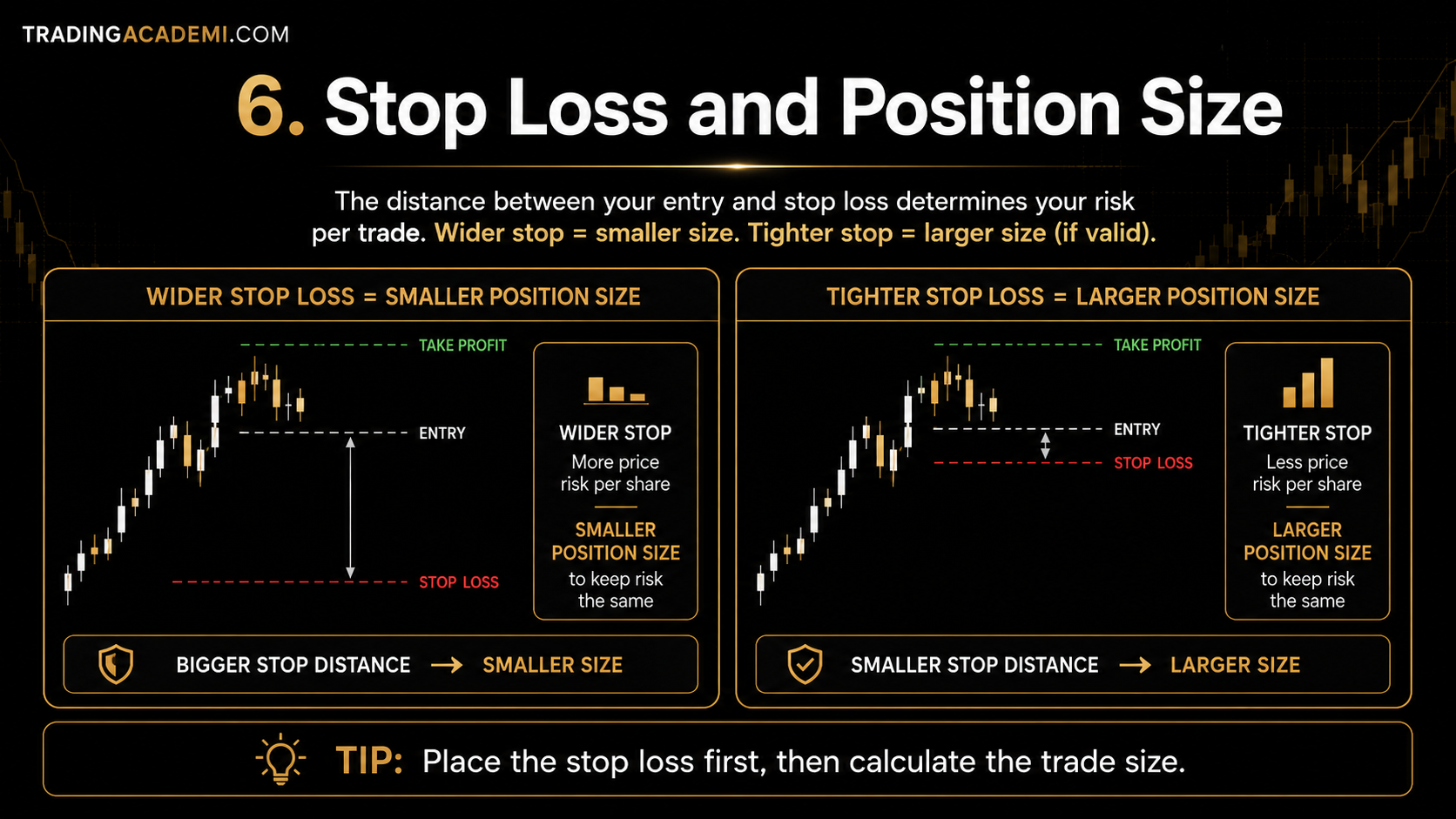
Position sizing connects directly with stop loss placement. If your stop loss is far away, your position size should usually be smaller. If your stop loss is closer, your position size may be larger.
But this does not mean you should place a stop loss very close just to take a bigger position. A stop loss should be placed where the trade idea becomes invalid, not where it allows the biggest trade size.
The correct order is simple: first define the trade idea, then identify the stop loss level, then decide how much money you are willing to risk, and finally calculate the position size.
The Basic Position Sizing Formula
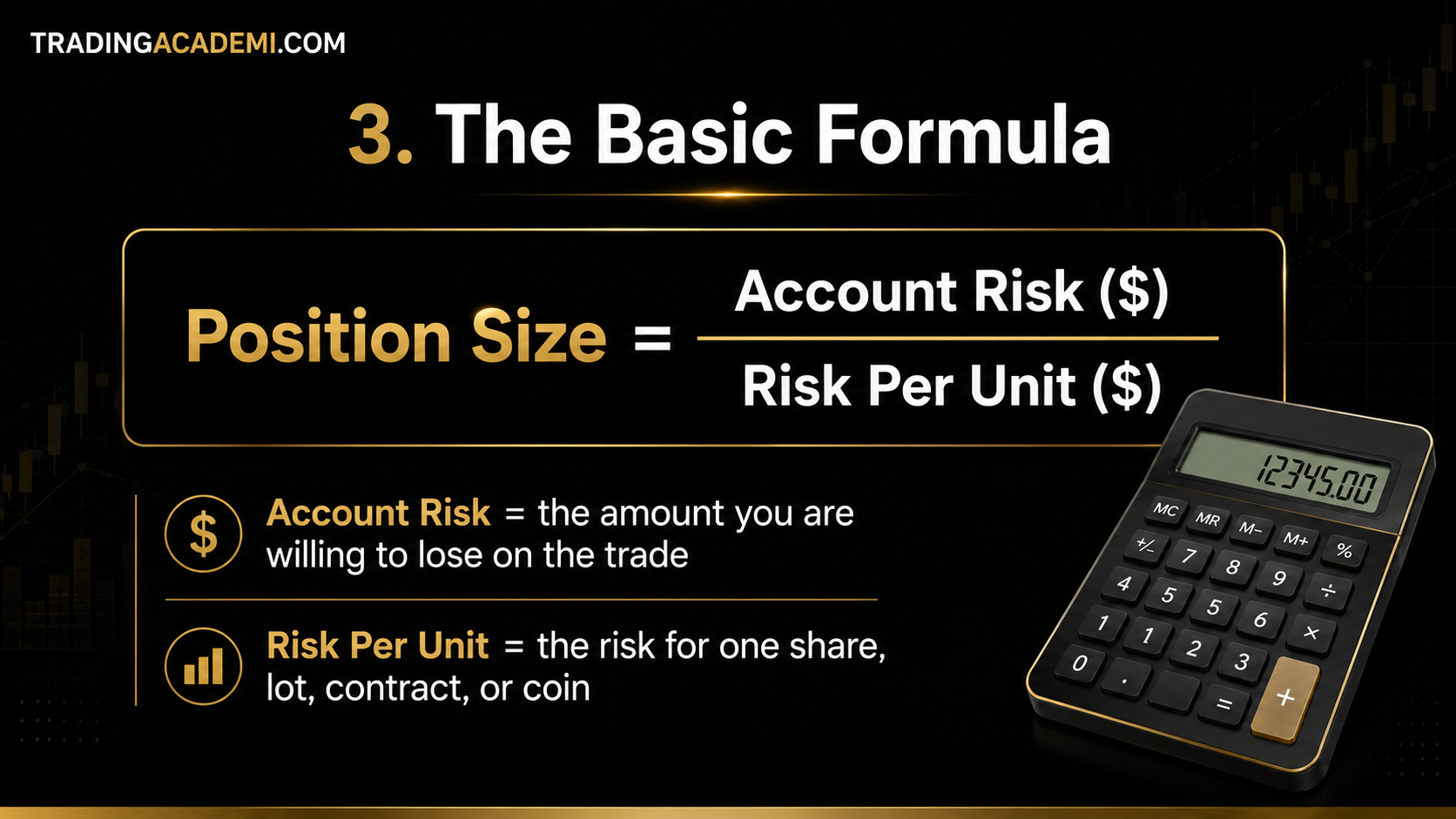
The basic position sizing formula is simple:
Position Size = Account Risk ÷ Risk Per UnitAccount risk is the amount of money you are willing to lose on the trade. Risk per unit is the difference between your entry price and your stop loss.
For stocks, the unit is usually one share. For crypto, the unit may be one coin or token. For forex, the calculation depends on lot size and pip value. For futures, it depends on tick value and contract size.
The idea is always the same. You decide how much money you are willing to risk, then calculate the trade size that matches that risk.
This formula is simple, but it is very powerful because it turns risk management from a vague idea into a clear number.
Example: Position Sizing for Stocks
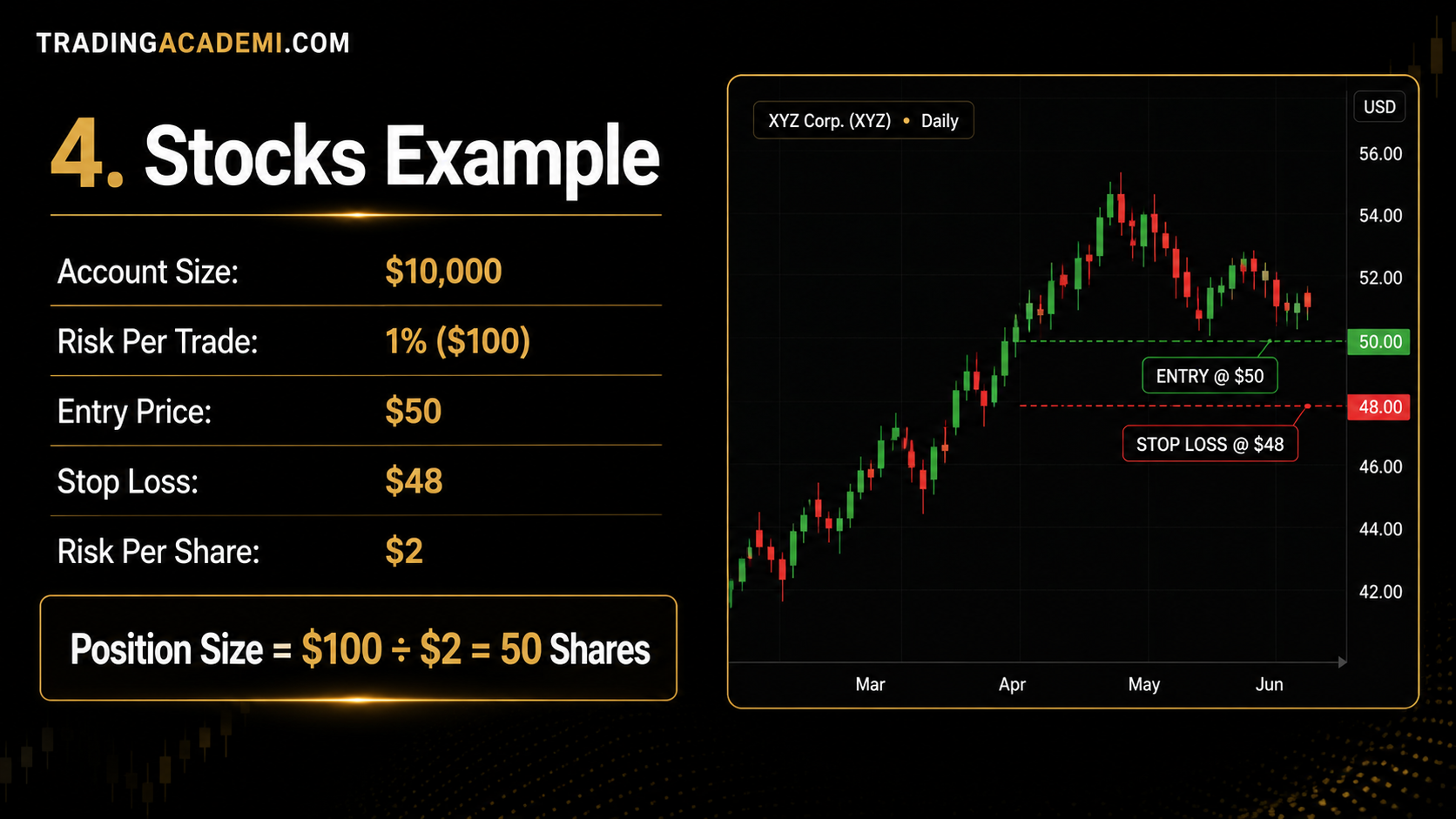
Imagine you have a $10,000 trading account and you decide to risk 1% of your account on one trade.
One percent of $10,000 is $100, so your account risk is $100.
Now imagine you want to buy a stock at $50, and your stop loss is at $48. Your risk per share is:
$50 - $48 = $2Now use the formula:
$100 ÷ $2 = 50 sharesThis means you can buy 50 shares. If the trade hits your stop loss, your planned loss is about $100.
That is position sizing. You are not choosing 50 shares randomly. You are choosing 50 shares because it matches your planned risk.
Example: What Happens If You Ignore Position Sizing?
Using the same example, imagine you buy 300 shares instead of 50.
Your entry price is $50, your stop loss is $48, and your risk per share is still $2. But because you bought 300 shares, your total risk becomes:
300 × $2 = $600Instead of risking $100, you are now risking $600. That is 6% of a $10,000 account on one trade.
If you lose, the damage is much larger. If you take several trades like this, your account can decline quickly. The problem is not only financial. A large loss can also affect your psychology. You may become scared, angry, impatient, or tempted to revenge trade.
Poor position sizing often creates emotional trading.
Percentage Risk Model
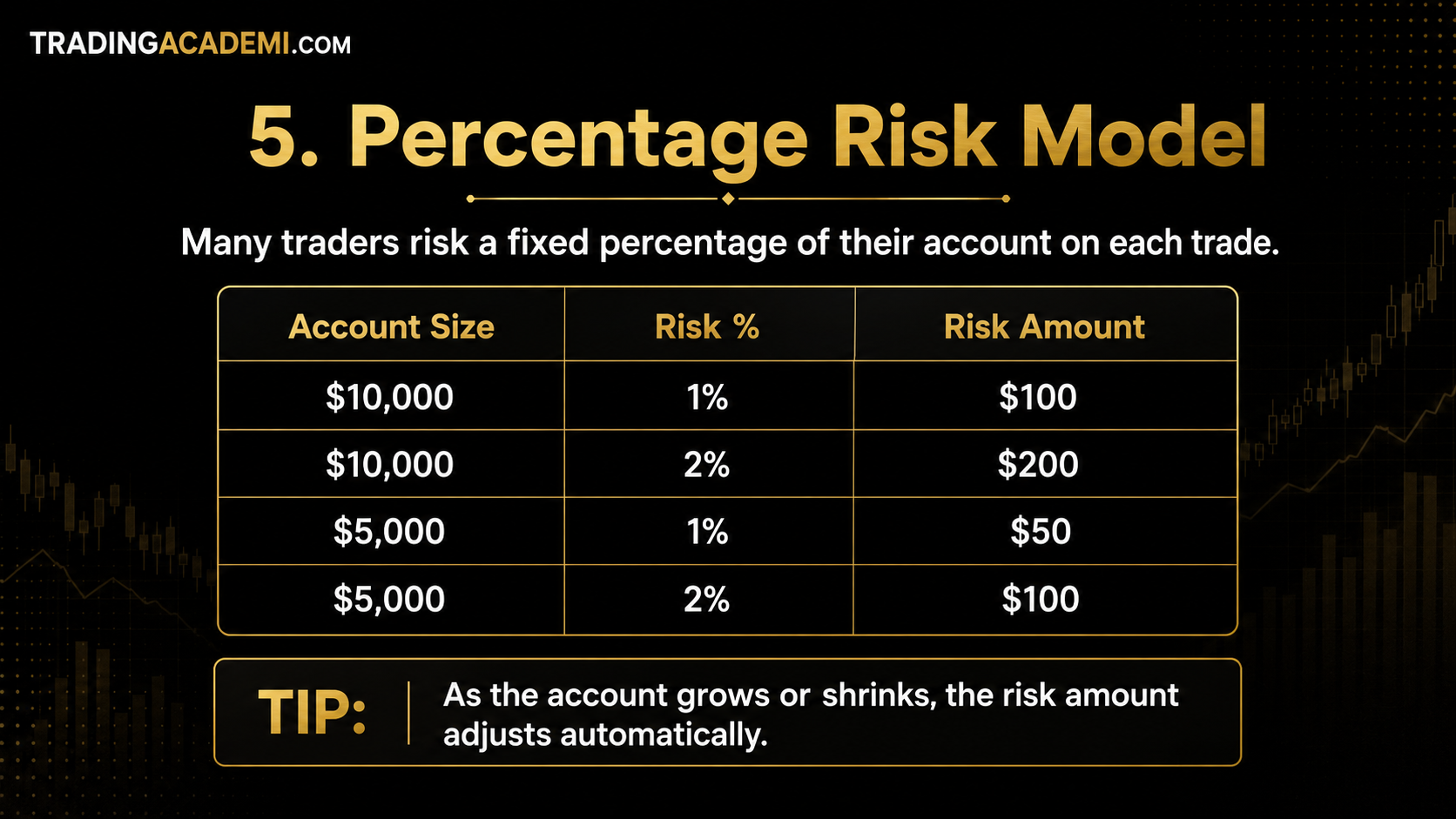
Many traders use a percentage risk model. This means they risk a fixed percentage of their account on each trade.
Common examples include 0.5%, 1%, or 2% per trade. For beginners, smaller risk is usually safer because it gives more room to learn and make mistakes without damaging the account too quickly.
For example, if a trader has a $5,000 account and risks 1%, the risk per trade is $50. If the account grows to $6,000, 1% becomes $60. If the account drops to $4,000, 1% becomes $40.
This model adjusts with account size. The benefit is that risk grows slowly when the account grows and decreases when the account declines.
Fixed Dollar Risk Model
Another method is fixed dollar risk. This means the trader risks the same dollar amount on each trade regardless of small account changes.
For example, a trader may decide to risk $50 on every trade. This method can be simple and easy for beginners to understand.
However, traders should still make sure the fixed dollar amount is not too large compared to the account size. Risking $50 on a $10,000 account is very different from risking $50 on a $500 account.
That is why percentage risk is often more balanced, especially for beginners who want their risk to adjust naturally with account growth or decline.
Position Sizing and Stop Loss Distance
The distance between your entry and stop loss has a big impact on position size.
Let’s use a $100 account risk. In Trade A, the entry is $50, the stop loss is $49, and the risk per share is $1. That allows a position size of 100 shares.
In Trade B, the entry is $50, the stop loss is $45, and the risk per share is $5. That allows a position size of only 20 shares.
In both examples, the planned risk is still $100. The position size changes because the stop loss distance is different.
The key point is this: the wider the stop loss, the smaller the position size should usually be. The tighter the stop loss, the larger the position size may be, but only if the stop loss makes sense.
Beginners often make the mistake of using a tight stop loss only to take a bigger position. This can lead to frequent stop-outs because the trade has no room to move. Your stop loss should be logical first. Your position size should adapt to it.
Position Sizing and Volatility
Volatility means how much price moves. Some markets move slowly, while others move quickly.
A highly volatile asset needs more room because price can move sharply in a short period. If you use the same position size on every trade without considering volatility, you may take too much risk.
For example, a stock that usually moves $1 per day is different from a stock that moves $10 per day. A crypto coin that moves 2% per day is different from one that moves 15% per day. A futures contract with a large tick value is different from one with a smaller tick value.
Position sizing should reflect volatility. When volatility is high, traders often reduce position size to keep risk controlled.
Position Sizing in Forex
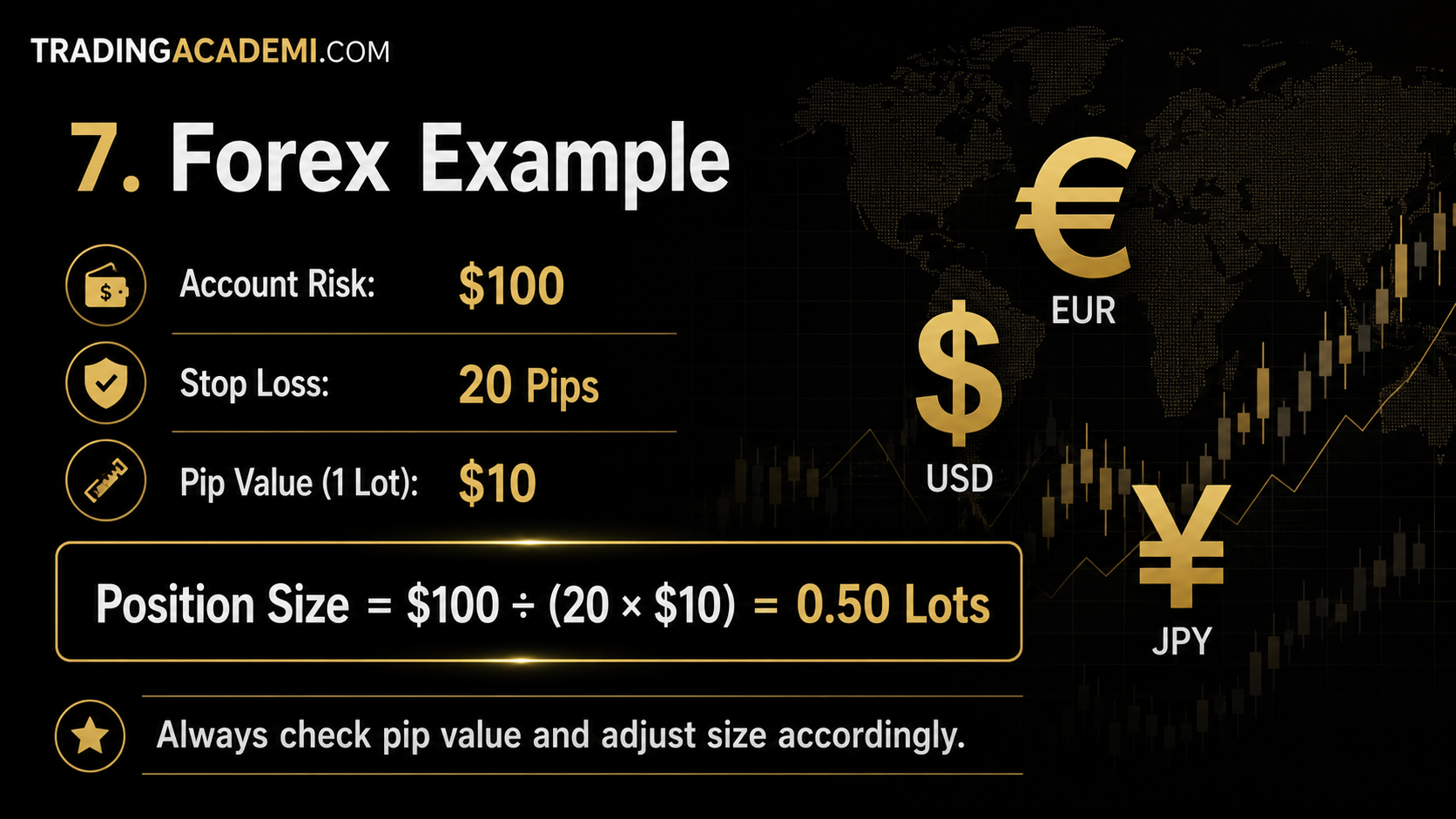
In forex trading, position size is usually measured in lots. Common lot sizes include standard lots, mini lots, micro lots, and nano lots.
The risk depends on the currency pair, entry price, stop loss distance in pips, pip value, lot size, and account currency. For example, if a trader places a stop loss 20 pips away and wants to risk $50, they need to choose a lot size that makes those 20 pips equal about $50.
Forex can be risky because leverage is often available. A beginner may open a large position because the platform allows it, but that does not mean it is safe.
In forex, position sizing is especially important because small price movements can become large gains or losses when the lot size is too big.
Position Sizing in Futures
Futures trading requires serious attention to contract size and tick value. Each futures contract has its own value per tick.
For example, one market may move $12.50 per tick, while another may move $5 per tick or more depending on the contract. If your stop loss is 10 ticks away and the tick value is $12.50, one contract risks:
10 × $12.50 = $125If your planned risk is $100, even one contract may be too large.
This is why futures traders must understand the product before trading. Micro futures can be useful for smaller accounts because they allow smaller position sizes, but they still require discipline and risk planning.
Position Sizing in Crypto
Crypto markets can be extremely volatile. A coin can move sharply in a short time, especially during news events, exchange issues, liquidity problems, or strong market sentiment.
Position sizing in crypto should be conservative, especially for beginners. A beginner should avoid putting too much of their account into one coin simply because it looks cheap or popular.
Crypto traders should consider volatility, liquidity, position size, stop loss distance, exchange risk, news risk, and whether the asset is highly speculative.
A small position in a volatile crypto asset can still carry significant risk.
Position Sizing in Options
Options position sizing can be more complex than stocks because options are affected by more than price direction. They are also affected by time decay, volatility, expiration, and option pricing.
A beginner may think that buying a cheap option is low risk because the price is small. But if they buy too many contracts, the total risk can still be high.
For example, buying one option contract for $100 may be manageable. Buying ten contracts for $1,000 may be too much for a small account.
Options traders should understand the maximum loss, expiration date, and how the option price may change before deciding position size.
Position Sizing and Losing Streaks
Every trader will face losing streaks. A losing streak means several losing trades in a row, and position sizing helps you survive them.
Imagine two traders both lose five trades in a row. Trader A risks 1% per trade, while Trader B risks 10% per trade. Trader A is down around 5%, which is uncomfortable but manageable. Trader B may be down heavily and may feel pressure to take bigger trades to recover.
This is why small risk matters. The goal is not to avoid losing streaks completely, because that is impossible. The goal is to make sure losing streaks do not destroy your account or your confidence.
Position Sizing and Emotional Control
Position sizing affects emotions.
If your position is too large, every small price movement feels stressful. You may keep staring at the chart, close trades too early, move stops, or panic.
If your position is reasonable, you can follow your plan more calmly. This does not mean you will feel no emotions, because trading always involves emotions. But proper position sizing keeps those emotions manageable.
A good test is this: if you cannot accept the planned loss before entering the trade, your position size is probably too large.
You should be able to say: “If this trade loses, I will not like it, but I can accept it.” That is healthy risk.
Common Position Sizing Mistakes Beginners Make
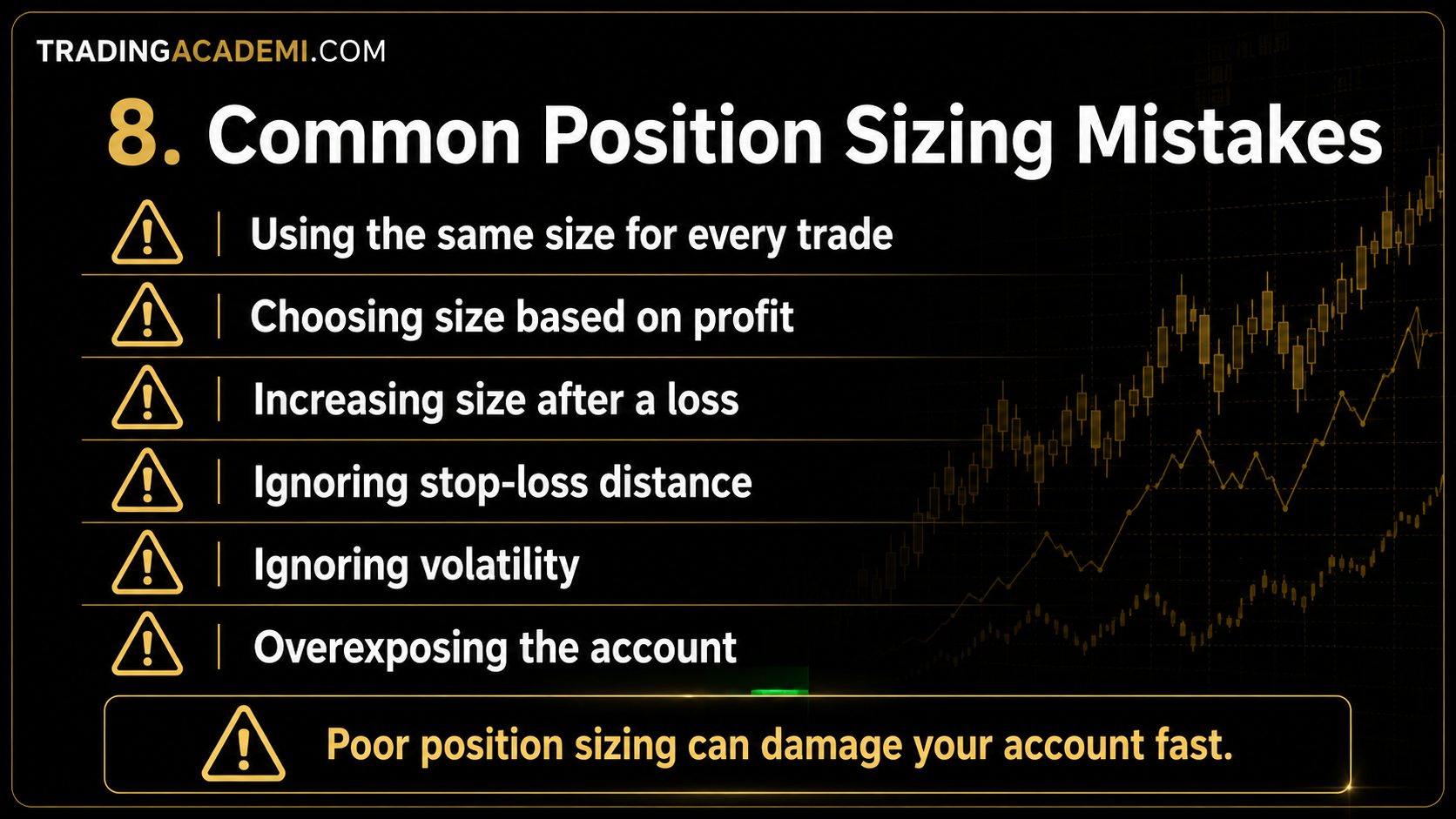
One common mistake is using the same position size for every trade. Different trades have different stop loss distances and different risk levels. Using the same size every time can create inconsistent risk.
Another mistake is choosing size based on profit expectations. A beginner may think, “If I buy more, I can make more.” That is true, but it also means they can lose more.
Increasing size after a loss to recover quickly is another dangerous mistake. This is revenge trading and can lead to account damage.
Some traders also ignore correlation. They may open multiple trades that all move in the same direction. Even if each position looks small, the total risk can be large.
Another mistake is not understanding the market product. This is common in futures, forex, and options, where contract value, leverage, or pip value can make risk larger than expected.
Position sizing requires calculation, not guessing.
How to Build a Simple Position Sizing Plan
A beginner can start with a simple position sizing plan.
First, decide your maximum risk per trade. For example, you may decide to risk 1% of your account per trade. Second, define your stop loss before entering. This could be below a recent swing low, above a recent swing high, or beyond a level that invalidates the trade idea.
Third, calculate the risk per unit. This is usually the entry price minus the stop loss price for long trades, or the stop loss price minus the entry price for short trades. Fourth, calculate position size by dividing account risk by risk per unit.
After that, check if the trade still makes sense. If the position size is too small, the trade may not be worth taking. If the position size is too large, reduce it or skip the trade.
Finally, follow the plan. Do not increase size because you feel confident, because you want to recover a loss, or because the last trade was a winner. Consistency is the goal..
Simple Position Sizing Checklist
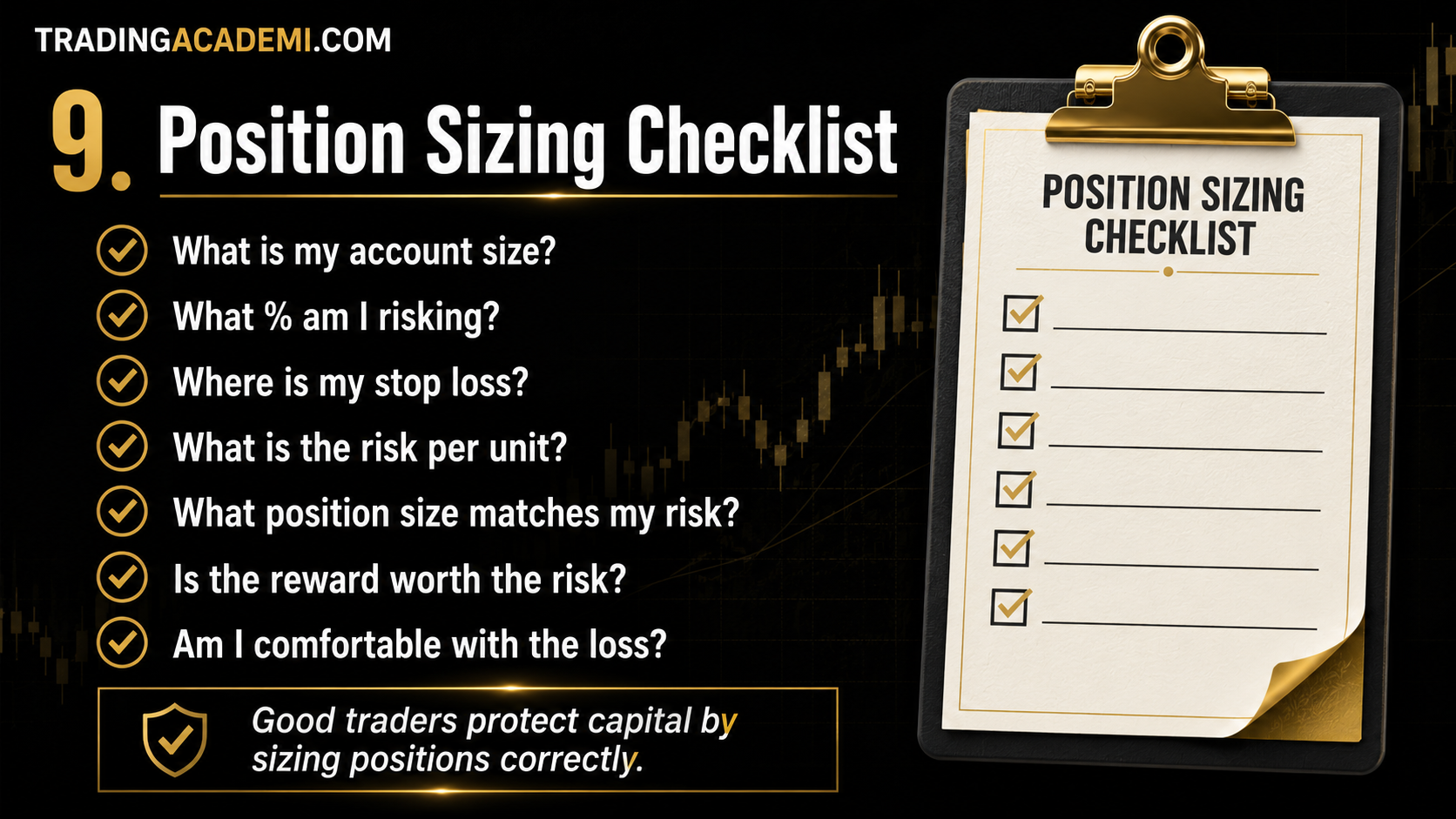
Before entering a trade, ask yourself a few questions.
What is my account size? What percentage am I risking? How much money is that in dollars? Where is my stop loss? What is the risk per share, lot, contract, or coin? What position size matches my risk? Is the reward worth the risk? Am I comfortable with the planned loss? Do I have other open trades with similar risk? Am I following my trading plan?
If you cannot answer these questions, you are not ready to enter the trade.
Position Sizing Example Step by Step
Let’s walk through a complete example.
Assume your account size is $10,000 and your risk per trade is 1%. That means your account risk is $100.
Now imagine your entry price is $50, your stop loss is $48, and your risk per share is $2.
The formula is:
Position size = Account risk ÷ Risk per shareSo:
$100 ÷ $2 = 50 sharesThis means your position size is 50 shares. If the trade loses, the planned loss is around $100.
If the target is $54, the potential reward is:
$4 × 50 shares = $200This creates a 1:2 risk-to-reward ratio. The trade may still lose, but the risk is planned, the size is calculated, and the decision is structured.
That is the purpose of position sizing.
Is Position Sizing More Important Than Entry?
Entry is important, but position sizing is what controls damage when the entry is wrong.
A good entry with bad position sizing can still lead to a painful loss. A decent strategy with disciplined position sizing can survive mistakes and improve over time.
Many traders spend months searching for perfect entries, but they ignore risk per trade. This is a mistake.
Trading is not about being right every time. It is about managing outcomes over many trades. Position sizing helps you stay consistent across those trades.
Final Thoughts
Position sizing is one of the most practical and important skills in trading. It turns risk management from an idea into a real number. Instead of saying, “I will be careful,” position sizing forces you to define exactly how much you are risking.
A beginner trader should never enter a trade without knowing the position size, stop loss, and account risk.
The market will always be uncertain. Some trades will win, and some trades will lose. But with proper position sizing, losses can stay controlled and manageable.
The goal is not to trade as big as possible. The goal is to trade at a size that allows you to stay disciplined, protect your account, and keep improving.
Before every trade, remember this: your position size should match your risk, your risk should match your account, and your account should survive your mistakes.
That is how traders stay in the game long enough to grow.
Educational Disclaimer
This article is for educational purposes only and should not be considered financial advice. Trading and investing involve risk, including the possible loss of capital. Always do your own research or consult a qualified financial professional before making financial decisions.