 By Anzo Trader
Risk management is one of the most important skills in trading, but many beginners ignore it when they first start.
Most new traders enter the market thinking mainly about profit. They ask questions like: how much can I make from this trade, which strategy has the highest win rate, what indicator gives the best entry, or how can I grow my account quickly?
These questions are common, but they are not the first questions a serious trader should ask. A better question is: how much can I lose if this trade goes wrong?
That question is the foundation of risk management.
Trading is not only about predicting where the market may go. It is also about surviving when your prediction is wrong. No trader wins every trade, and no strategy works perfectly in all market conditions. Even professional traders take losses.
The difference between a beginner and a disciplined trader is not that one loses and the other never loses. The real difference is how they manage those losses.
Risk management helps traders protect capital, control emotions, avoid large account damage, and stay consistent over time. In this guide, you will learn what risk management in trading means, why it matters, how it works, which tools traders use, and which beginner mistakes to avoid.
What Is Risk Management in Trading?
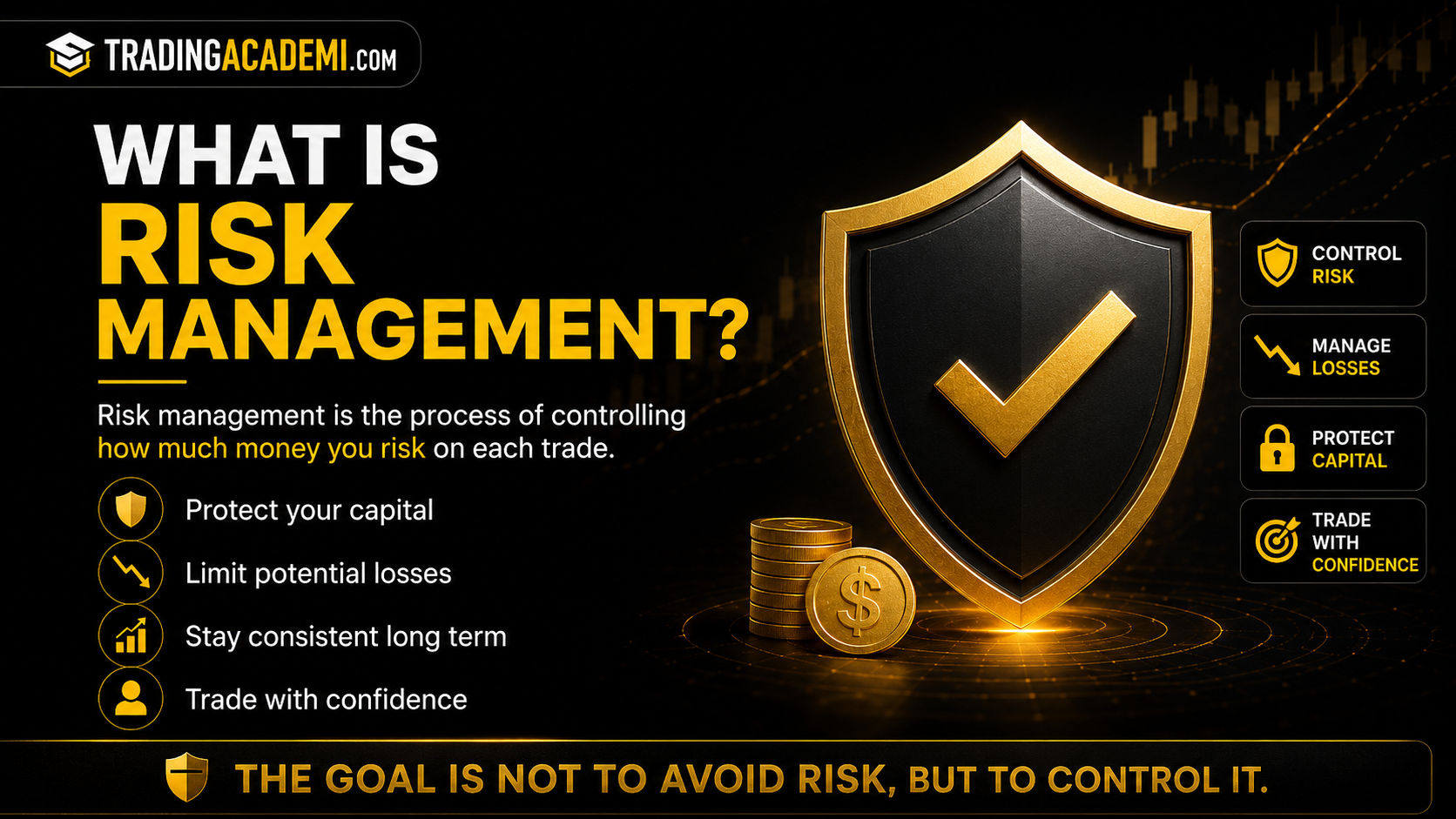
Risk management in trading means controlling how much money you are willing to risk before, during, and after a trade. It is the process of planning your possible loss before entering the market.
In simple terms, risk management helps you decide how much money to risk on one trade, where to place your stop loss, how large your position should be, when to avoid a trade, when to stop trading for the day, and how to protect your account during losing streaks.
Risk management does not guarantee profits. It does not make every trade successful, and it does not remove losses from trading. Instead, it helps make sure that one bad trade, one bad day, or one emotional mistake does not destroy your trading account.
A trader with poor risk management can lose money even with a good strategy. A trader with strong risk management can survive losses, review mistakes, and keep improving.
That is why many experienced traders say that protecting capital comes before making money.
Why Risk Management Matters
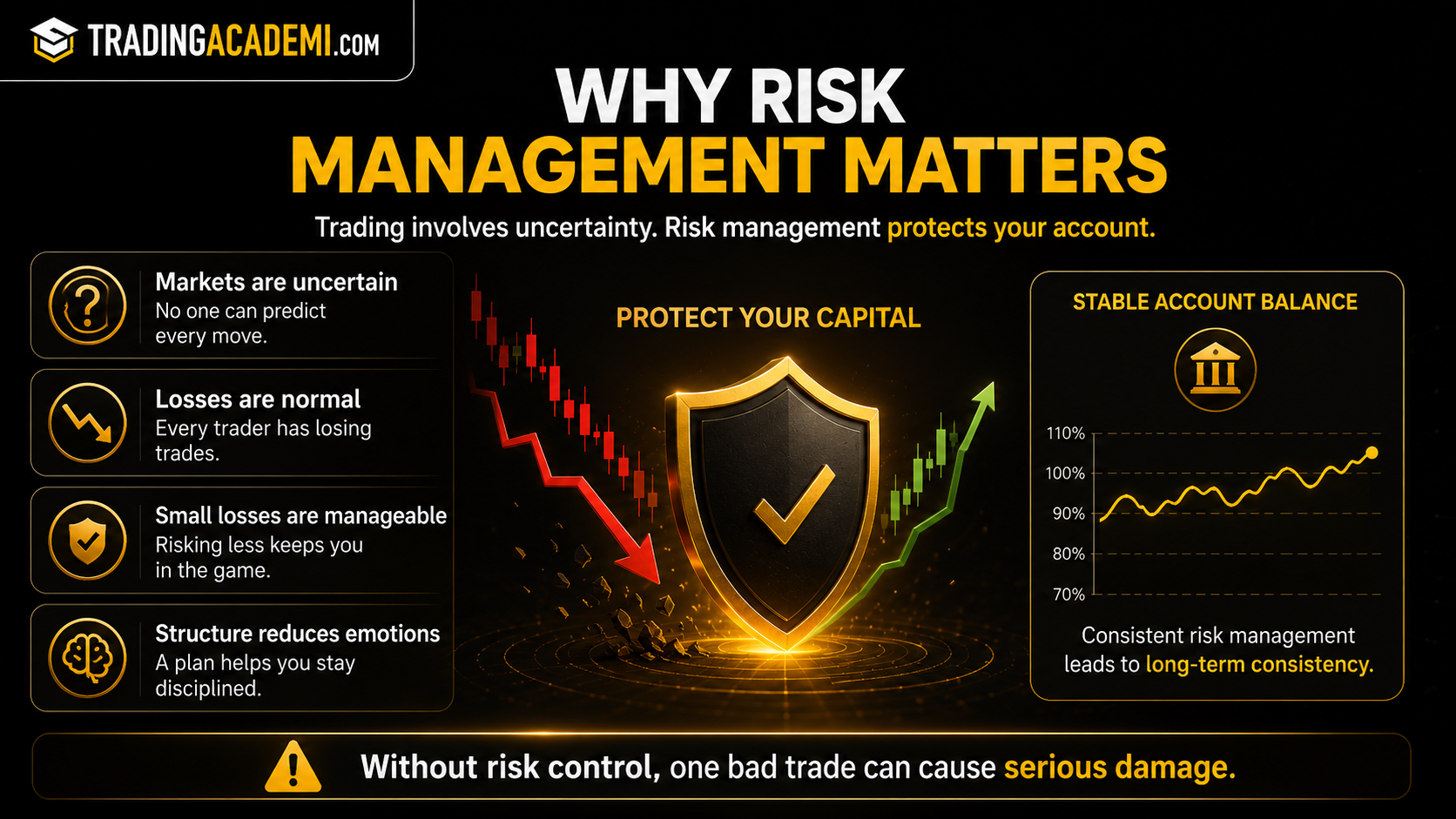
Risk management matters because trading always involves uncertainty. No setup is guaranteed, no chart pattern is perfect, and no indicator can predict the future with complete accuracy. Market conditions can change quickly because of news, economic data, liquidity, volatility, and unexpected events.
If a trader does not control risk, a normal losing trade can become a large loss. A large loss can lead to panic, panic can lead to revenge trading, and revenge trading can lead to even bigger losses. This is how many beginners damage their accounts.
Risk management creates structure. It gives the trader clear rules before emotions take control.
For example, if you already know that you are risking only 1% of your account on a trade, the loss becomes easier to accept. It is still not pleasant, but it is planned. It is part of the trading process.
Without risk management, every trade can feel personal. With risk management, every trade becomes one decision inside a bigger plan.
Risk Management vs Trading Strategy
Many beginners confuse risk management with trading strategy, but they are not the same thing.
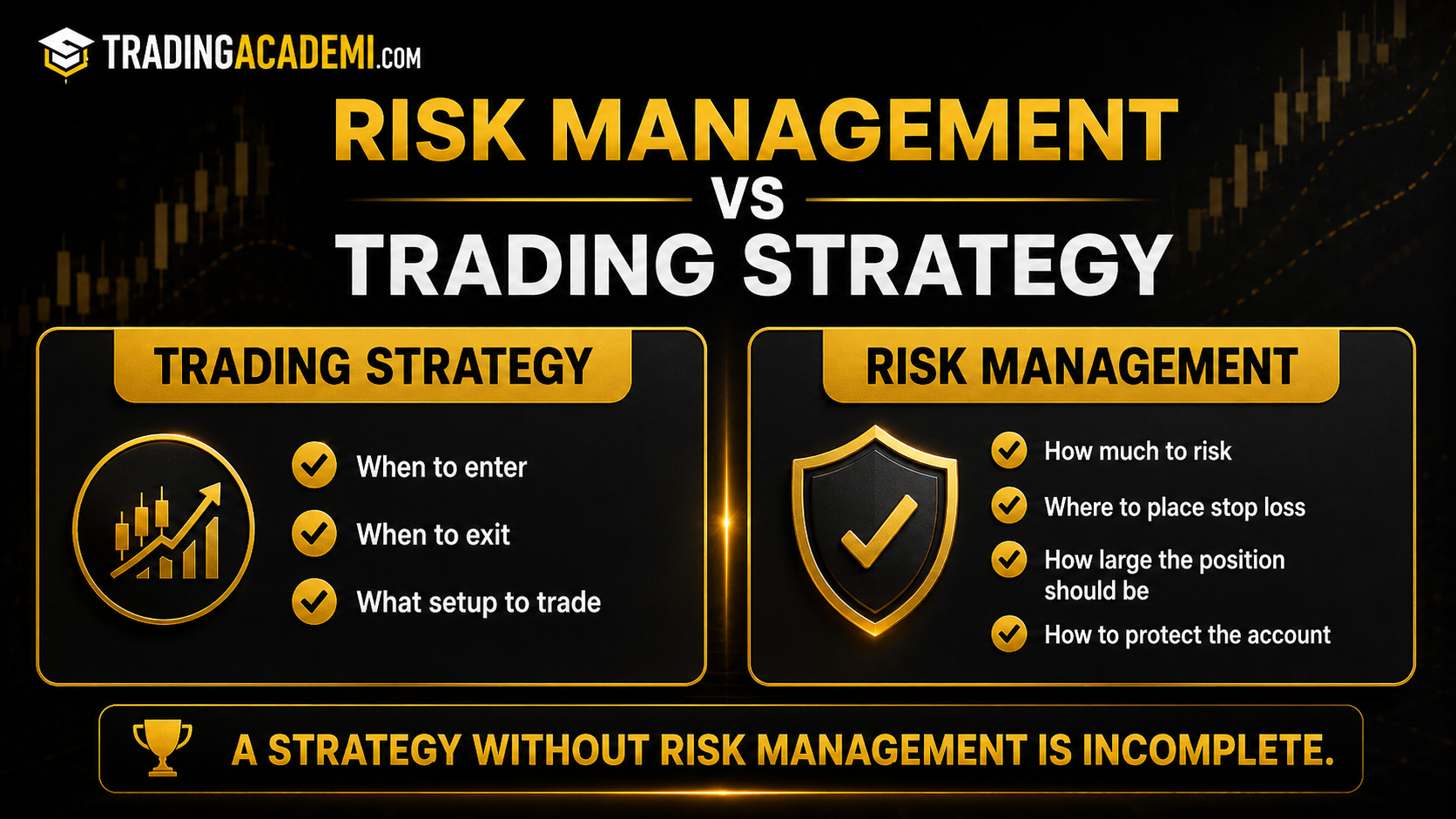
A trading strategy tells you when to enter and exit the market. Risk management tells you how much to risk and how to protect your account.
For example, a strategy may say to buy when price breaks above resistance, sell when price rejects a key level, enter when a moving average crossover appears, or trade only during a specific session.
Risk management answers different questions. How much money should I risk on this trade? Where is my invalidation point? What position size should I use? Is the potential reward worth the risk? Should I stop trading after two losses?
A strategy without risk management is incomplete. Even if your entries are good, bad risk control can still make you lose money. Trading results are not only about being right. They are also about how much you lose when you are wrong and how much you gain when you are right.
The Main Goal of Risk Management
The main goal of risk management is not to avoid every loss. Losses are part of trading.
The real goal is to keep losses small enough so that you can continue trading, learning, and improving. A trader should think about risk management like a safety system. It does not stop the market from moving against you, but it helps prevent the damage from becoming too large.
Good risk management can help you stay in the game longer, avoid emotional decisions, protect your capital, reduce account blowups, trade with more confidence, handle losing streaks, and measure performance more clearly.
A trader who survives long enough can improve. A trader who loses everything too quickly does not get that chance.
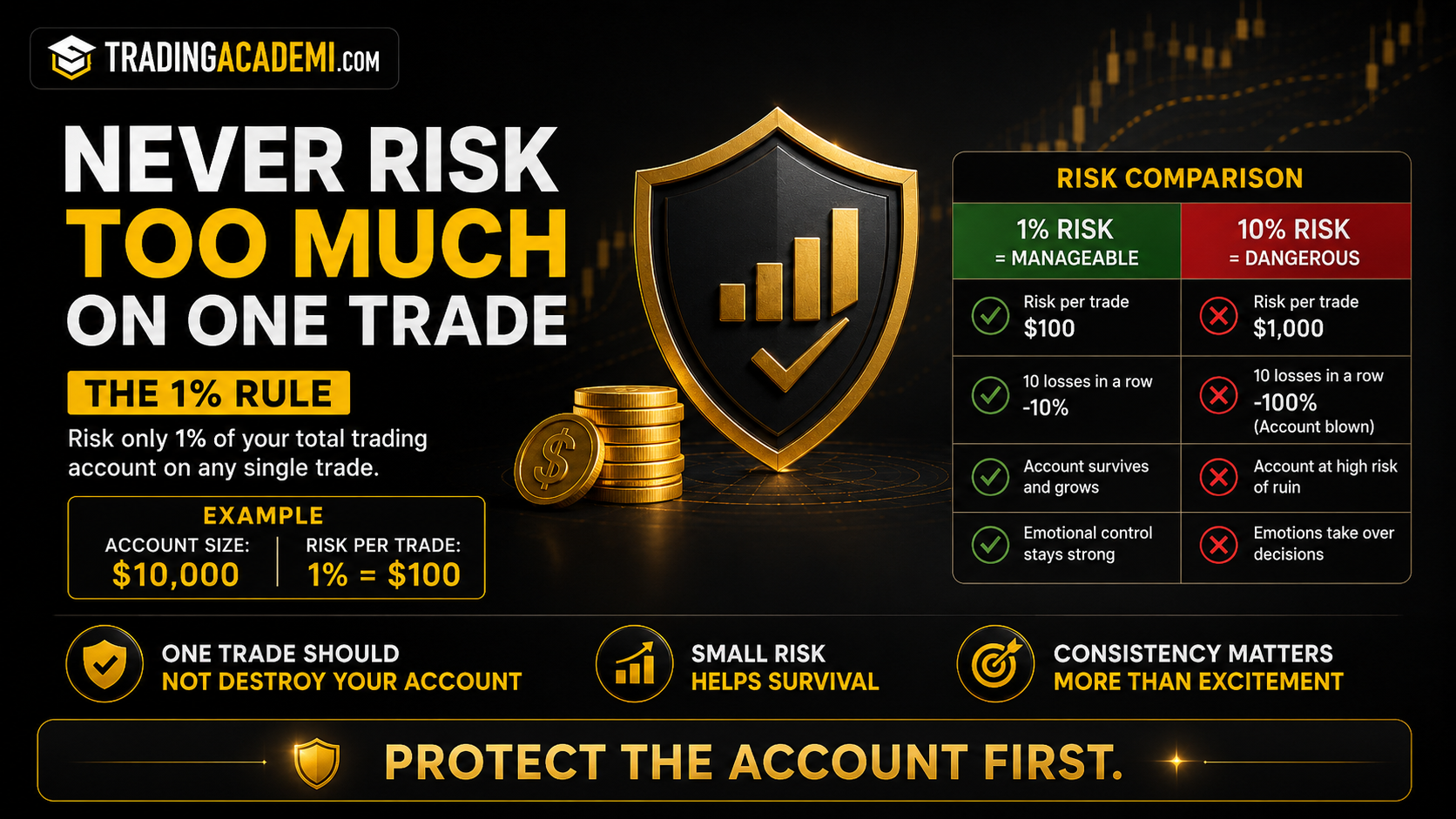
The First Rule: Never Risk Too Much on One Trade
One of the most important risk management rules is to avoid risking too much on a single trade.
Many beginners risk 10%, 20%, or even more of their account because they feel confident about a setup. This is dangerous because even a strong setup can fail.
If you risk too much, a few losses can seriously damage your account. After that, you may feel pressure to win everything back quickly, which often leads to worse decisions.
Many traders use a small percentage risk model. For example, they may risk 1% or 2% of their account on one trade. This does not mean every trader must use the exact same number. The right percentage depends on experience, strategy, market, account size, and risk tolerance.
But the principle is simple: one trade should never be able to destroy your account.
Example: Risking 1% Per Trade
Imagine a trader has a $10,000 account. If they risk 1% per trade, the maximum planned loss on one trade is $100.
If they lose five trades in a row, they lose around $500, or about 5% of the account. That is not good, but the account is still alive. The trader can review mistakes, adjust, and continue.
Now imagine the same trader risks 10% per trade. One loss equals $1,000, and five losses can damage the account badly. The trader may panic, overtrade, or abandon the plan.
This is why small risk per trade matters. The goal is not to avoid losing trades. The goal is to make sure losing trades stay manageable.
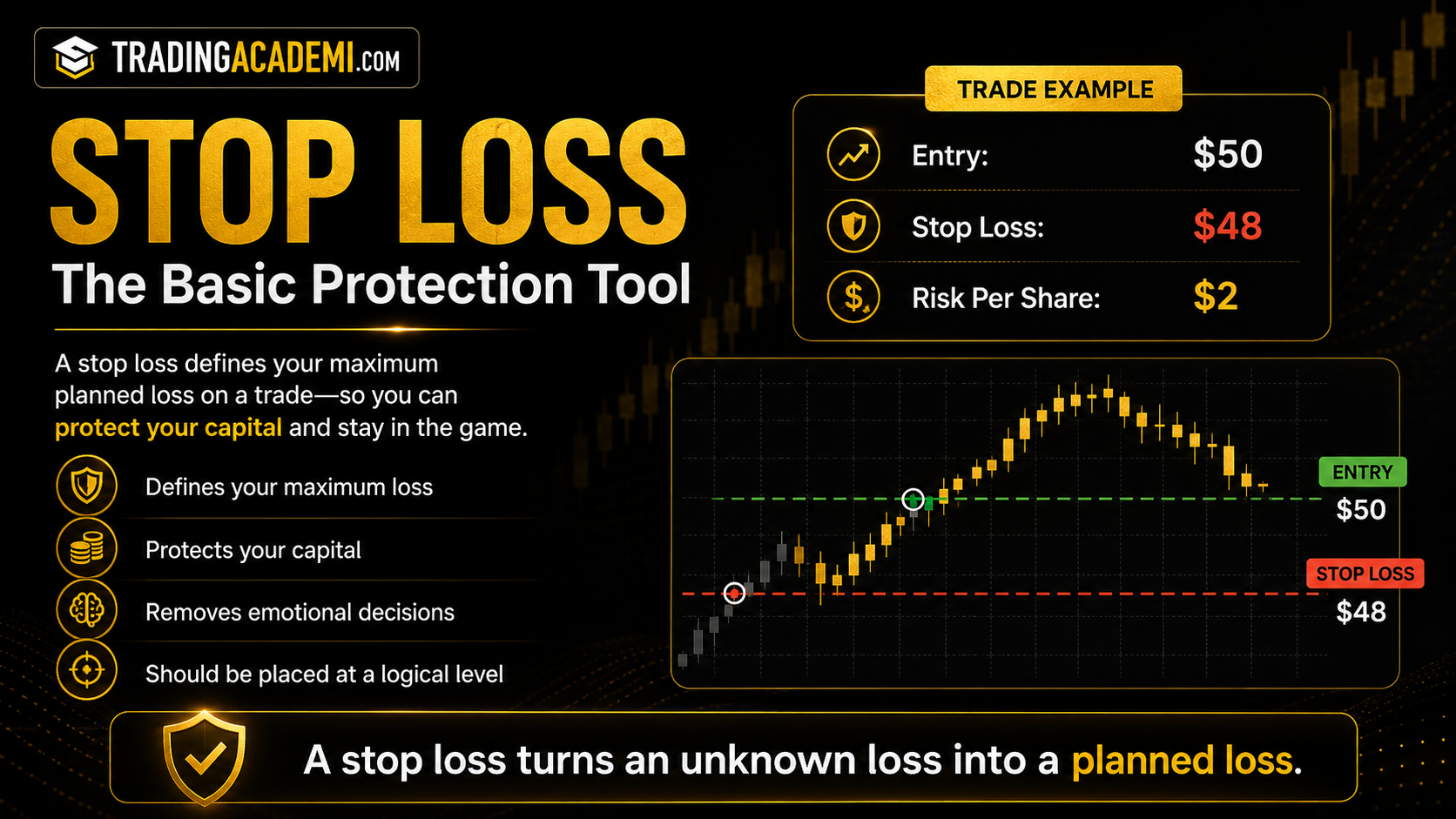
Stop Loss: The Basic Protection Tool
A stop loss is an order or planned exit that closes a trade if the market moves against you. It helps define your maximum planned loss before the trade becomes emotional.
For example, if you buy a stock at $50 and place a stop loss at $48, you are deciding that your trade idea is wrong if price drops to $48.
A stop loss is useful because it removes some emotional pressure from the decision. You already know where you will exit if the trade fails.
However, a stop loss should not be placed randomly. A good stop loss is usually based on market structure, volatility, support and resistance, or the point where your trade idea becomes invalid.
A common beginner mistake is placing the stop loss too close because they want to risk less money. But if the stop is too close, normal market movement may stop them out too early. Another mistake is moving the stop loss farther away when the trade goes against them. This usually turns a planned small loss into a larger emotional loss.
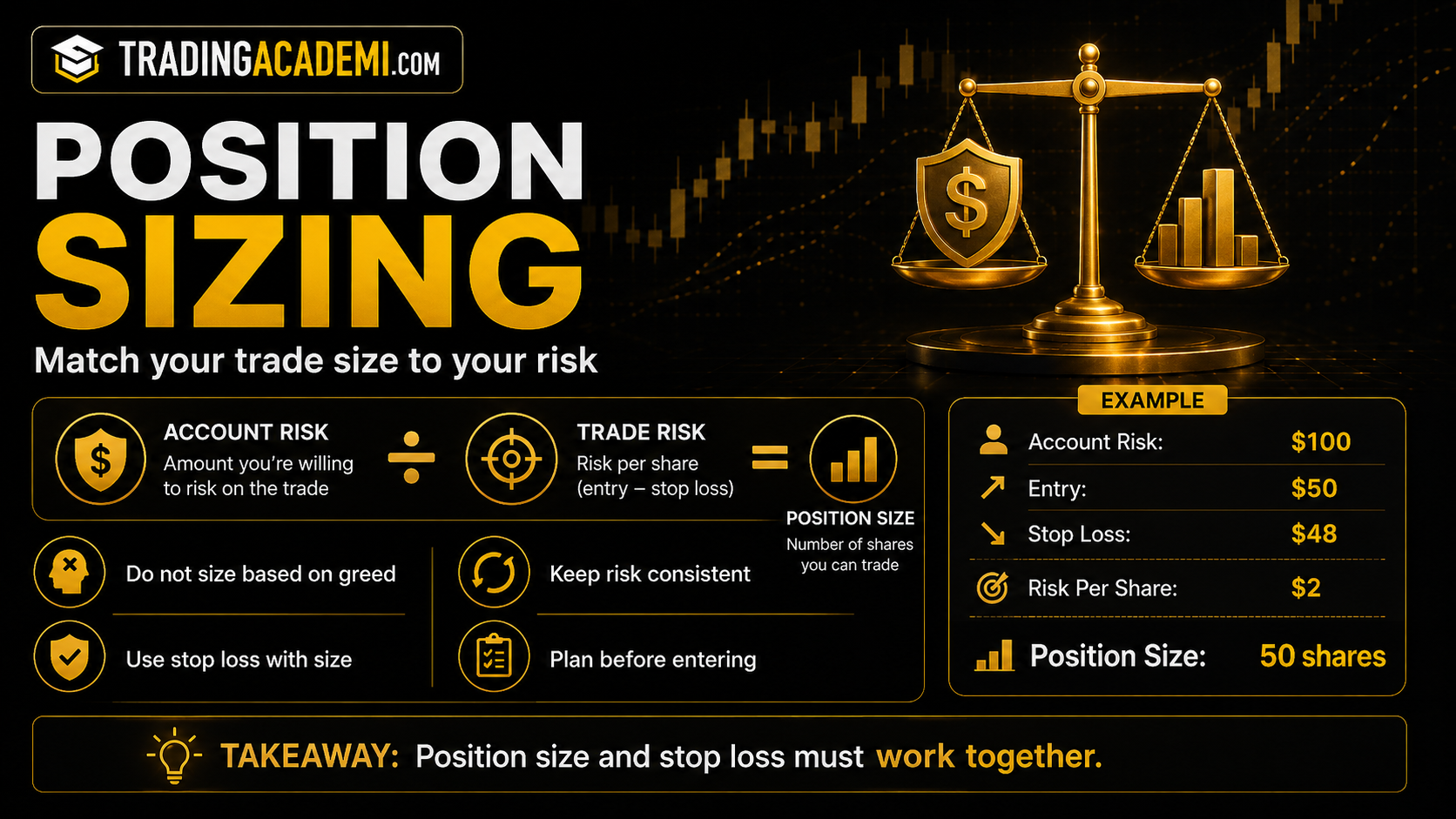
Position Sizing: Matching Trade Size to Risk
Position sizing means deciding how many shares, contracts, lots, or units to trade.
This is where many beginners make mistakes. They choose trade size based on how much money they want to make, not how much they can afford to lose.
A better approach is to calculate position size based on risk. The basic idea is:
Account risk ÷ trade risk = position sizeFor example, imagine you are willing to risk $100 on a trade. You buy a stock at $50 and your stop loss is at $48. Your risk per share is $2.
So:
$100 ÷ $2 = 50 sharesThis means you can buy 50 shares while keeping your planned risk around $100. If you buy 200 shares instead, your risk becomes much higher than planned.
This is why position sizing is essential. Your stop loss and position size must work together..
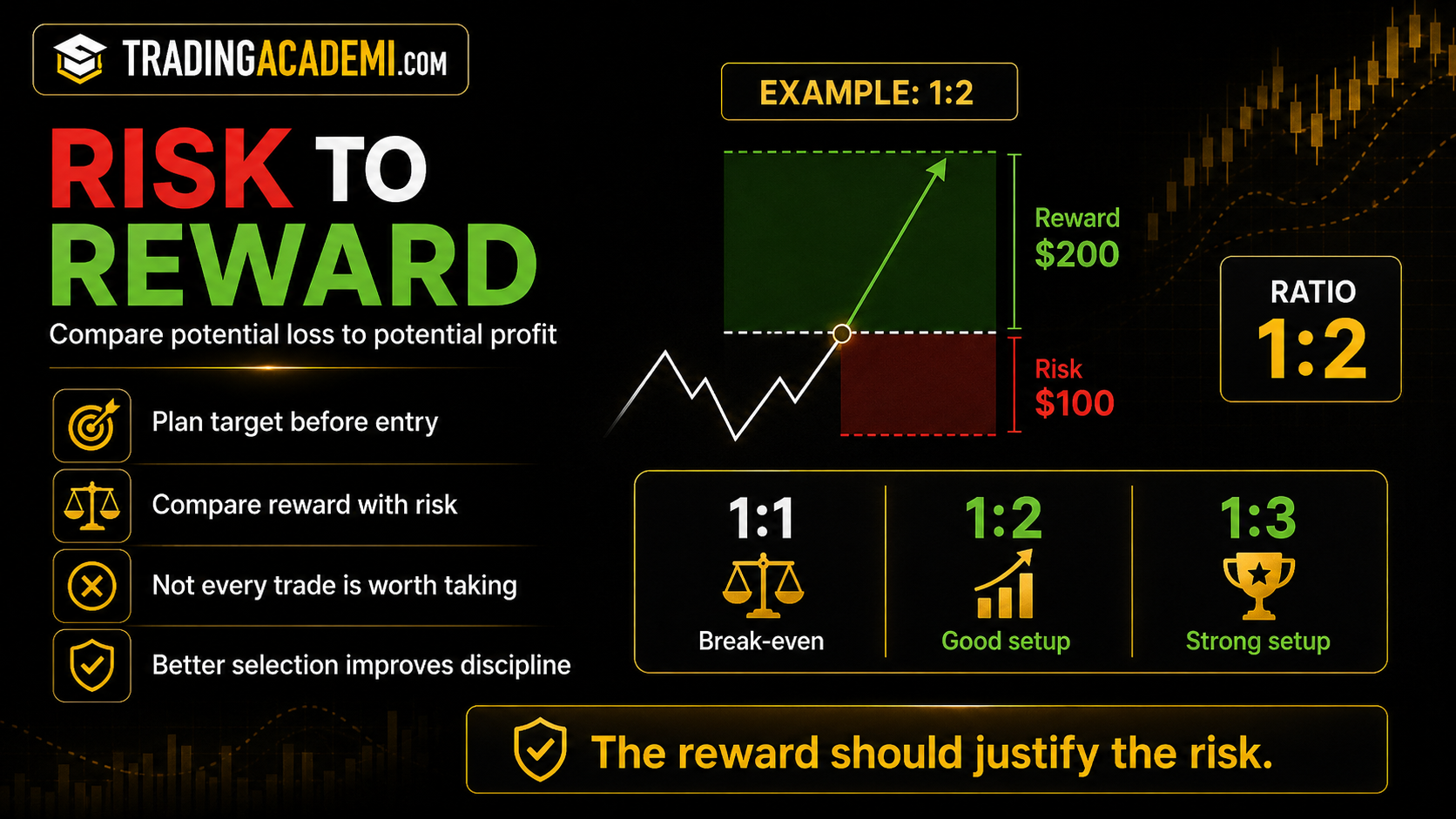
Risk-to-Reward Ratio
Risk-to-reward ratio compares how much you are risking with how much you are trying to make.
For example, if you risk $100 to try to make $200, your risk-to-reward ratio is 1:2. If you risk $100 to try to make $300, the ratio is 1:3.
Risk-to-reward does not guarantee success, but it helps you think clearly before entering a trade. A trade may look attractive, but if you are risking $100 to make only $50, the reward may not justify the risk unless your win rate is very high.
Beginners should learn to ask whether the potential reward is worth the risk, where the stop loss is, where the target is, and whether the trade makes sense before entering.
A trade should not be entered only because price is moving. It should have a clear plan.
Daily Loss Limits
A daily loss limit is the maximum amount you allow yourself to lose in one trading day.
This is important because emotions become stronger after losses. After losing one or two trades, many traders start feeling frustrated. They may try to win the money back quickly, and this is called revenge trading.
A daily loss limit helps prevent this. For example, a trader may decide to stop trading if they lose 3% of their account in one day, lose three trades in a row, or break their rules once.
These rules protect the trader from emotional damage. Sometimes the best trade is no trade. Sometimes the smartest decision is to stop for the day.
Losing Streaks Are Normal
Every trader experiences losing streaks. Even a profitable strategy can have several losses in a row because trading is based on probabilities, not certainty.
A beginner may think that three or four losses mean the strategy is broken. But that is not always true. The important question is whether the losses followed the plan.
If you followed your rules and controlled risk, the losing streak may simply be part of the system. If you broke rules, increased size emotionally, moved stops, or chased trades, then the problem is not just the market. The problem is execution.
Risk management helps you survive losing streaks without losing discipline.
Risk Management and Trading Psychology
Risk management is closely connected to trading psychology. When risk is too high, emotions become stronger.
A trader who risks too much may feel fear, stress, greed, and panic. They may close winning trades too early because they are afraid of losing profit, or hold losing trades too long because they do not want to accept the loss.
When risk is controlled, trading becomes calmer. You may still feel emotions, but they are easier to manage because the possible loss is planned and acceptable.
This is one reason risk management improves discipline. A trader who knows their maximum loss can focus on execution instead of fear.
The Difference Between Risk and Uncertainty
Risk and uncertainty are related, but they are not exactly the same.
Risk is something you can measure or plan for. For example, you can decide to risk $100 on a trade, place a stop loss, and calculate your position size.
Uncertainty is what you cannot fully predict. The market may react unexpectedly to news, price may gap, liquidity may disappear, or a sudden event may move the market quickly.
Risk management does not remove uncertainty. It helps you prepare for it.
A trader should always remember that the market can do anything. That is why protection matters.
Common Risk Management Tools
There are several tools traders use to manage risk. A stop loss helps exit a trade when the market moves against the plan. Position sizing helps control how much money is at risk. Risk-to-reward ratio helps compare potential loss with potential profit.
A daily loss limit helps stop trading after a difficult session, while maximum open risk helps avoid having too many risky positions open at the same time. A trading journal helps review mistakes and improve decision-making, and a trading plan helps define rules before entering the market.
All of these tools work together. Risk management is not one single action. It is a complete process.
Common Mistakes Beginners Make
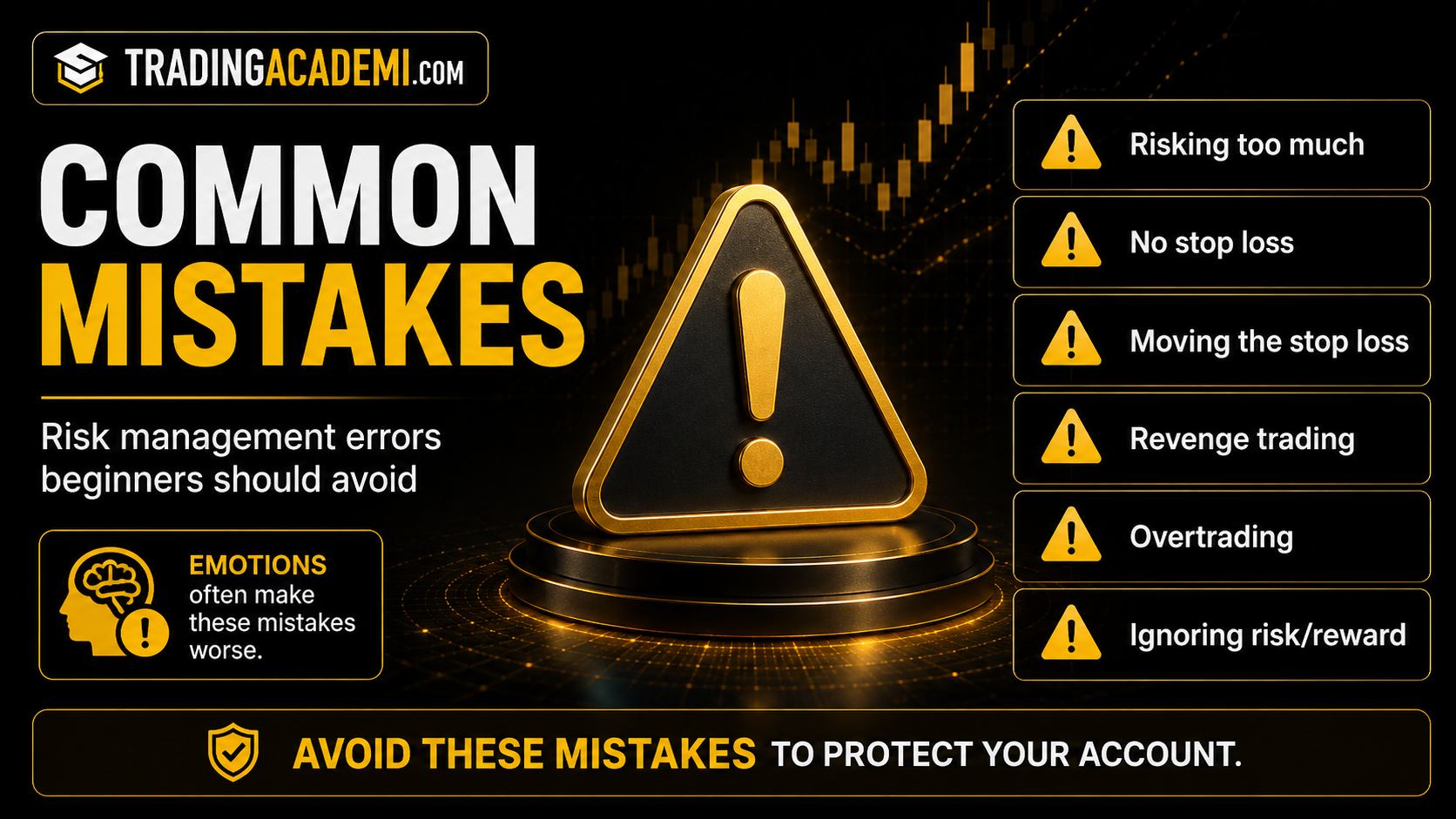
One common mistake is trading without a stop loss. Some beginners believe they will manually close the trade if it goes wrong, but when the market moves fast, emotions can take over.
Another mistake is risking too much because the setup “looks perfect.” No setup is perfect. Some beginners also move their stop loss farther away because they do not want to take a loss, which often makes the loss larger.
Increasing position size after a loss is another dangerous mistake. This is revenge trading, and it can damage the account quickly.
Many beginners also ignore correlation. For example, they may open several trades that are all exposed to the same market direction. If the market moves against them, all trades can lose together.
Another mistake is focusing only on win rate. A high win rate does not matter if losses are much bigger than wins.
Risk management requires honesty. You must accept that you can be wrong and plan for that possibility.
Risk Management Rules for Beginners
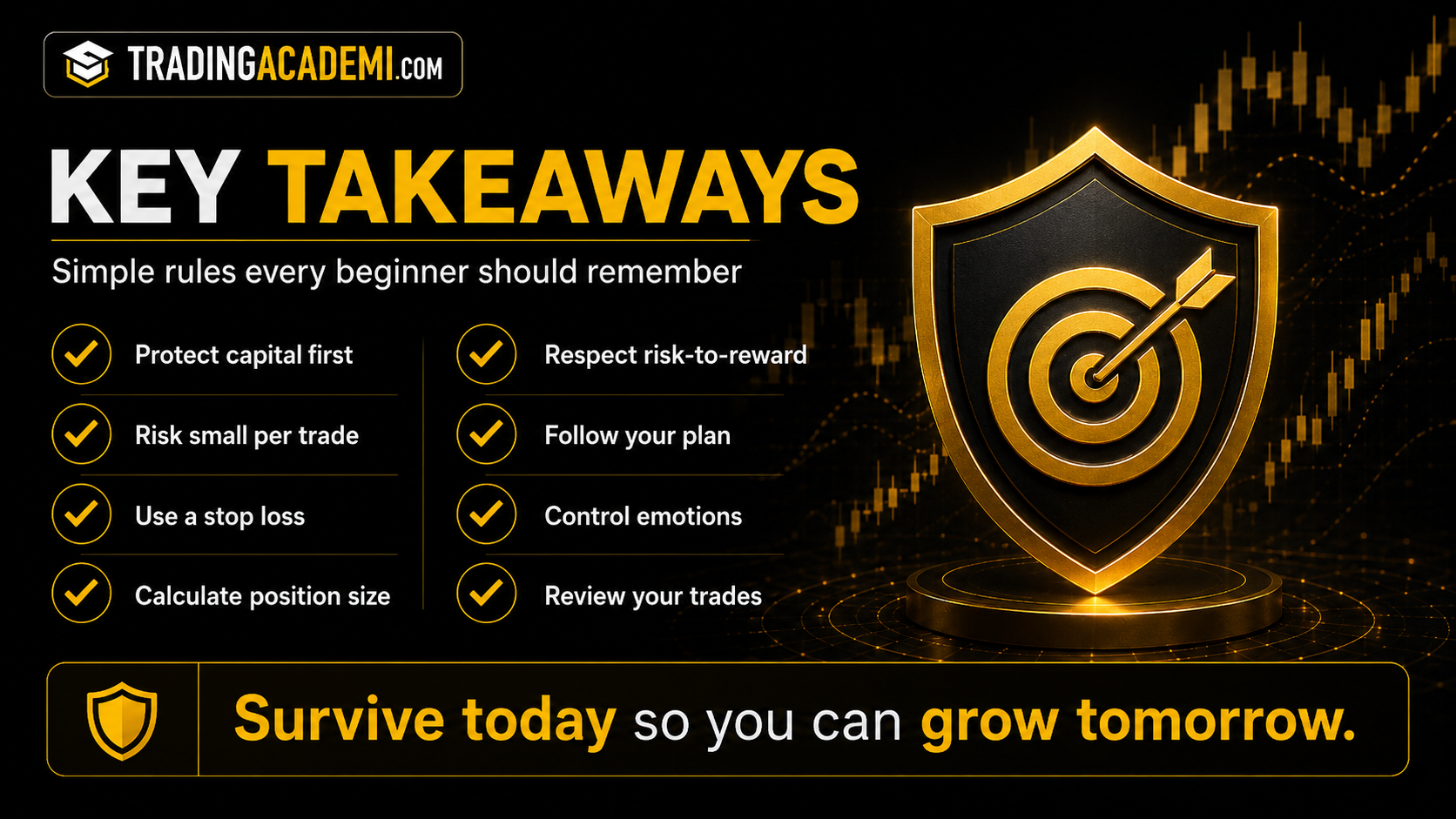
Beginners should risk only a small percentage of their account per trade and always know where the stop loss is before entering. Position size should be calculated before placing the trade, and stop losses should not be moved emotionally.
It is also important to avoid having too many positions open at the same time, set a daily loss limit, avoid revenge trading after a loss, review trades in a journal, and be careful with high leverage.
These rules may sound simple, but following them consistently is difficult. That is why discipline matters.
The main idea is simple: protect capital before chasing profit.
Is Risk Management Only for Day Traders?
Risk management is not only for day traders. It is important for all traders and investors.
Day traders need risk management because they enter and exit frequently. Swing traders need it because positions stay open overnight and can be affected by gaps. Forex traders need it because leverage can magnify losses. Futures traders need it because contract size can be large.
Options traders need risk management because time decay, volatility, and expiration can affect positions. Crypto traders need it because the market is highly volatile and open 24/7. Long-term investors also need risk management through diversification, position sizing, asset allocation, and avoiding overexposure.
Risk management applies to every market.
Risk Management Example
Imagine a beginner trader wants to buy a stock at $100. They believe the price can rise to $110, but they decide their trade idea is wrong if price drops below $97.
The risk per share is:
$100 entry - $97 stop loss = $3 risk per shareThe trader has a $5,000 account and wants to risk 1%.
1% of $5,000 = $50Now they calculate position size:
$50 ÷ $3 = 16 shares approximatelyIf the trade loses, the planned loss is around $48. If the target is $110, the potential gain is:
$10 per share × 16 shares = $160This gives a potential reward that is larger than the risk. It does not mean the trade will win, but it means the trader entered with a clear plan.
That is risk management.
Final Thoughts
Risk management is the foundation of trading. It is not the most exciting part, but it is one of the most important.
Many beginners spend too much time looking for perfect entries and not enough time learning how to protect their capital. The truth is simple: you can have losing trades and still become a better trader if your losses are controlled. But if your losses are too large, you may not survive long enough to improve.
A good trader respects risk before thinking about profit.
Risk management helps you trade with structure, discipline, and patience. It reminds you that every trade is only one trade in a long journey.
Before entering any market, ask yourself how much you are risking, where your stop loss is, what your position size is, whether the reward is worth the risk, and what you will do if you are wrong.
If you can answer these questions clearly, you are already thinking like a more disciplined trader.
Educational Disclaimer
This article is for educational purposes only and should not be considered financial advice. Trading and investing involve risk, including the possible loss of capital. Always do your own research or consult a qualified financial professional before making financial decisions.