 By Anzo Trader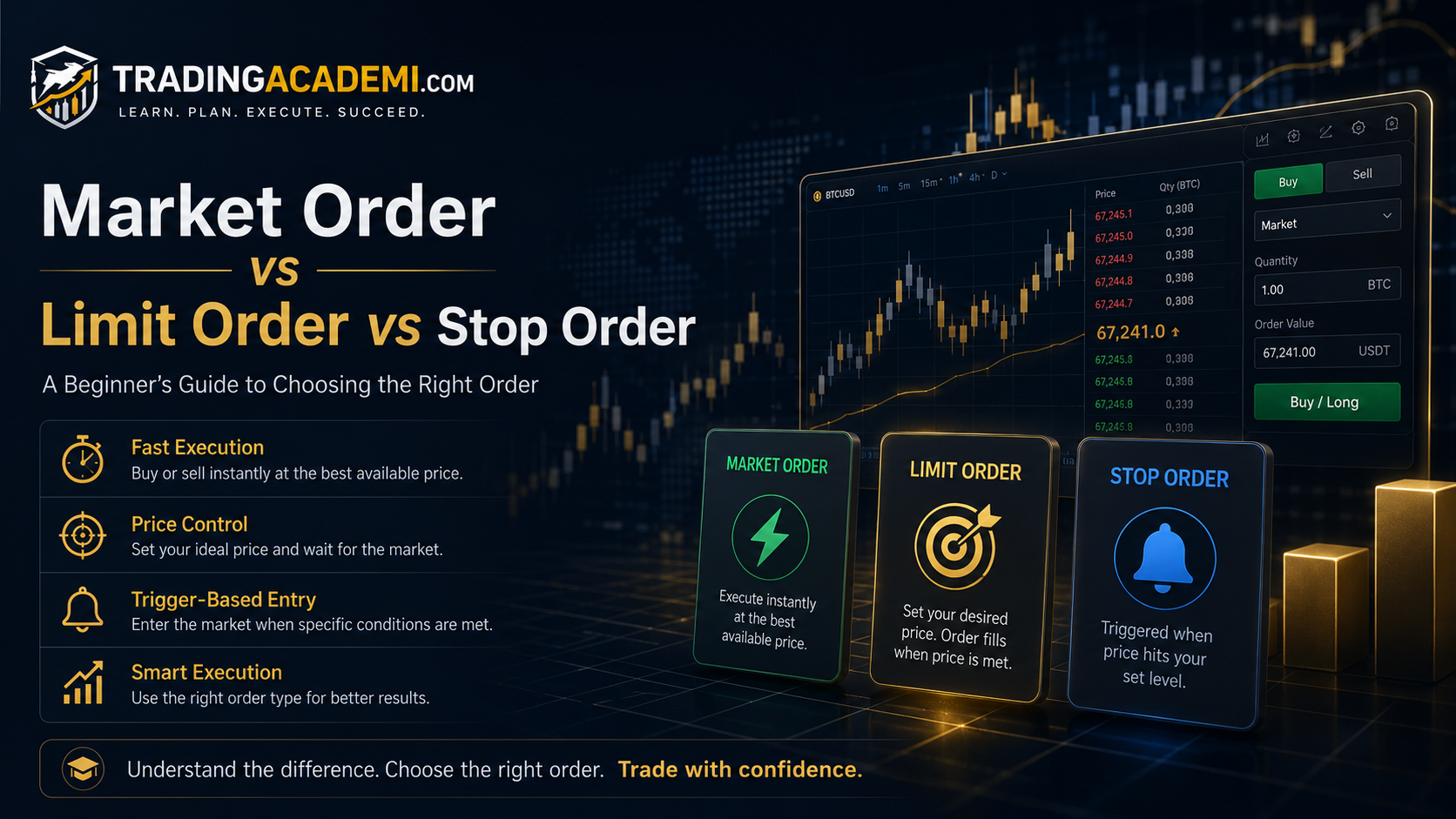
When you start learning trading, one of the first things you need to understand is how orders work. A trading order is simply an instruction you send to your broker or trading platform. It tells the platform what you want to do in the market, whether that means buying a stock, selling a crypto asset, entering a futures trade, or closing a forex position.
But not every order works the same way. Some orders are made for speed, some are made for price control, and others are designed to activate only when price reaches a specific level. This is why beginners should understand the three basic order types: market orders, limit orders, and stop orders.
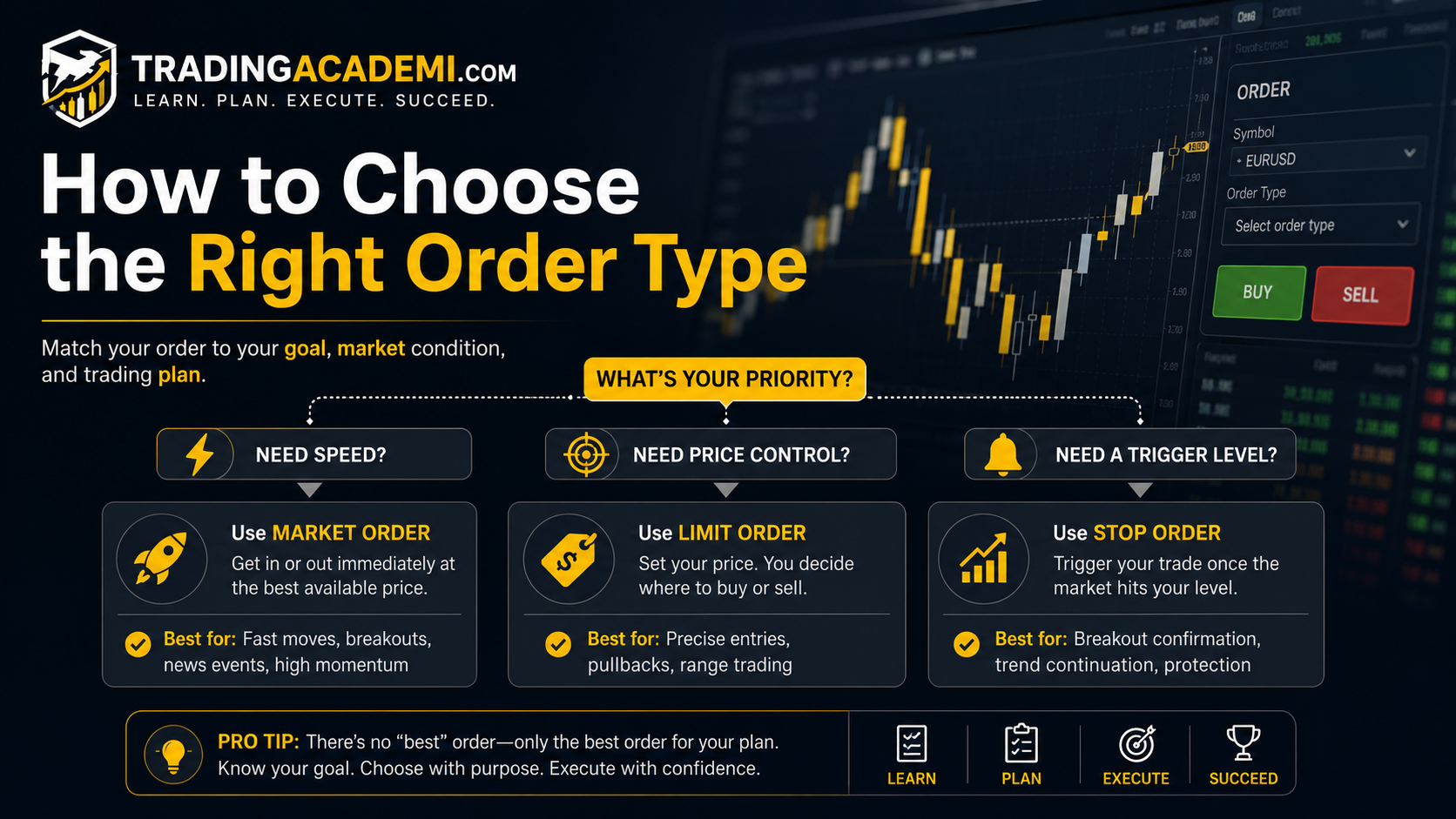
In simple terms, a market order is used when you want to enter or exit immediately. A limit order is used when you want a specific price or better. A stop order is used when you want the order to activate only after price reaches a trigger level.
These order types are used in many financial markets, including stocks, forex, futures, commodities, and crypto. Understanding them is important because your order choice can affect your entry price, exit price, timing, slippage, risk, and overall execution quality. Order types are part of the foundation of key trading terminology and connect directly with what trading is, long vs short trading, and risk management.
What Are Trading Orders?
A trading order is a command that tells your broker what action to take. It may tell the platform to buy now, sell now, buy only at a certain price, sell only at a certain price, enter after price breaks a level, exit if price moves against you, or take profit when price reaches a target.
Orders help traders control how they enter and exit the market. Without orders, trading would be difficult to manage because every decision would depend only on reacting in the moment. A trader can use orders to enter a long trade, enter a short trade, exit a profitable position, limit a loss, protect capital, plan around support and resistance, and reduce emotional decisions.
For example, if you want to buy an asset immediately, you may use a market order. If you want to buy only when price comes down to a better level, you may use a limit order. If you want to enter only after price breaks above resistance, you may use a stop order. Each order type has a different purpose, and choosing the right one depends on the trade plan.
What Is a Market Order?
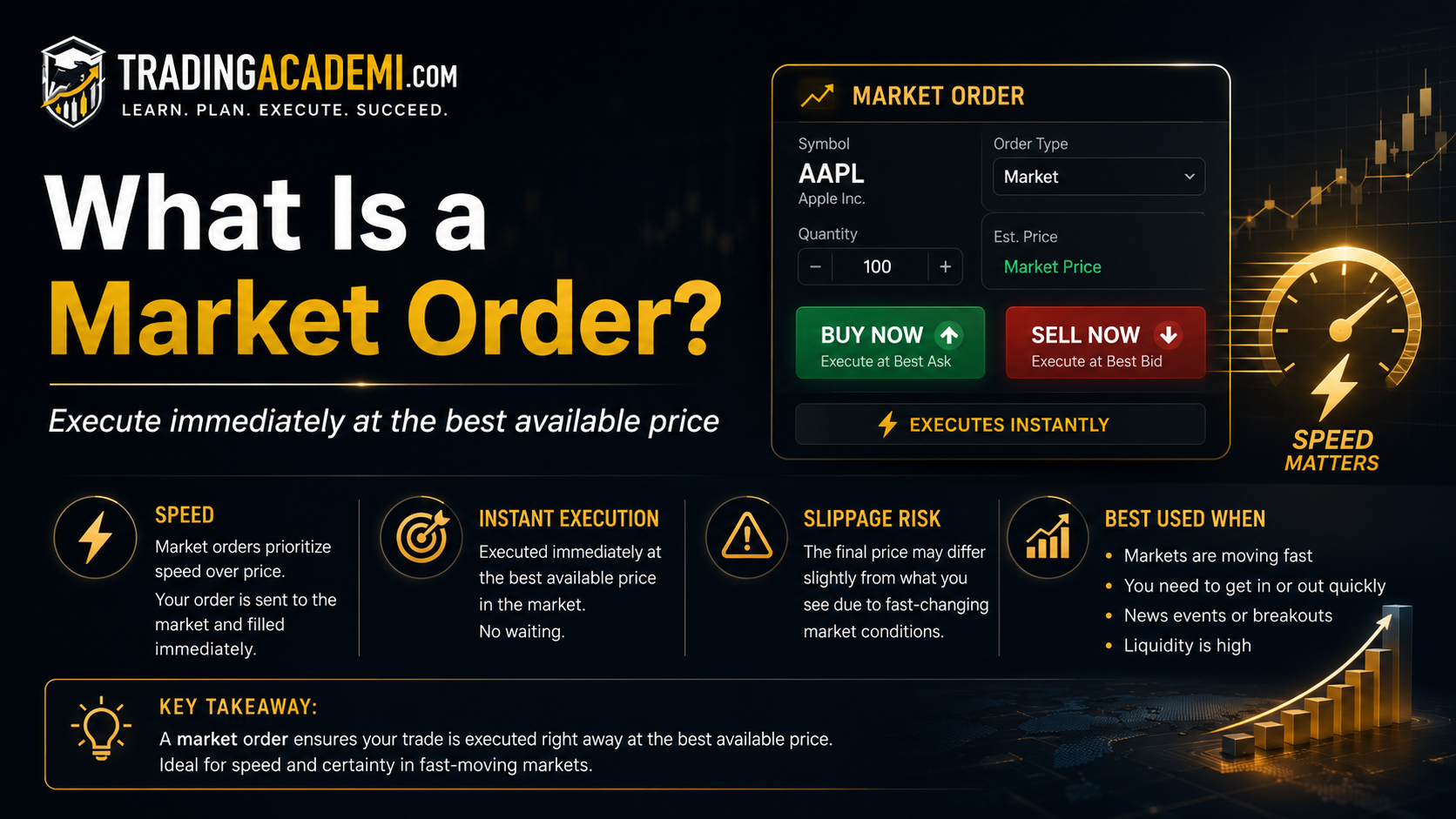
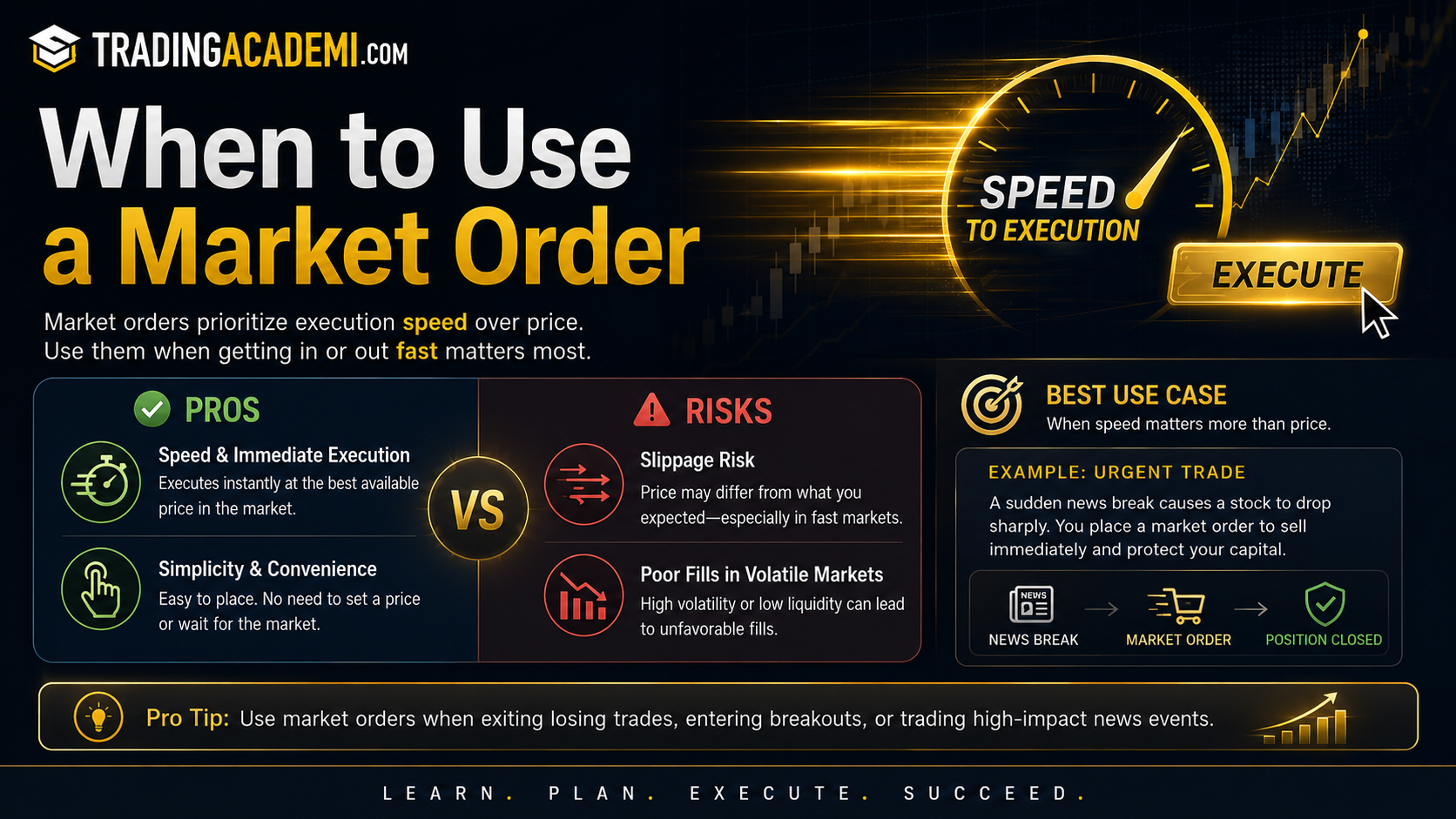
A market order is an instruction to buy or sell immediately at the best available current price. When you place a market order, speed is the priority. You are basically telling your broker: “Enter or exit this trade now.”
In simple words, market order = execute immediately.
For example, imagine a stock is trading around $100. If you place a buy market order, your broker will try to buy immediately at the best available price. You may get filled near $100, but the final price can be slightly higher or lower depending on liquidity, spread, and market movement.
This is why market orders are simple but not perfect. They are useful when you need fast execution, but they do not guarantee the exact price you see on the screen.
When Traders Use Market Orders
When Traders Use Market Orders
Traders usually use market orders when execution speed matters more than perfect price control. A market order may be useful when a trader needs to enter quickly, exit quickly, close a risky position, or avoid missing immediate execution in a liquid market.
For example, if a trader is in a losing trade and wants to reduce risk quickly, a market order can help close the position fast. It may also be useful when the market is highly liquid and the spread is small, because in those conditions the fill price is often close to the expected price.
However, beginners should be careful. Fast execution does not always mean good execution. In fast-moving markets, during news events, or in low-liquidity conditions, a market order can fill at a worse price than expected.
Market Order Example
Imagine a trader wants to buy a stock immediately. The quote shows:
Bid: $99.98
Ask: $100.00
If the trader places a buy market order, the order may fill around the ask price because that is where sellers are available. If the market is liquid, the fill may be close to $100.
But if price is moving quickly, the trader may get filled at $100.05, $100.10, or higher. That difference is called slippage.
This is why market orders connect directly with concepts like bid, ask, spread, volume, and liquidity.
Advantages and Disadvantages of Market Orders
Market orders are popular because they are simple and fast. They are easy for beginners to understand and can be useful when a trader cares more about being filled than controlling the exact price.
The main advantage is quick execution. A market order can help you enter or exit immediately, especially in liquid markets. It can also be helpful when closing a risky position quickly.
The disadvantage is that you do not control the exact fill price. Slippage can happen, poor fills can occur in fast markets, wide spreads can increase cost, and low liquidity can create unexpected execution prices. A beginner may see one price on the screen and assume that is the exact price they will get, but the actual fill depends on available buyers and sellers at that moment.
So, market orders are useful, but they should be used carefully.
What Is a Limit Order?
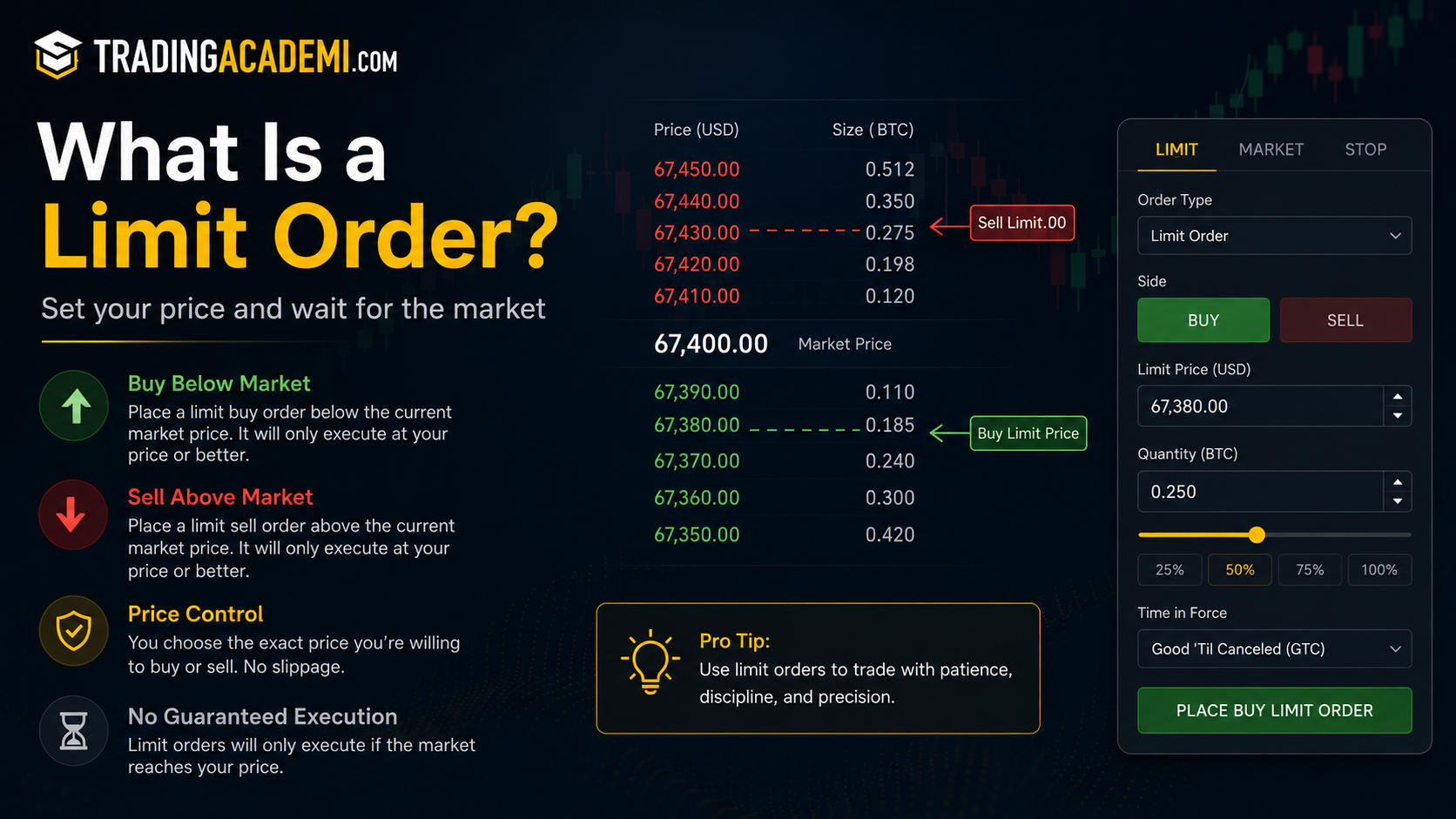
A limit order is an instruction to buy or sell only at a specific price or better. With a limit order, price control is the priority. You are telling your broker: “Only execute this trade if I can get my chosen price or better.”
In simple words, limit order = wait for your price.
For a buy limit order, you choose the maximum price you are willing to pay. For a sell limit order, you choose the minimum price you are willing to accept. A limit order gives you more control over execution price, but it does not guarantee that the order will be filled.
This makes limit orders useful for traders who prefer patience, planning, and price control instead of immediate execution.
Buy Limit Order Example
Imagine a stock is trading at $100, but a trader only wants to buy if price drops to $95. The trader can place a buy limit order at $95.
If price falls to $95 and there are sellers available, the order may be filled. If price never reaches $95, the order will not be filled.
This can help the trader avoid chasing price. A buy limit order is often used near support zones, pullback areas, or value zones. This connects with support and resistance explained.
Sell Limit Order Example
Imagine a trader owns a stock bought at $100 and wants to take profit at $110. The trader can place a sell limit order at $110.
If price rises to $110 and buyers are available, the order may be filled. If price never reaches $110, the order will not be filled.
A sell limit order is often used near a target level, resistance zone, or planned exit area. It helps traders plan exits instead of reacting emotionally when price moves.
When Traders Use Limit Orders
Traders use limit orders when they want price control. A limit order may be useful when a trader wants to buy at a better price, sell at a planned target, avoid chasing moves, trade around support and resistance, or create a planned entry instead of entering emotionally.
For example, a trader may want to buy only if price pulls back to support. Instead of watching the screen all day and reacting quickly, the trader can place a buy limit order at the planned level.
Limit orders encourage planning, but they also have a trade-off. The market may never reach the chosen price, so the trader may miss the trade.
Advantages and Disadvantages of Limit Orders
The main advantage of a limit order is control. You control the maximum buy price or the minimum sell price. This can help you plan entries and exits, reduce emotional decision-making, avoid chasing price, and target specific support or resistance levels.
The disadvantage is that the order may not be filled. Price may touch the area but not fill your order, or it may come close and then move away. This means you can miss trades.
Beginners sometimes think a limit order is automatically safer, but that is not true. A limit order controls the entry price, but it does not decide whether the trade idea is good. A trader still needs confirmation, risk management, and a full plan.
What Is a Stop Order?
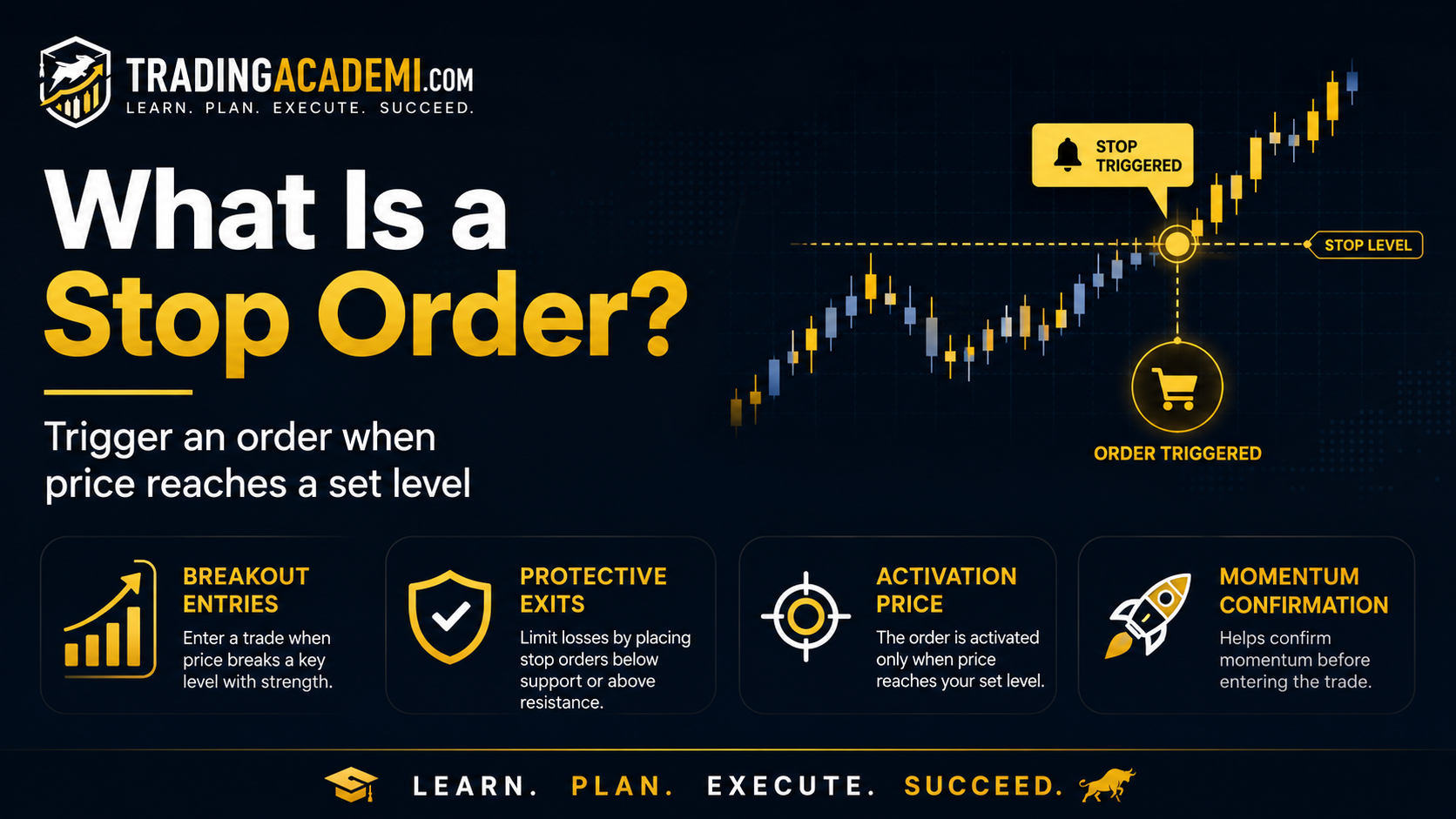
A stop order is an order that becomes active only after price reaches a specific trigger level. It is often used to enter or exit after price moves through an important level.
In simple words, stop order = activate after price reaches a trigger.
Beginners usually hear about two common types: buy stop orders and sell stop orders. A buy stop order is placed above the current market price, while a sell stop order is placed below the current market price.
Stop orders are often used for breakouts, breakdowns, and protective exits.
Buy Stop Order Example
Imagine a stock is trading at $100 and resistance is near $105. A trader may not want to buy unless price breaks above resistance.
The trader can place a buy stop order at $105. If price reaches $105, the buy stop order activates and attempts to enter the trade.
This can help traders enter only after price shows strength. A buy stop order is often used for bullish breakout setups, which connects with breakout, pullback, trend, and range explained.
Sell Stop Order Example
Imagine a stock is trading at $100 and support is near $95. A trader may believe that if price breaks below $95, weakness could continue.
The trader can place a sell stop order at $95. If price reaches $95, the sell stop order activates and attempts to sell.
This can be used to enter a short trade after a breakdown, or to exit a long trade if support fails.
Stop Orders for Risk Protection
Stop orders are also commonly used for risk management. A stop loss order is a type of stop order used to exit a trade if price moves against the trader.
For example, a long trader may place a stop loss below support. A short trader may place a stop loss above resistance. The goal is to define risk before entering the trade.
A stop order does not guarantee a perfect exit price, especially in fast markets, but it helps create structure and discipline. This is why stop orders are closely connected with Stop Loss Orders Explained.
When Traders Use Stop Orders
Traders may use stop orders when they want price confirmation. A stop order may be useful when a trader wants to buy only after a breakout, sell only after a breakdown, exit if price hits a stop loss, or wait for price to prove strength or weakness first.
Stop orders are often used by traders who want momentum confirmation before entering. Instead of guessing early, they let price reach a trigger level first.
This can help avoid entering too early, but it does not remove risk. False breakouts, slippage, and poor placement can still create losses.
Advantages and Disadvantages of Stop Orders
Stop orders can help traders react to important levels. They are useful for breakout entries, breakdown entries, stop loss protection, emotional exit control, and momentum-based setups.
The downside is that stop orders can be triggered by false breakouts. Price may touch the trigger level, activate the order, and then reverse. Slippage can also happen after activation, especially if the stop order becomes a market order depending on the platform.
This is why beginners should not place stop orders randomly. A stop order works best when the trigger level is connected to a clear trading plan.
Market Order vs Limit Order vs Stop Order: Simple Difference
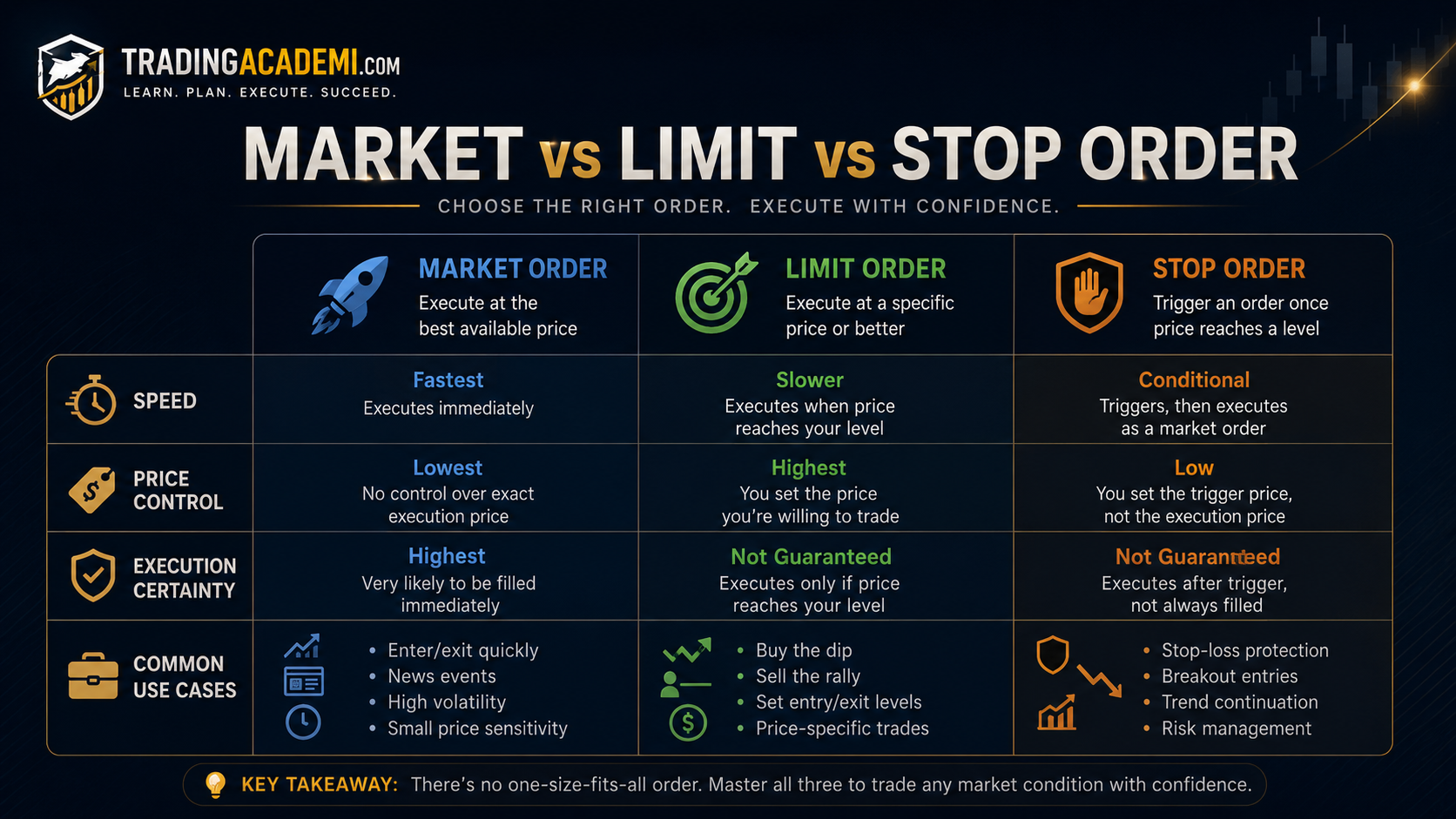
The easiest way to understand these order types is to connect each one with its main purpose.
| Order Type | Main Purpose | Execution Style | Main Risk |
|---|---|---|---|
| Market Order | Enter or exit immediately | Executes now at best available price | Slippage or poor fill |
| Limit Order | Control entry or exit price | Executes only at chosen price or better | May not get filled |
| Stop Order | Trigger after price reaches a level | Activates when trigger price is reached | False breakouts or slippage |
In short, market order = speed, limit order = price control, and stop order = trigger confirmation.
Each order type can be useful. The best choice depends on the trader’s goal, the market condition, and the trade setup.
How Order Types Work in Long Trades
In a long trade, the trader expects price to rise. Different order types can be used depending on the entry plan.
A trader may use a market order to buy immediately, a buy limit order to buy near support, or a buy stop order to buy above resistance. After entering, the trader may use a sell limit order to take profit at a target or a sell stop order to exit if price falls below support.
For example, a trader who wants to go long in an uptrend may use a buy limit order near support if they want a pullback entry. Another trader may use a buy stop order above resistance if they want a breakout entry.
Both approaches can work, but they require different plans. This connects with long vs short in trading.
How Order Types Work in Short Trades
In a short trade, the trader expects price to fall. Order types can also be used for short setups.
A trader may use a market order to sell immediately, a sell limit order to short near resistance, or a sell stop order to short below support. After entering, they may use a buy limit order to take profit lower or a buy stop order to exit if price rises above resistance.
For example, a trader who wants to go short in a downtrend may use a sell limit order near resistance if they want a rejection entry. Another trader may use a sell stop order below support if they want a breakdown entry.
After entering, the stop loss may go above resistance, while the profit target may be near the next support level.
Market Orders and Slippage
Slippage is one of the biggest risks with market orders. It happens when your order is filled at a different price than expected.
For example, you click buy when price looks like $100, but your fill happens at $100.15. This may happen because the market moved quickly, liquidity was low, the spread was wide, news caused volatility, or your order size was large compared with available liquidity.
Slippage can happen in stocks, forex, futures, crypto, and other markets. It is especially important during news events or volatile sessions.
This is why understanding liquidity and spreads matters before using market orders.
Limit Orders and Missed Trades
Limit orders help control price, but they can also cause missed trades.
For example, if price is at $100 and you place a buy limit at $95, price may only drop to $96 and then move higher. Your order does not fill. You avoided chasing, but you also missed the trade.
This is not always bad. A missed trade is better than an emotional trade. But traders should understand the trade-off: limit orders give price control, but not execution certainty.
Stop Orders and False Breakouts
Stop orders are useful for confirmation, but they can be triggered by false breakouts.
A false breakout happens when price breaks above or below a level, triggers traders into the market, and then quickly reverses. For example, price may break above resistance and trigger buy stop orders, then fall back below resistance. Traders who entered the breakout may become trapped.
This is why some traders wait for a candle close beyond the level, a retest, volume confirmation, or additional signals before entering.
Confirmation matters.
Common Beginner Mistakes With Order Types
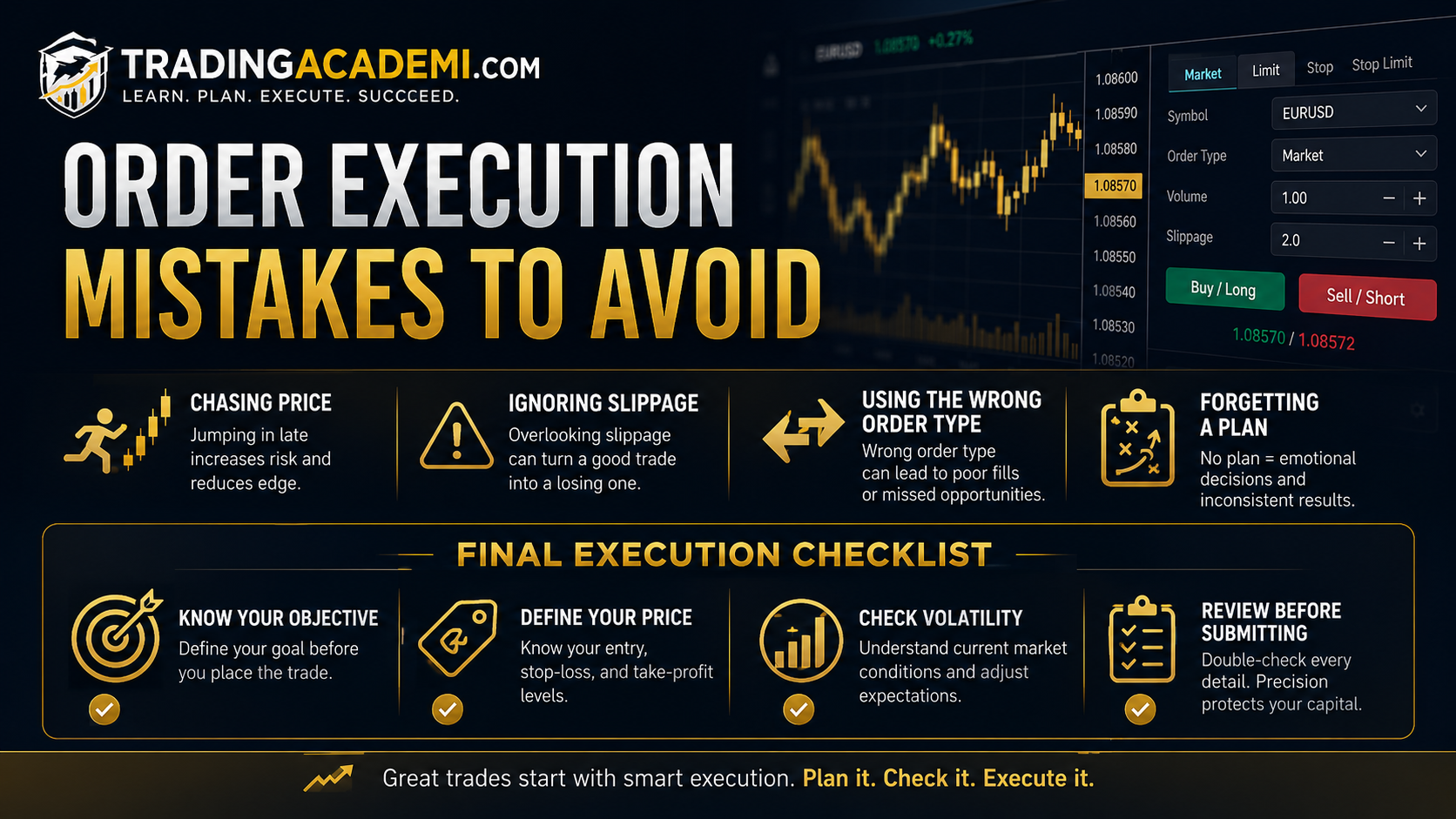
Many beginners use order types without understanding the market condition. Using market orders in illiquid markets can create poor fills when volume is low or spreads are wide. Thinking limit orders guarantee good trades is another mistake, because a limit order controls price but does not guarantee profit.
Some beginners place stop orders too close to price, which can lead to getting triggered by normal market noise. Breakout traders may also enter without confirmation, which increases the risk of false breakouts.
Another common mistake is ignoring slippage, especially during fast-moving markets. Traders should also understand their platform settings because different brokers may handle stop, stop-limit, and market orders differently.
The order type does not fix a weak trade idea. A trader still needs structure, risk management, and discipline.
Beginner Checklist Before Placing an Order
Before placing any order, ask yourself what the trade direction is and whether you are going long or short. Then decide whether you need speed, price control, or trigger confirmation.
You should also check if price is near support or resistance, whether the setup is a breakout, pullback, or range trade, and where your stop loss and target will be. Before entering, think about slippage, spread, liquidity, and whether the trade is part of your plan.
A good order should support a good trade idea. It should not be a random click.
Which Order Type Is Best for Beginners?
There is no single best order type for every situation. A market order may be useful when execution speed matters. A limit order may be useful when price control matters. A stop order may be useful when confirmation matters.
The best order type depends on market conditions, trade setup, risk tolerance, entry strategy, liquidity, volatility, timeframe, and the trader’s plan.
Beginners should not focus only on which order type is “best.” They should focus on why they are using that order. A good order supports a good plan.
Final Thoughts
Market orders, limit orders, and stop orders are basic but important trading tools.
A market order is used when you want immediate execution. A limit order is used when you want price control. A stop order is used when you want price to reach a trigger level first.
Each order type has strengths and weaknesses. The goal is not to memorize definitions only. The goal is to understand when and why each order type might be used.
A strong trader does not click randomly. A strong trader plans the trade, chooses the right order type, manages risk, and follows the process.
Educational Disclaimer
This article is for educational purposes only and should not be considered financial advice. Trading and investing involve risk, including the possible loss of capital. Order types do not guarantee profit or perfect execution. Market conditions, liquidity, volatility, and platform rules can affect trade execution. Always do your own research and consider consulting a qualified financial professional before making financial decisions.