 By Anzo Trader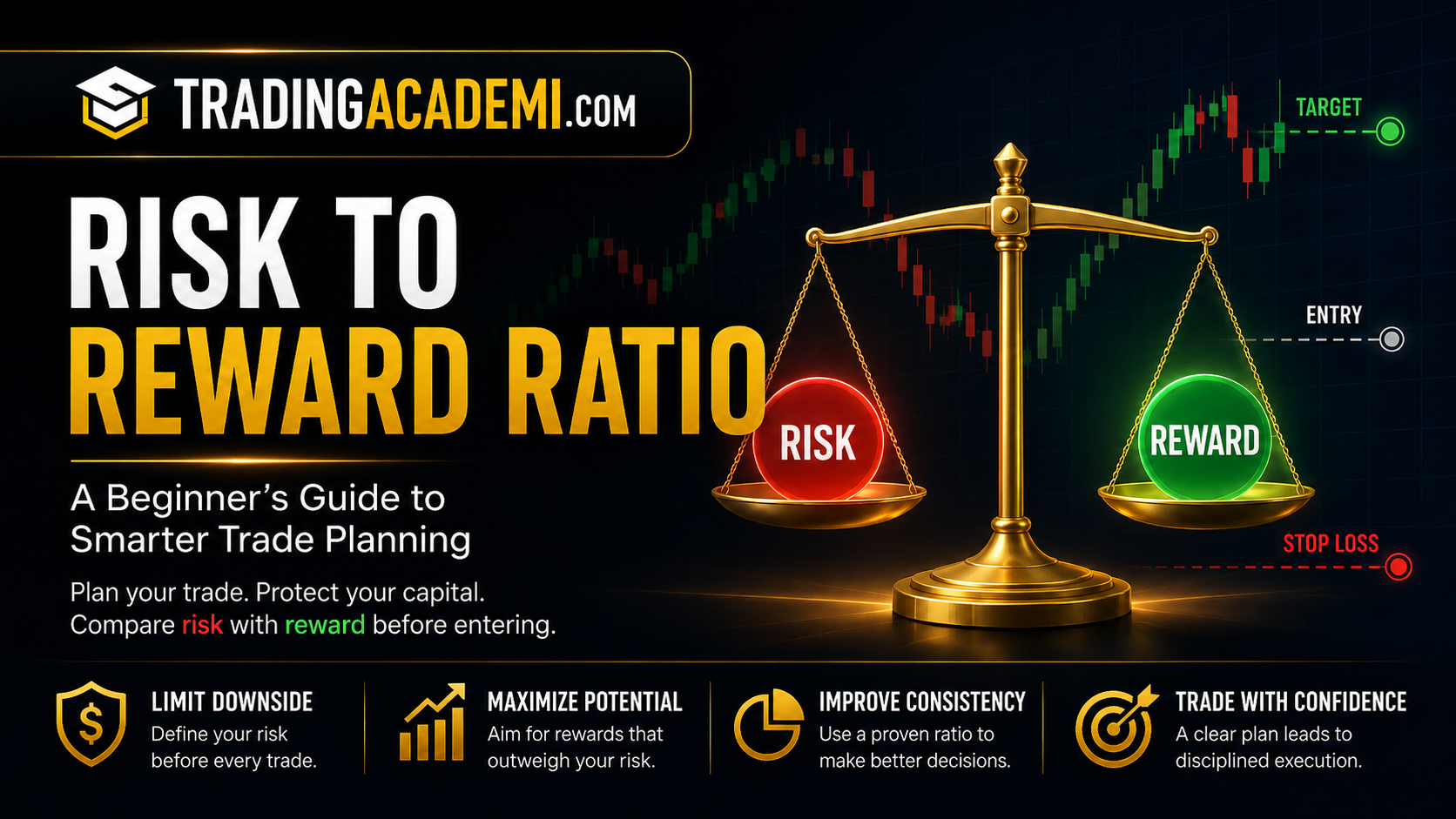
Risk-to-reward ratio is one of the most important concepts in trading because it helps you compare what you are risking with what you are trying to gain. Many beginner traders enter a trade simply because the chart looks good or because price is moving fast. They may think about the potential profit, but they often forget to measure the potential loss first.
That can be dangerous.
Before entering any trade, a trader should know three important levels: the entry, the stop loss, and the target. Once these levels are clear, the trader can calculate the risk-to-reward ratio and decide whether the trade is worth taking.
A trade can have a good-looking setup, but if the potential reward is small compared to the risk, it may not be a strong opportunity. On the other hand, a trade that offers a larger potential reward compared to the planned loss may give the trader a better structure.
Risk-to-reward does not guarantee profit. It does not mean every 1:2 or 1:3 trade will win. However, it helps traders build discipline, avoid random trades, and think clearly before risking money.
Before reading this guide, it can help to understand the basics of risk management in trading, position sizing, and stop loss orders, because these concepts work together.
What Is Risk-to-Reward Ratio?
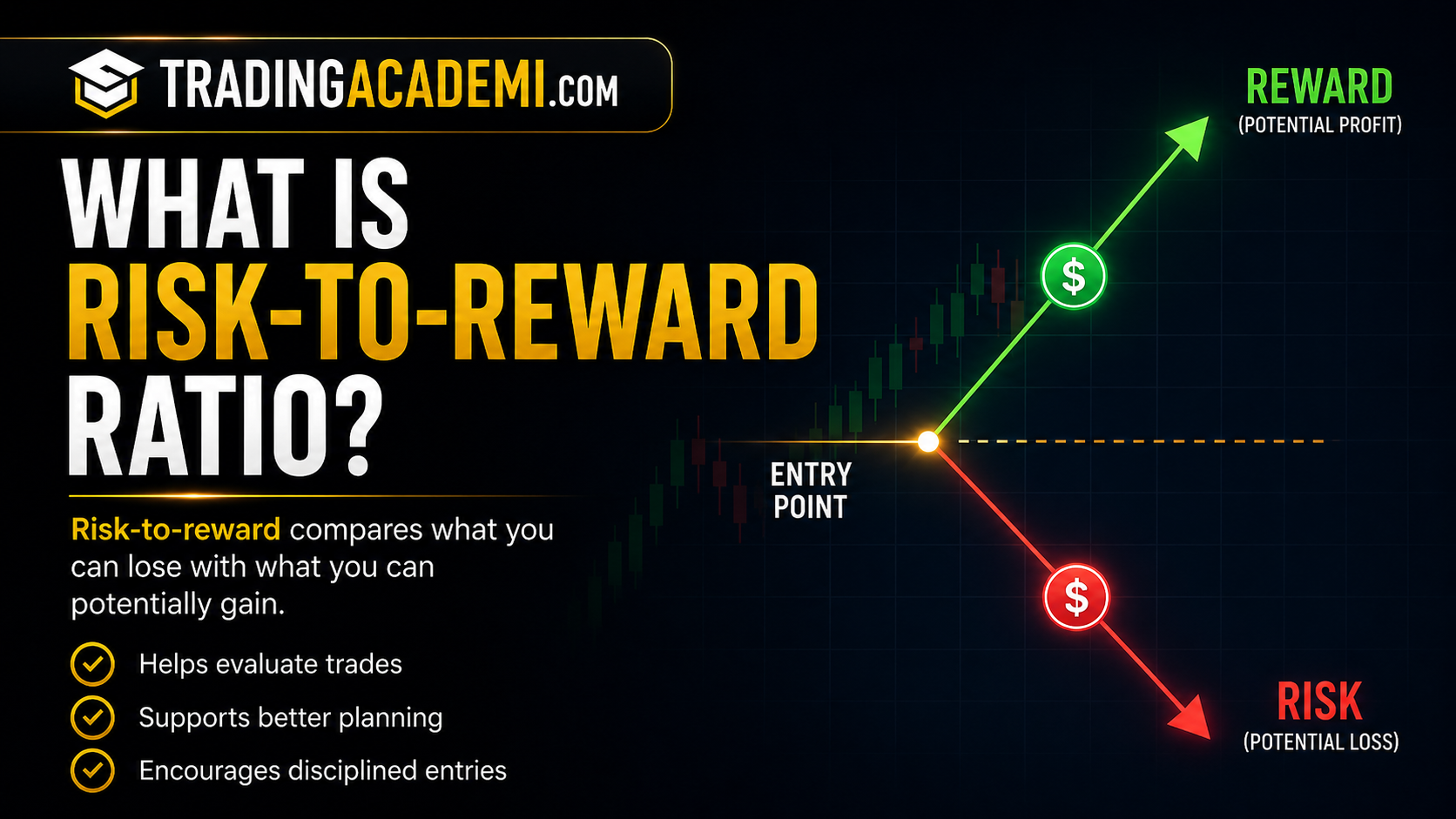
Risk-to-reward ratio compares the amount of money you are willing to lose on a trade with the amount of money you are trying to make.
In simple terms, risk is how much you can lose if the trade fails, while reward is how much you can gain if the trade reaches your target.
For example, if you risk $100 to try to make $200, your risk-to-reward ratio is 1:2. This means that for every $1 you risk, you are aiming to make $2.
If you risk $100 to try to make $300, the ratio is 1:3. If you risk $100 to try to make $100, the ratio is 1:1.
The ratio helps you understand whether the potential reward justifies the planned risk.
Why Risk-to-Reward Ratio Matters
Risk-to-reward matters because traders do not need to win every trade to be profitable.
Many beginners believe they need a very high win rate to succeed. They think that if they win more trades than they lose, they will automatically make money. But that is not always true.
A trader can win many small trades and still lose money if the losing trades are much larger than the winning trades.
For example, imagine a trader wins 8 trades and makes $50 on each one. That creates $400 in profit. But if the same trader loses 2 trades and loses $300 on each one, that creates $600 in losses. Even with an 80% win rate, the trader is still down $200.
This happens because the average loss is too large compared to the average win.
Risk-to-reward helps traders avoid this problem by planning trades where the potential reward is worth the risk. This is why it is an important part of trading risk management.
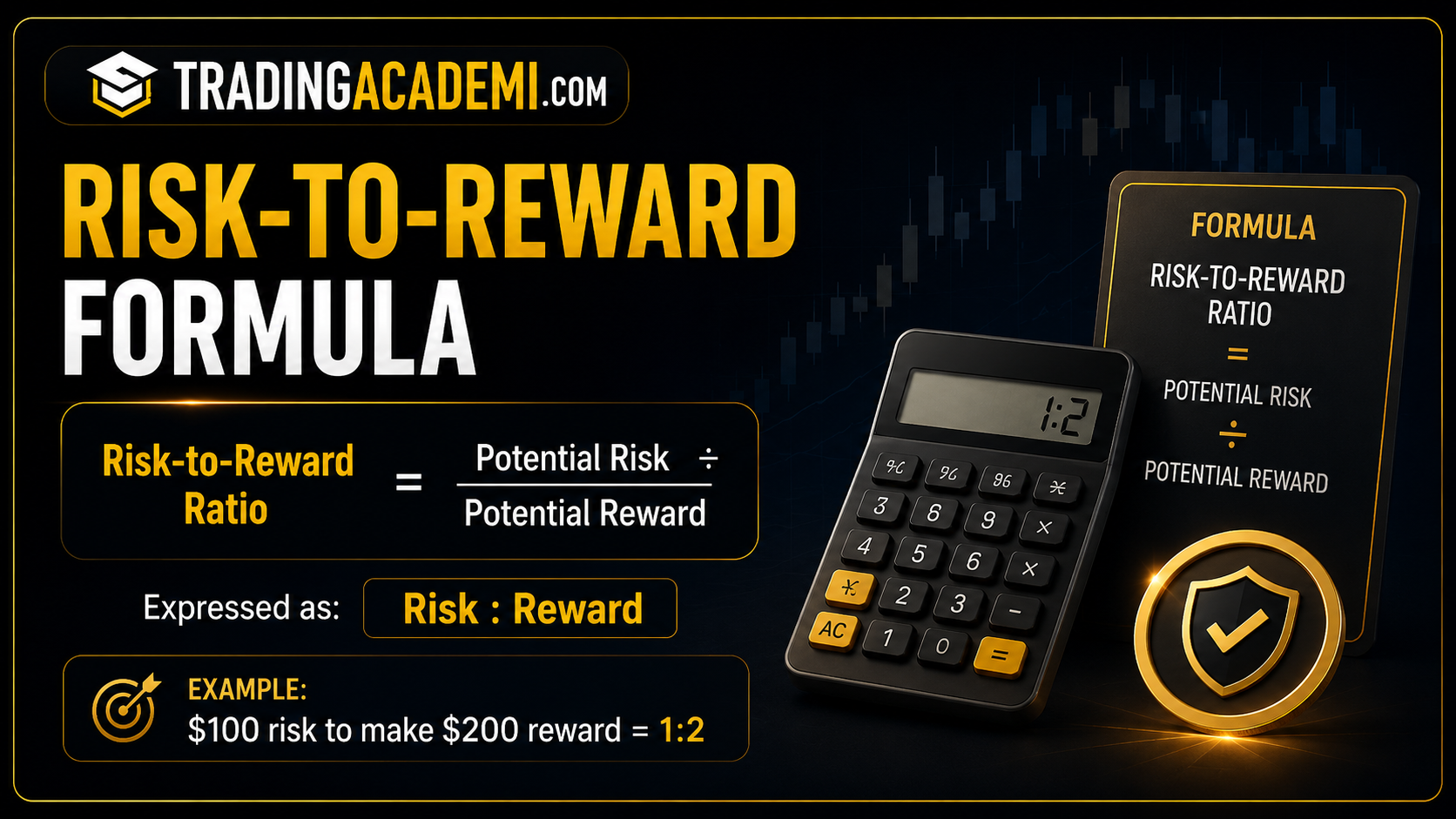
Risk-to-Reward Formula
The basic formula is simple:
Risk-to-Reward Ratio = Potential Risk ÷ Potential RewardHowever, traders usually express it as:
Risk : RewardFor example, if your risk is $100 and your reward is $200, the ratio is:
$100 : $200 = 1 : 2If your risk is $50 and your reward is $150, the ratio is:
$50 : $150 = 1 : 3If your risk is $100 and your reward is $100, the ratio is:
$100 : $100 = 1 : 1The smaller the risk compared to the reward, the better the ratio looks. But a better ratio does not automatically mean a better trade. The target still needs to be realistic.
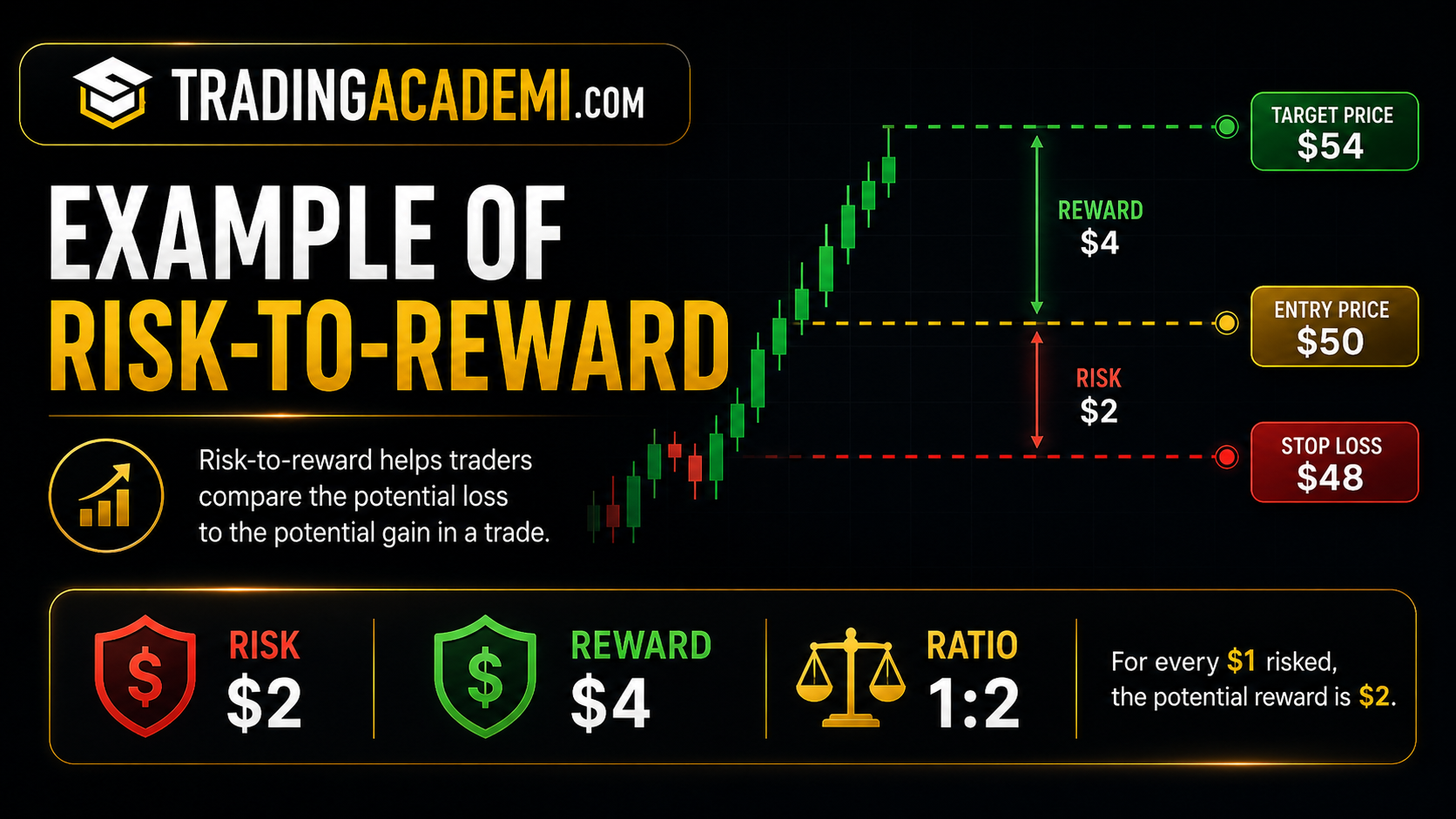
Example of Risk-to-Reward Ratio
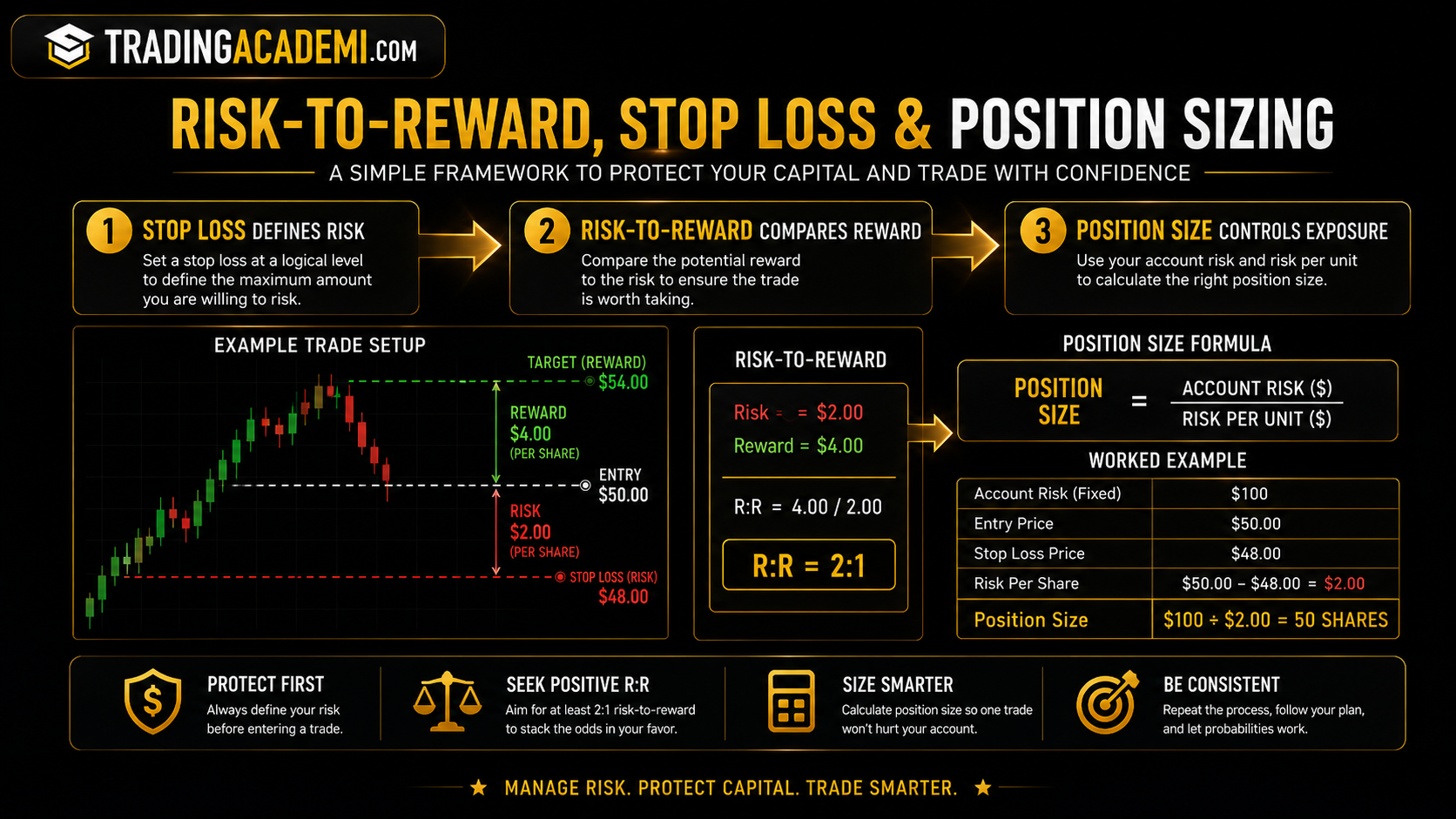
Imagine you buy a stock at $50. You place your stop loss at $48 and set your profit target at $54.
Now calculate the risk. Your entry is $50 and your stop loss is $48, so the risk per share is:
$50 - $48 = $2Now calculate the reward. Your target is $54 and your entry is $50, so the reward per share is:
$54 - $50 = $4That gives you:
$2 risk : $4 rewardThis simplifies to a 1:2 risk-to-reward ratio.
In simple terms, you are risking $1 to potentially make $2. If you want to understand how the stop loss level affects this calculation, read Stop Loss Orders Explained..
Risk-to-Reward and Stop Loss
Your stop loss defines the risk side of the trade. Without a stop loss, you cannot calculate risk-to-reward properly.
For example, if you buy at $50 and your target is $54, you know your possible reward is $4 per share. But if you do not know where you will exit if the trade fails, you do not know the risk.
That means you do not really know whether the trade is worth taking.
A stop loss gives the trade structure. It tells you where the trade idea is wrong, how much you may lose, how large your position should be, and whether the reward is worth the risk.
This is why a stop loss is not only an exit tool. It is also a planning tool. A trader who enters without a stop loss is not calculating risk. They are guessing.
Risk-to-Reward and Position Sizing
Risk-to-reward and position sizing are connected, but they are not the same thing.
Risk-to-reward compares potential loss with potential profit. Position sizing decides how many shares, lots, contracts, or units you should trade based on your planned risk.
For example, imagine your trade has an entry at $50, a stop loss at $48, and a target at $54. The risk per share is $2, the reward per share is $4, and the risk-to-reward ratio is 1:2.
Now imagine your account risk is $100. Your position size would be:
$100 ÷ $2 = 50 sharesIf the trade loses, you lose about $100. If the trade wins, you make about:
50 shares × $4 = $200So the 1:2 ratio becomes real in dollar terms.
This is why you should calculate position sizing after defining your stop loss and target.
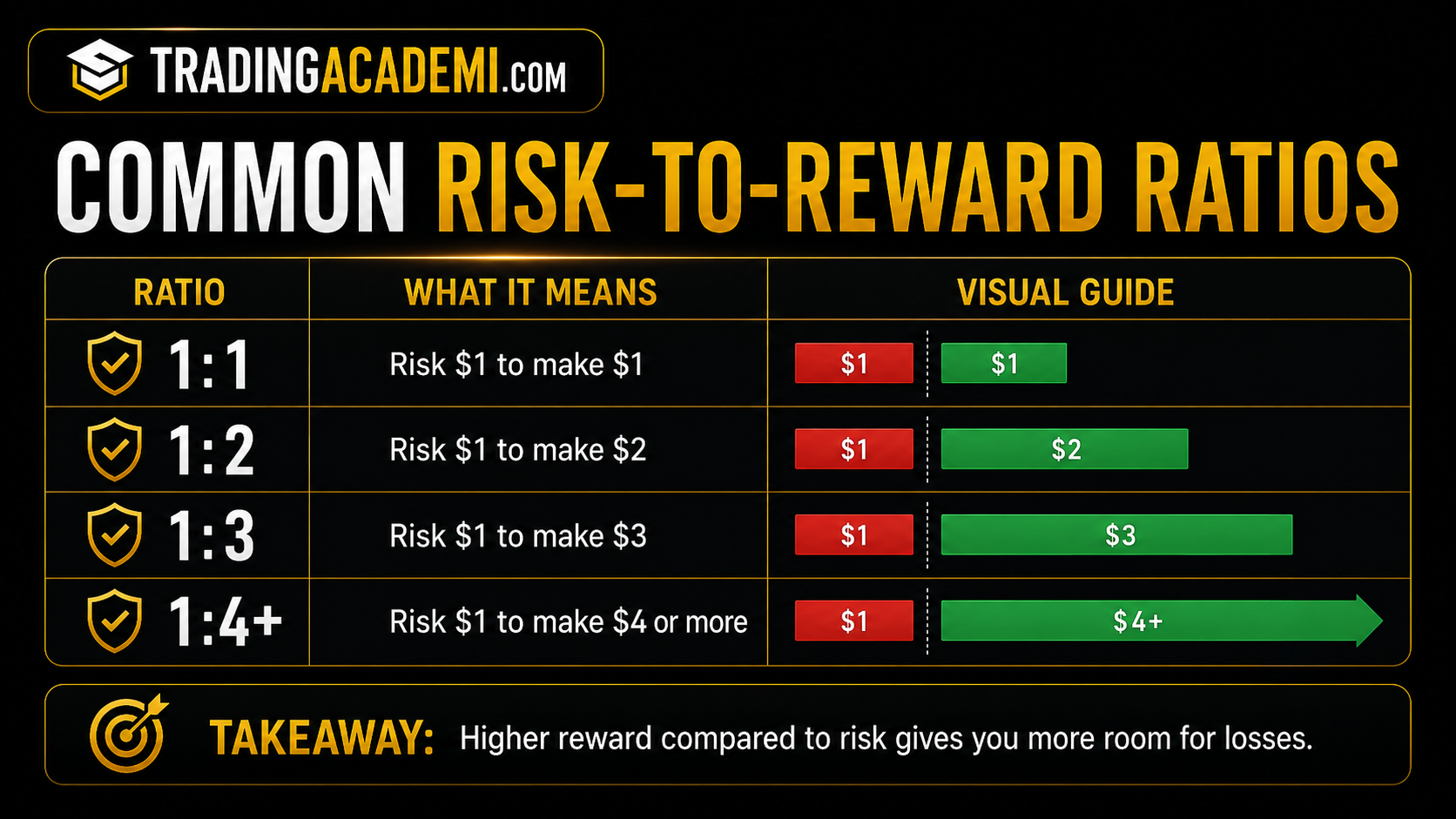
Common Risk-to-Reward Ratios
Traders often talk about ratios like 1:1, 1:2, 1:3, or higher. Each ratio has a different meaning.
A 1:1 risk-to-reward ratio means you are risking the same amount you are trying to make. For example, you risk $100 to make $100. This type of trade needs a higher win rate to be profitable after costs, commissions, spreads, and mistakes.
A 1:2 risk-to-reward ratio means you are risking $1 to try to make $2. For example, you risk $100 to make $200. This is a common ratio because it gives the trader more reward than risk while still keeping the target realistic in many market conditions.
A 1:3 risk-to-reward ratio means you are risking $1 to try to make $3. For example, you risk $100 to make $300. This can be attractive, but the target must still make sense. If the target is too far away, the trade may have a lower chance of reaching it.
A 1:4 or higher ratio can look excellent on paper, but not every market condition supports that kind of move. Beginners should be careful not to set unrealistic targets only to make the ratio look better.
A good risk-to-reward ratio should be based on real market structure, not imagination.
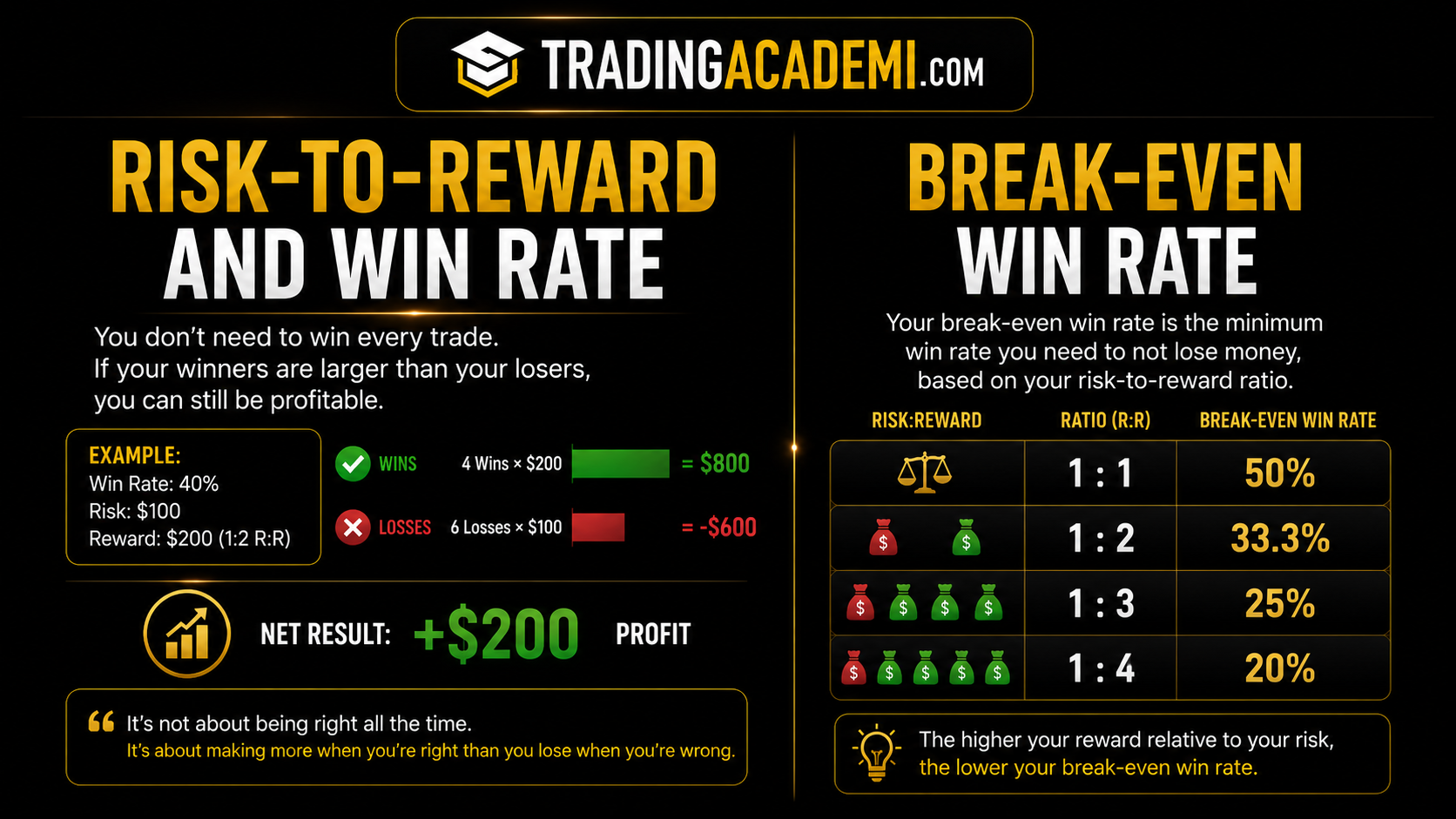
Risk-to-Reward and Win Rate
Risk-to-reward is closely connected to win rate. Win rate means the percentage of trades that are profitable.
For example, if you take 100 trades and win 50 of them, your win rate is 50%.
The important point is that a trader with a lower win rate can still be profitable if the winners are larger than the losers.
For example, imagine a trader risks $100 per trade and aims for $200 profit. That is a 1:2 ratio. If the trader wins 40 trades out of 100, the result would be:
40 wins × $200 = $8,000
60 losses × $100 = $6,000
Before costs, the trader is up $2,000.
This means the trader can be wrong more often than right and still potentially make money, as long as risk is managed properly and the plan is followed consistently.
Break-Even Win Rate
Break-even win rate is the win rate needed to avoid losing money before costs. Different risk-to-reward ratios have different break-even points.
| Risk-to-Reward Ratio | Approximate Break-Even Win Rate |
|---|---|
| 1:1 | 50% |
| 1:2 | 33.3% |
| 1:3 | 25% |
| 1:4 | 20% |
This does not include commissions, spreads, slippage, or fees.
The better the reward compared to the risk, the lower the win rate needed to break even. But again, a high ratio does not help if your targets are unrealistic or your trades rarely reach them.
A Good Ratio Does Not Guarantee a Good Trade
One of the biggest beginner mistakes is thinking that a high risk-to-reward ratio automatically means a good trade.
It does not.
A 1:5 trade may look great, but if the target is far away and unlikely to be reached, it may not be realistic. A good trade needs more than a good ratio. It needs a clear setup, logical stop loss, realistic target, enough liquidity, good market environment, proper position sizing, and discipline to follow the plan.
Risk-to-reward is a filter, not a complete strategy. You can use it to reject bad trades, but you still need a real trading plan.
How to Choose a Realistic Target
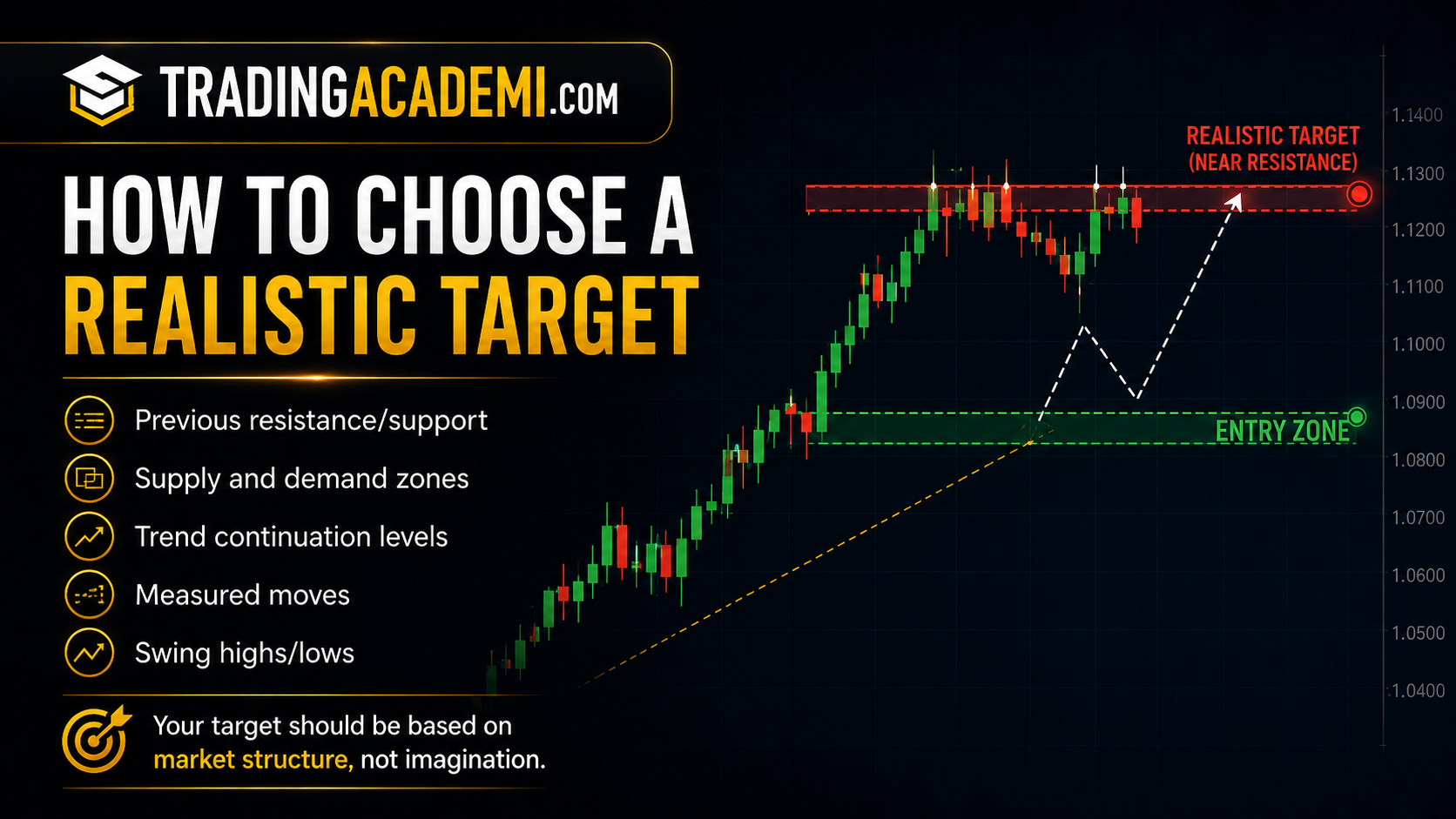
Your target should be based on market structure, not just on the ratio you want.
Common target areas include previous resistance, previous support, supply or demand zones, trend continuation levels, measured move levels, volume areas, swing highs, or swing lows.
For example, if you are buying near support, your target may be near the next resistance level. If the next resistance is too close, the trade may not offer enough reward.
This is why technical analysis can help with risk-to-reward planning. It helps traders choose targets that are connected to the chart instead of random numbers.
Risk-to-Reward in Different Markets
Risk-to-reward applies to many markets, but the way traders use it can vary.
In stocks, traders may use support and resistance levels to define stops and targets. Swing traders should also consider gap risk because some stocks can open much higher or lower after news or earnings.
In forex, traders often calculate risk and reward in pips. For example, a trader may risk 30 pips to target 60 pips, creating a 1:2 ratio. Forex traders should also consider spreads, volatility, and major economic news.
In futures, traders often calculate risk and reward using ticks and points. Because futures contracts can have high value per point, position sizing is very important.
In crypto, markets can move fast and remain open 24/7. Targets and stops should consider high volatility, liquidity, and sudden price spikes.
In options, risk-to-reward can be more complex because options are affected by time decay, volatility, strike price, and expiration. Maximum loss and potential reward depend on the strategy being used.
Using Risk-to-Reward Before Entering a Trade
Risk-to-reward should be calculated before entering a trade, not after.
A simple process can start with finding a setup, choosing an entry level, placing a logical stop loss, and choosing a realistic target. After that, the trader calculates the risk-to-reward ratio, checks whether the trade fits their rules, calculates position size, and enters only if the trade still makes sense.
This process helps prevent emotional entries. If you calculate the ratio after entering, you may already be biased because you want the trade to work.
A planned trade is always better than a trade that is justified after the fact.
Minimum Risk-to-Reward: Should You Always Aim for 1:2?
Many traders like using 1:2 as a minimum target because it creates a structure where the potential reward is larger than the potential risk.
However, there is no universal rule that every trader must use 1:2. Some strategies may use smaller ratios with higher win rates, while other strategies may use larger ratios with lower win rates.
The key is consistency. You need to know how your strategy performs over many trades.
Beginners can start by studying trades that offer at least 1:2, but they should also understand that the ratio alone is not enough. A 1:2 trade with a bad setup is still a bad trade.
Risk-to-Reward and Trading Psychology
Risk-to-reward helps with psychology because it gives your trade a clear plan. When you know your risk and target, you are less likely to panic during normal price movement.
However, traders still face emotional challenges. A trader may close a winning trade too early because they are afraid of losing profit. Another trader may move the stop loss farther away because they do not want to accept a loss. Another may remove the target and become greedy.
Risk-to-reward only works if you respect the plan. That is why trading psychology is important. The ratio can guide the trade, but discipline is what allows the plan to work.
Common Risk-to-Reward Mistakes
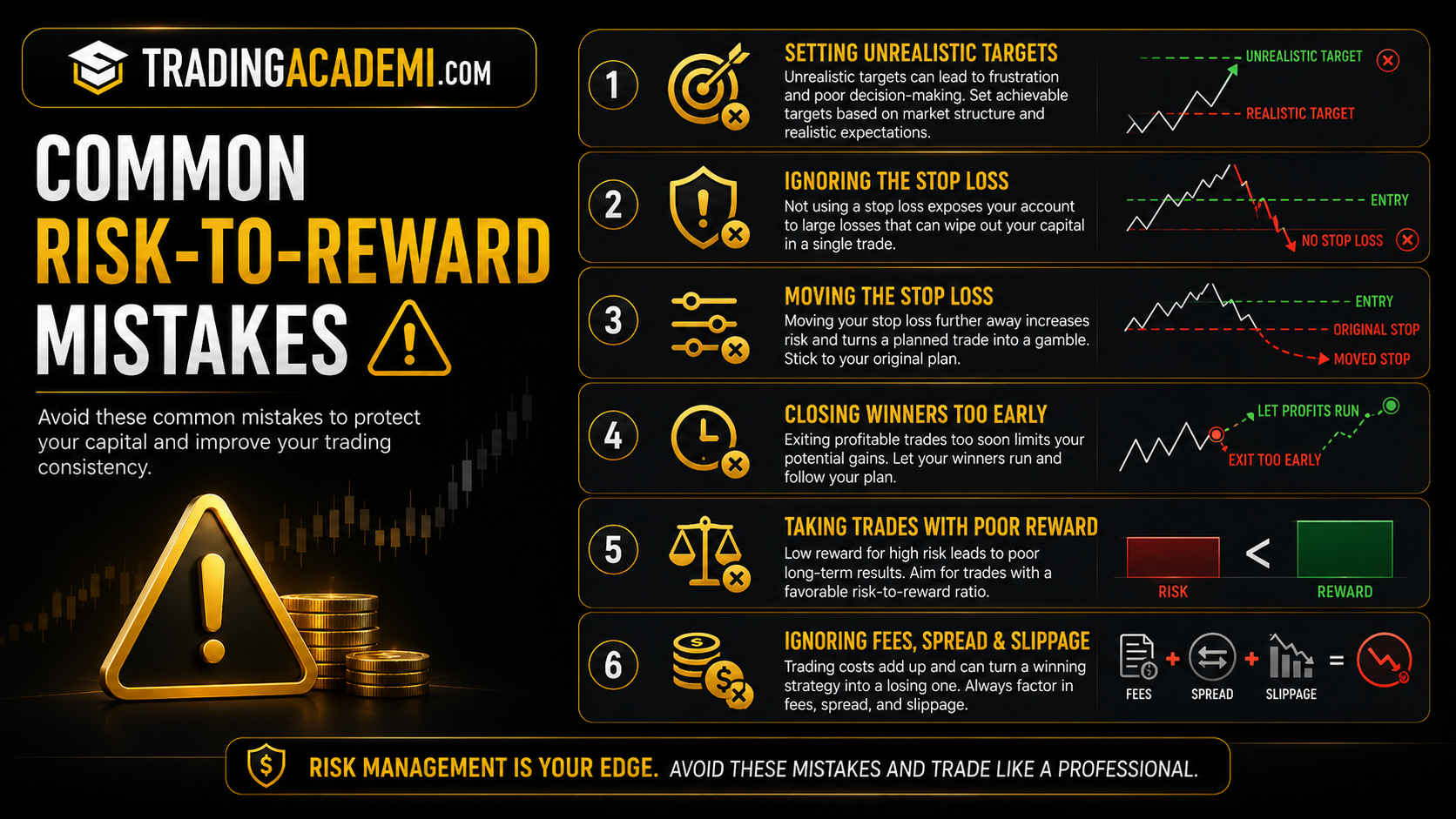
One common mistake is setting unrealistic targets. Some traders place targets very far away just to create a better ratio, but if the target is not realistic, the ratio is misleading.
Another mistake is ignoring the stop loss. A trade cannot have a real risk-to-reward ratio without a defined stop loss.
Moving the stop loss farther away is also dangerous because it increases risk and makes the original ratio invalid. Closing winners too early can create another problem because the reward side of the trade never has time to work.
Some traders also take trades with poor reward potential. A setup may have a clear entry, but if the nearest target is too close, the trade may not be worth taking.
Finally, fees, spread, and slippage should not be ignored because they can reduce the real reward and increase the real risk, especially for active traders.
Risk-to-Reward Checklist
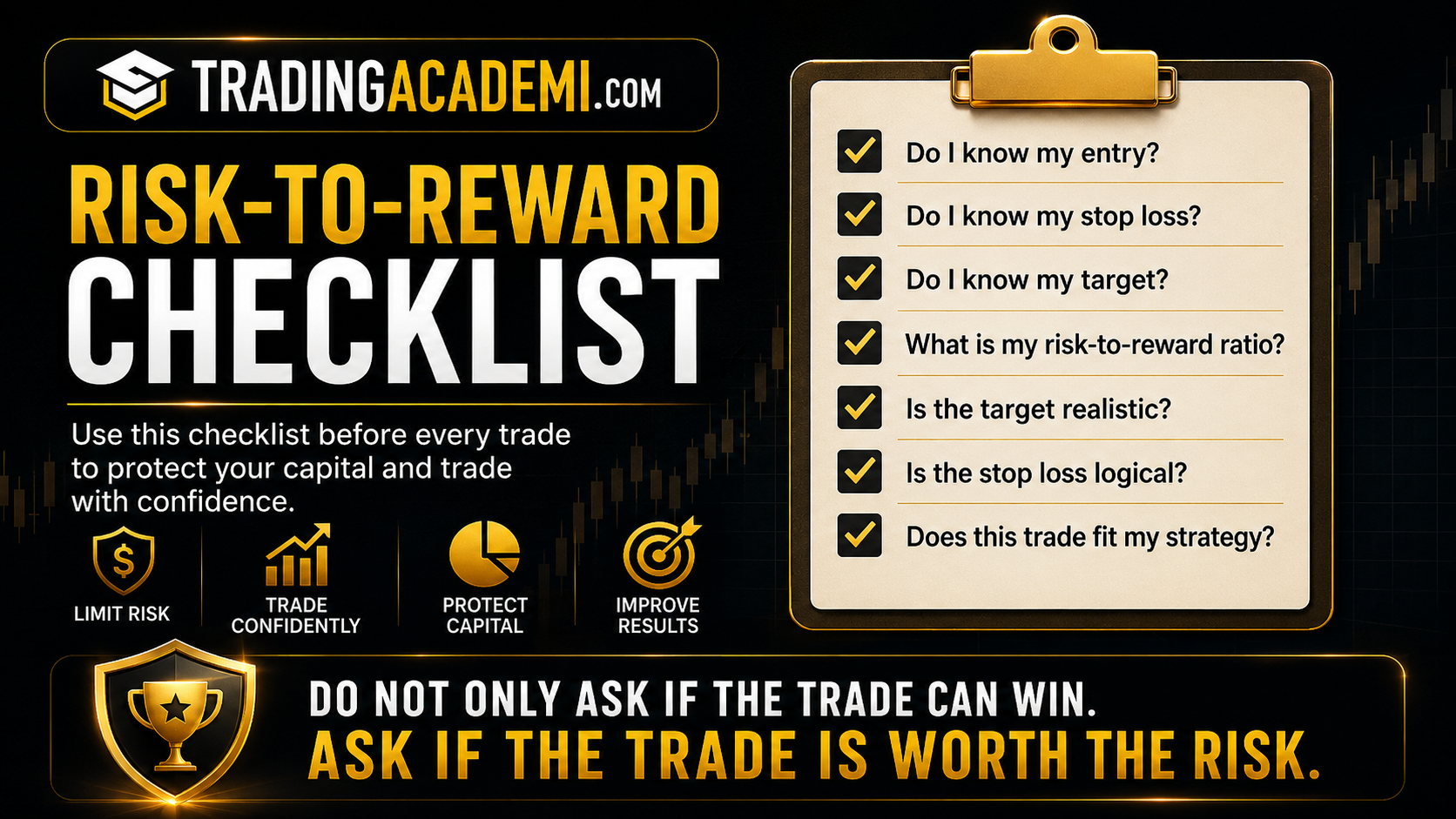
Before entering a trade, ask yourself where the entry is, where the stop loss is, and where the target is. Then calculate how much you are risking per unit, how much you can potentially make per unit, and what the risk-to-reward ratio is.
You should also ask whether the target is realistic, whether the stop loss is logical, whether the trade fits your strategy, and what position size matches your risk.
Most importantly, ask yourself whether you are willing to accept the planned loss and whether you will follow the plan if the market moves against you.
If you cannot answer these questions clearly, the trade may not be ready.
Example: Comparing Two Trades
Imagine two trade opportunities.
Trade A has an entry at $100, a stop loss at $98, and a target at $102. The risk is $2, the reward is $2, and the ratio is 1:1.
Trade B has an entry at $100, a stop loss at $98, and a target at $106. The risk is $2, the reward is $6, and the ratio is 1:3.
Trade B has a better risk-to-reward ratio, but that does not automatically mean it is better.
You still need to ask whether $106 is a realistic target, whether there is resistance before $106, whether the market is trending strongly enough, whether the stop loss is logical, and whether the setup supports the trade.
A better ratio is useful only when the trade idea makes sense.
Final Thoughts
Risk-to-reward ratio is a simple concept, but it can completely change the way you plan trades. It helps you stop thinking only about profit and start thinking in terms of risk, reward, probability, and structure.
A good trader does not enter a trade just because price is moving. A good trader asks how much they can lose, how much they can make, whether the reward is worth the risk, whether the target is realistic, and whether the trade fits the plan.
Risk-to-reward does not guarantee winning trades. But it helps you avoid poor trades, control expectations, and trade with more discipline.
When combined with stop losses, position sizing, and emotional control, risk-to-reward becomes one of the most practical tools in a trader’s risk management plan.
Before you take your next trade, remember this: do not only ask if the trade can win. Ask if the trade is worth the risk.
Educational Disclaimer
This article is for educational purposes only and should not be considered financial advice. Trading and investing involve risk, including the possible loss of capital. Risk-to-reward ratio is a planning tool and does not guarantee profits or prevent losses. Always do your own research or consult a qualified financial professional before making financial decisions.