 By Anzo Trader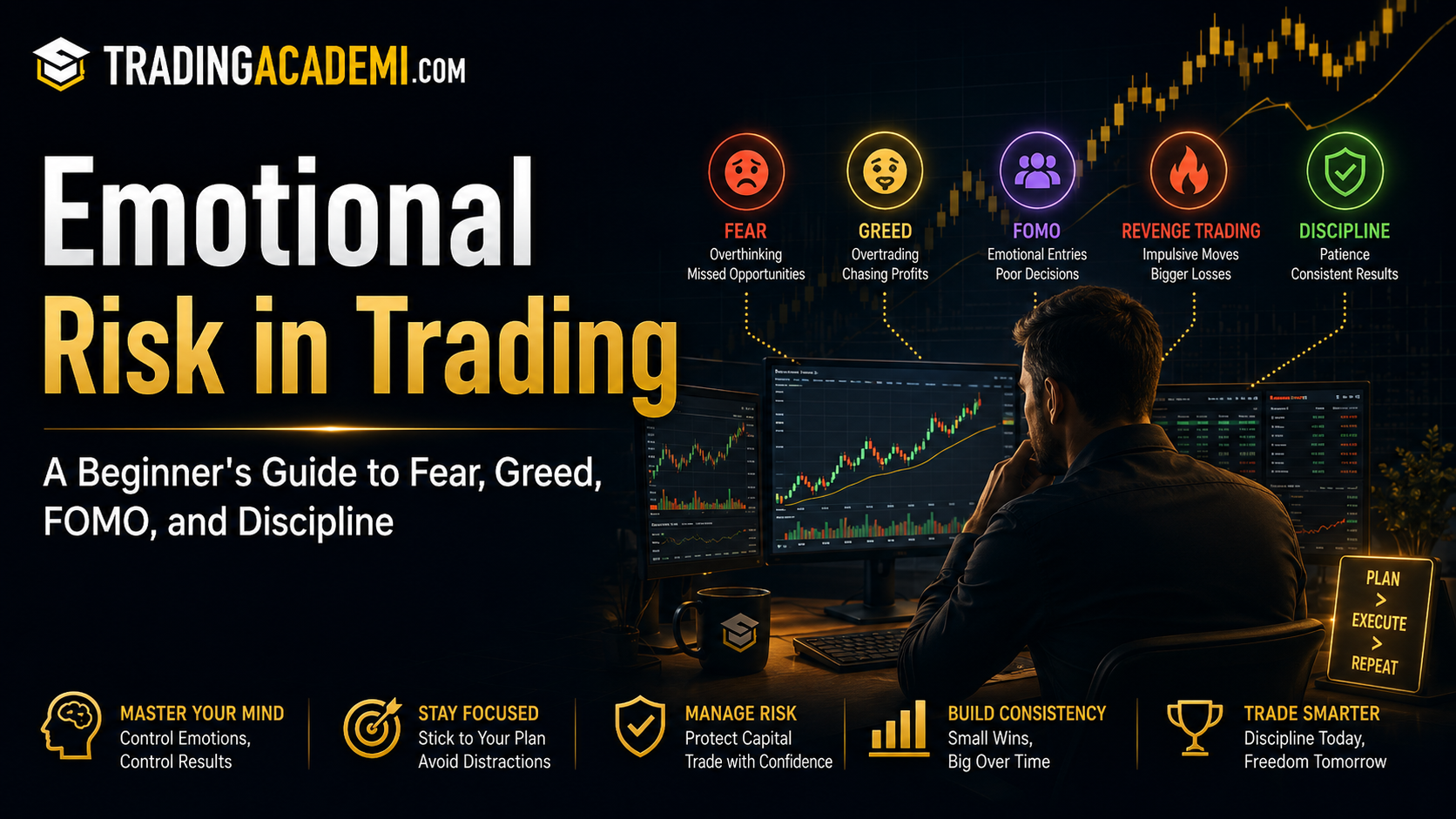
Emotional risk is one of the most underestimated risks in trading. Many beginners believe trading success depends only on finding the right strategy, the best indicator, or the perfect entry. They spend hours studying charts, signals, patterns, and market predictions. All of these things can matter, but they are not enough.
A trader can have a good strategy and still lose money because of emotions.
Fear can make you exit too early. Greed can make you risk too much. FOMO can make you chase bad entries. Frustration can lead to revenge trading. Overconfidence can make you ignore your rules.
This is emotional risk.
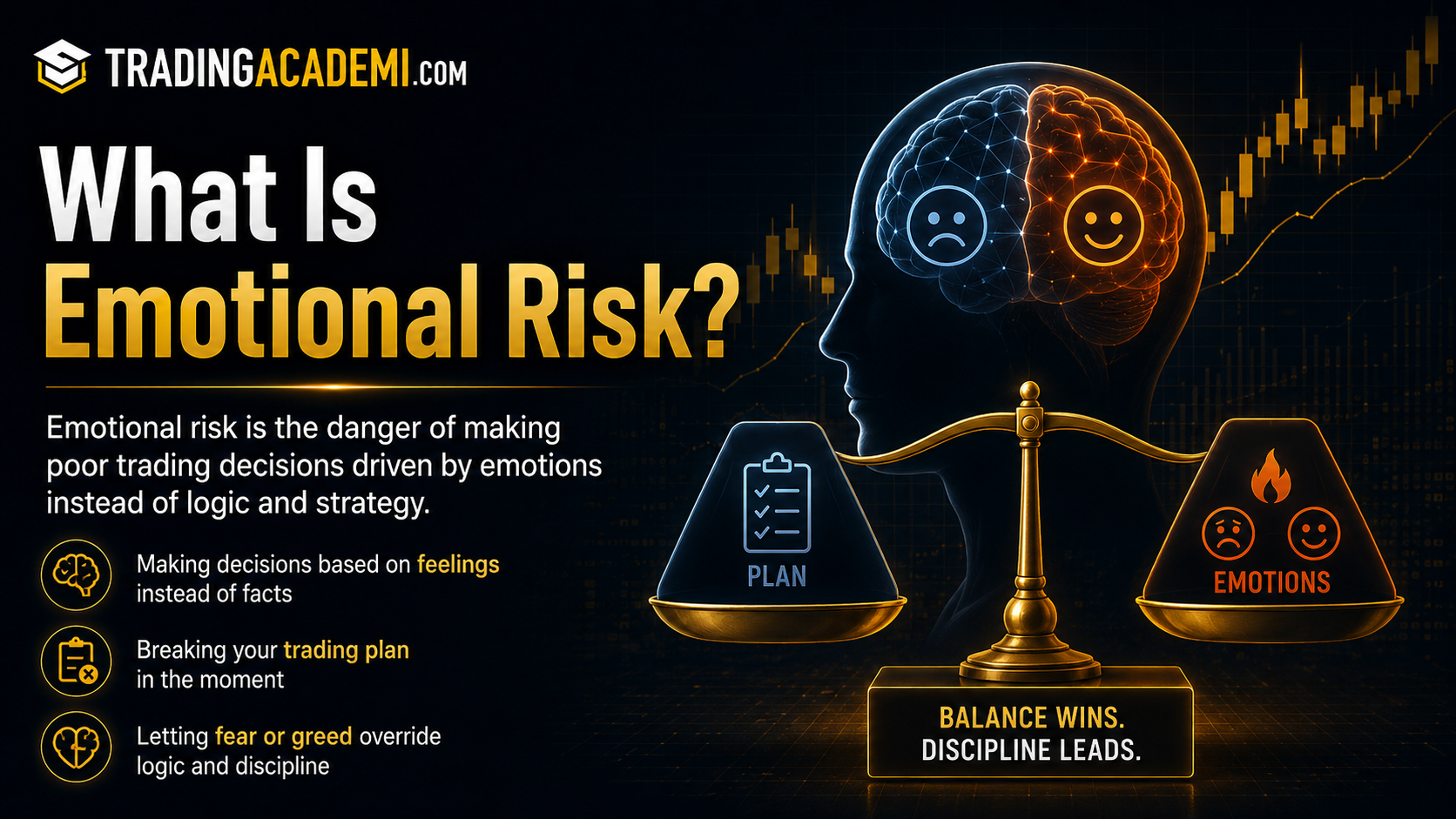
Emotional risk is the danger of making trading decisions based on feelings instead of a clear plan. It often appears when money is on the line, when losses happen, or when the market moves quickly.
The market does not only test your strategy. It also tests your patience, discipline, and self-control.
Before reading this guide, it can help to understand the foundations of risk management in trading, position sizing, stop loss orders, risk-to-reward ratio, drawdown control, and leverage risk, because poor emotional control can damage all of them.
What Is Emotional Risk in Trading?
Emotional risk in trading is the risk of making poor trading decisions because of emotions. It happens when feelings become stronger than your trading plan.
For example, you may enter a trade because you are afraid of missing out. You may hold a losing trade because you do not want to accept being wrong. You may increase position size because you feel confident after a winning streak. You may take another trade immediately after a loss because you want to recover quickly.
All of these actions come from emotion, not structure.
Emotional risk does not always look obvious in the moment. It can feel like confidence, instinct, urgency, or determination. But if the decision breaks your rules, it is emotional risk.
A disciplined trader does not try to remove emotions completely. That is unrealistic. Instead, a disciplined trader builds rules that prevent emotions from controlling the trade.
Why Emotional Risk Matters
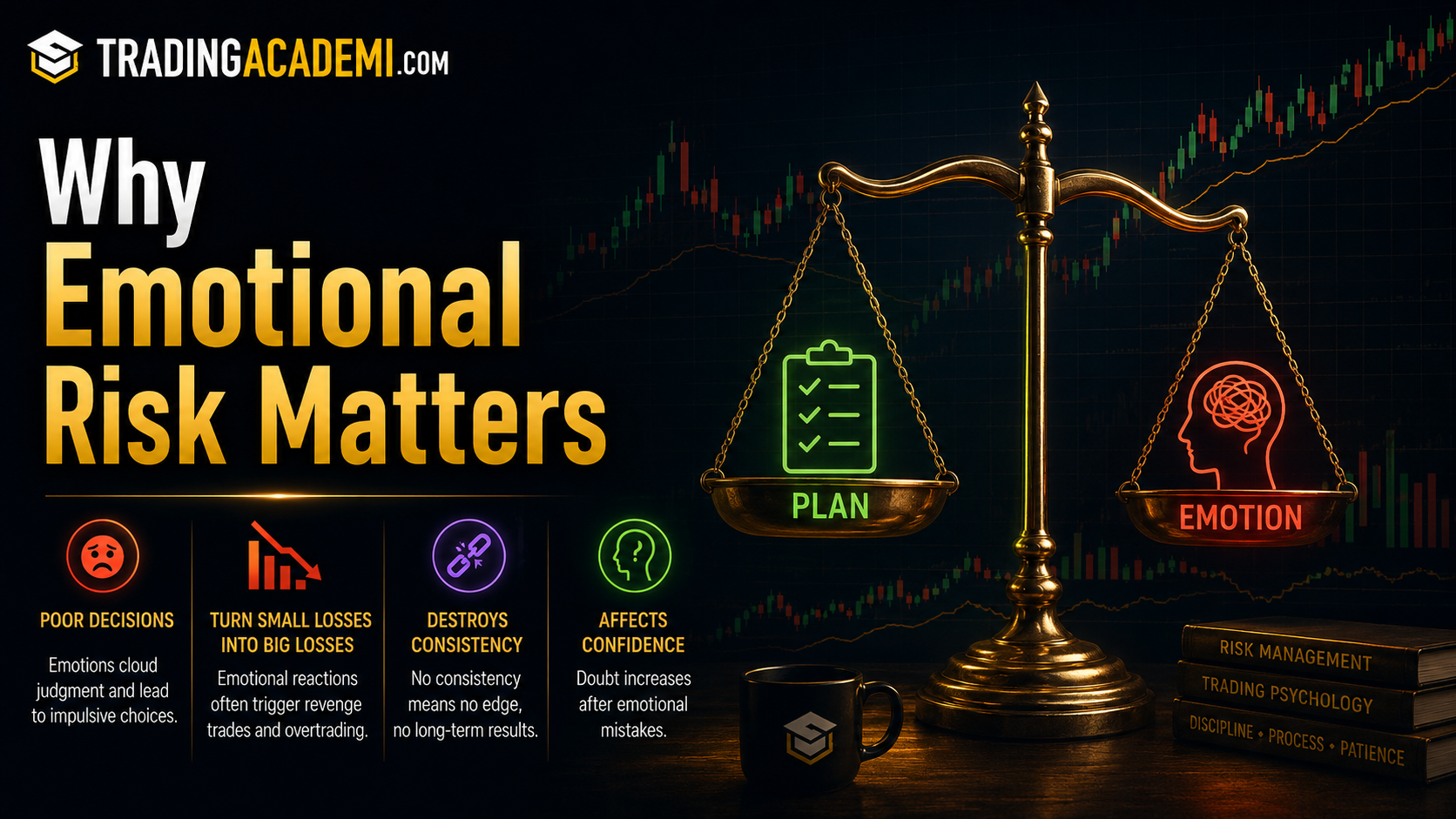
Emotional risk matters because trading involves uncertainty. No trader knows the future with complete certainty. Even a strong setup can fail. Even a clean strategy can have losing streaks. Even experienced traders feel emotions when real money is involved.
The problem is not feeling emotion. The problem is acting on emotion.
A trader who acts emotionally may enter trades too late, close winning trades too early, hold losing trades too long, move stop losses, increase size after losses, ignore daily loss limits, overtrade, use too much leverage, or abandon a good trading plan.
These mistakes can turn small losses into large losses.
This is why emotional control is a major part of trading risk management. Managing risk is not only about numbers. It is also about behavior.
Fear in Trading
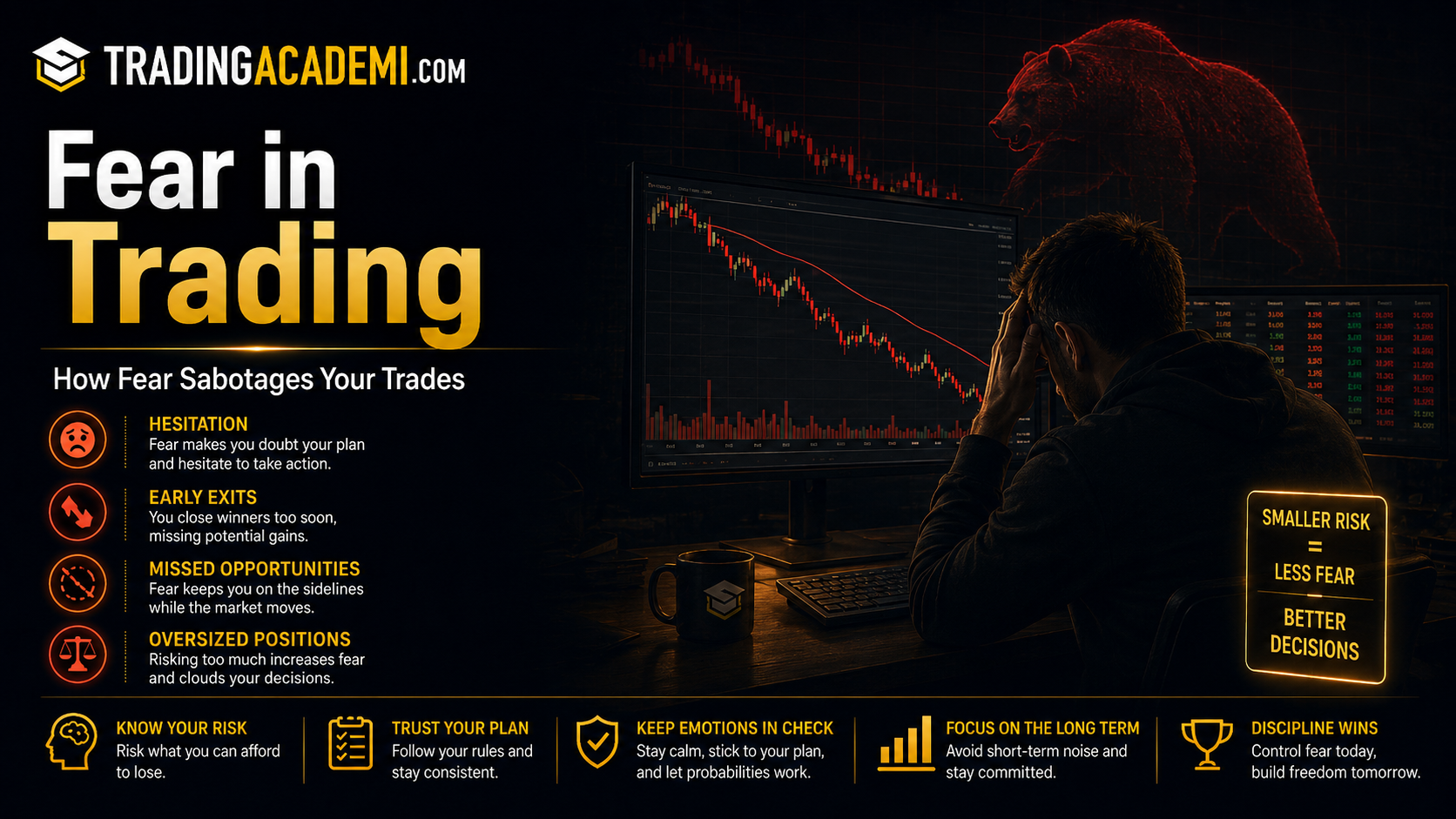
Fear is one of the most common trading emotions. It can appear before entering a trade, while holding a trade, or after a loss.
A trader may fear losing money, being wrong, giving back profits, or entering after missing an earlier opportunity. This fear can cause hesitation.
For example, a trader may see a valid setup but avoid entering because the previous trade was a loss. Then the trade works without them. After missing the move, the trader becomes frustrated and enters late at a worse price.
Fear can also cause early exits. A trader may enter a good trade, see price move slightly in profit, and close too early because they are afraid of losing the small gain. Later, the market reaches the original target without them.
Fear often becomes stronger when position size is too large. If a planned loss feels emotionally unacceptable, the trade size is probably too big. This is why position sizing helps reduce emotional pressure.
Greed in Trading
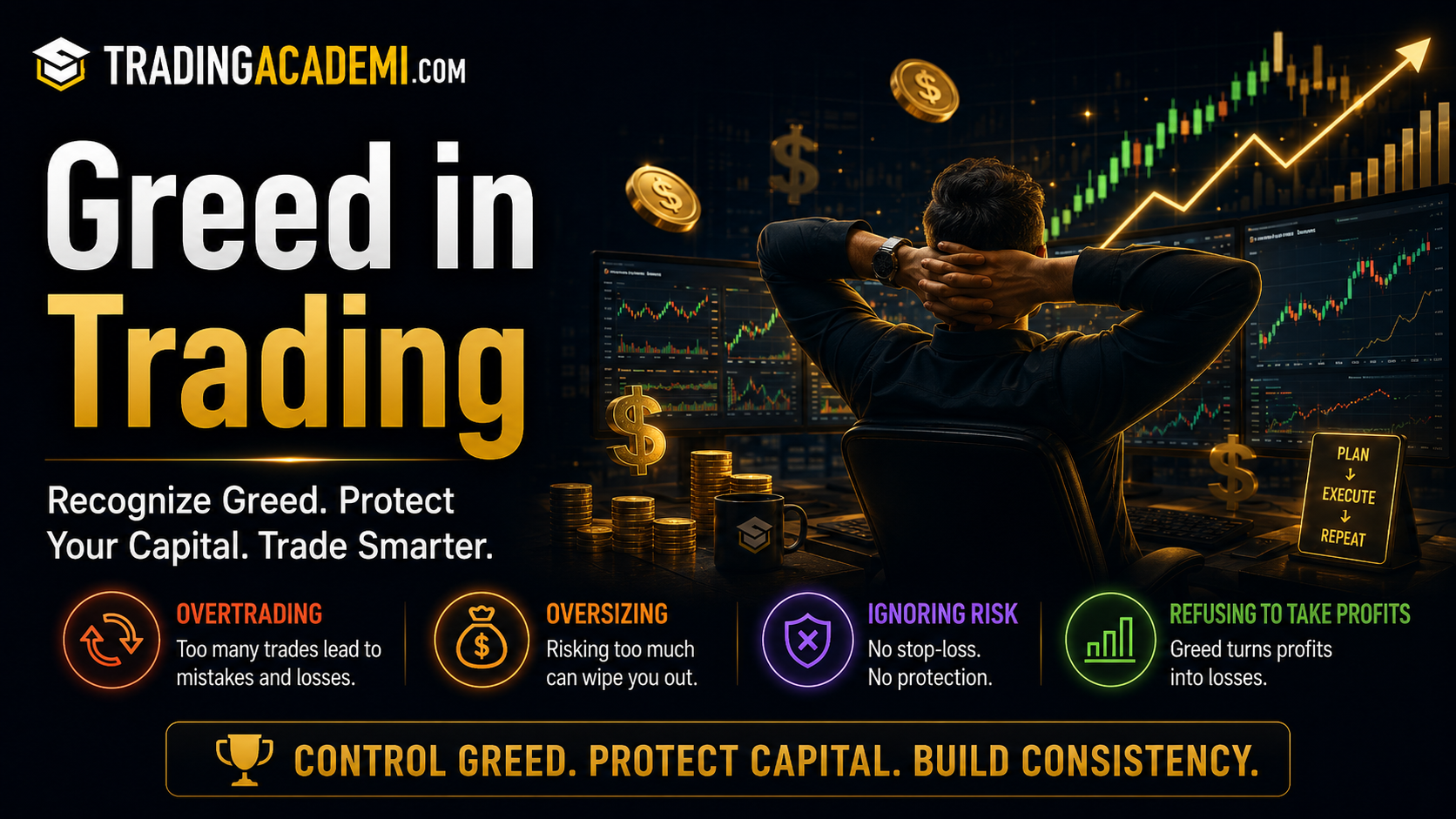
Greed is the desire to make more money quickly. It can make traders ignore risk and break their own rules.
A greedy trader may increase position size too much, use excessive leverage, refuse to take planned profits, chase trades after a big move, keep trading after reaching the daily target, ignore stop losses, or enter low-quality setups because they want action.
Greed often appears after winning trades. A trader wins several trades and starts feeling unstoppable. They may think the next trade will also work, so they increase size. If the trade loses, the loss may erase previous gains.
Greed can also appear when a trade is already profitable. The trader may remove the target and keep holding because they want more. Sometimes this works, but often the market reverses and the trader gives back profit.
Greed becomes dangerous when it breaks the trading plan. A good trader understands that not every opportunity must be taken and not every move must be captured.
FOMO: Fear of Missing Out
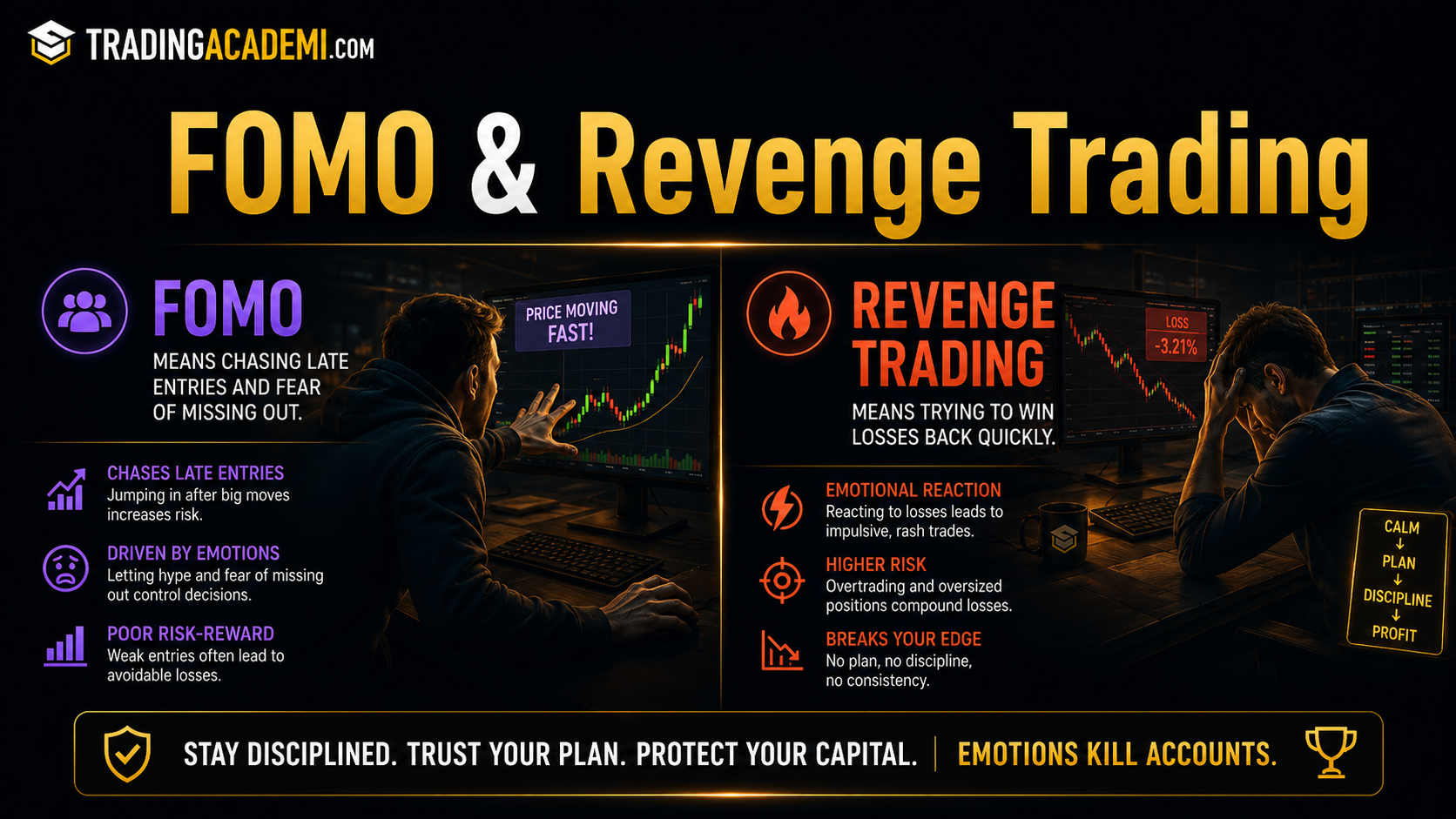
FOMO means fear of missing out. It happens when a trader sees the market moving without them and feels pressure to enter immediately.
FOMO is common in fast markets, trending markets, crypto markets, news moves, and social media-driven trading environments.
A trader may think everyone is making money except them, that the move is too strong to miss, or that they must enter now before the opportunity disappears. The danger is that FOMO often leads to late entries.
By the time the emotional trader enters, the best entry may already be gone. The stop loss may be too far, the risk-to-reward may be poor, and the trade may reverse.
FOMO trades usually feel urgent. Good trades usually allow planning.
Before entering because of FOMO, ask yourself where the stop loss is, where the target is, whether the risk-to-reward is still good, and whether you are following your plan or chasing price. If the trade does not fit your rules, it is better to let it go.
Revenge Trading
Revenge trading happens when a trader tries to recover losses quickly after a losing trade. This is one of the most dangerous emotional mistakes.
After a loss, the trader may feel angry, frustrated, or embarrassed. Instead of accepting the loss and reviewing the trade, they immediately look for another trade to win the money back.
This often leads to poor decisions. The trader may enter without a real setup, increase position size, ignore the stop loss, trade outside their normal market or timeframe, or keep trading until the loss becomes much larger.
Revenge trading can destroy a good trading day, a good week, or even an account.
This is why daily loss limits are important. A daily limit creates a hard stop before emotions take over. You can learn more about account protection in drawdown control in trading.
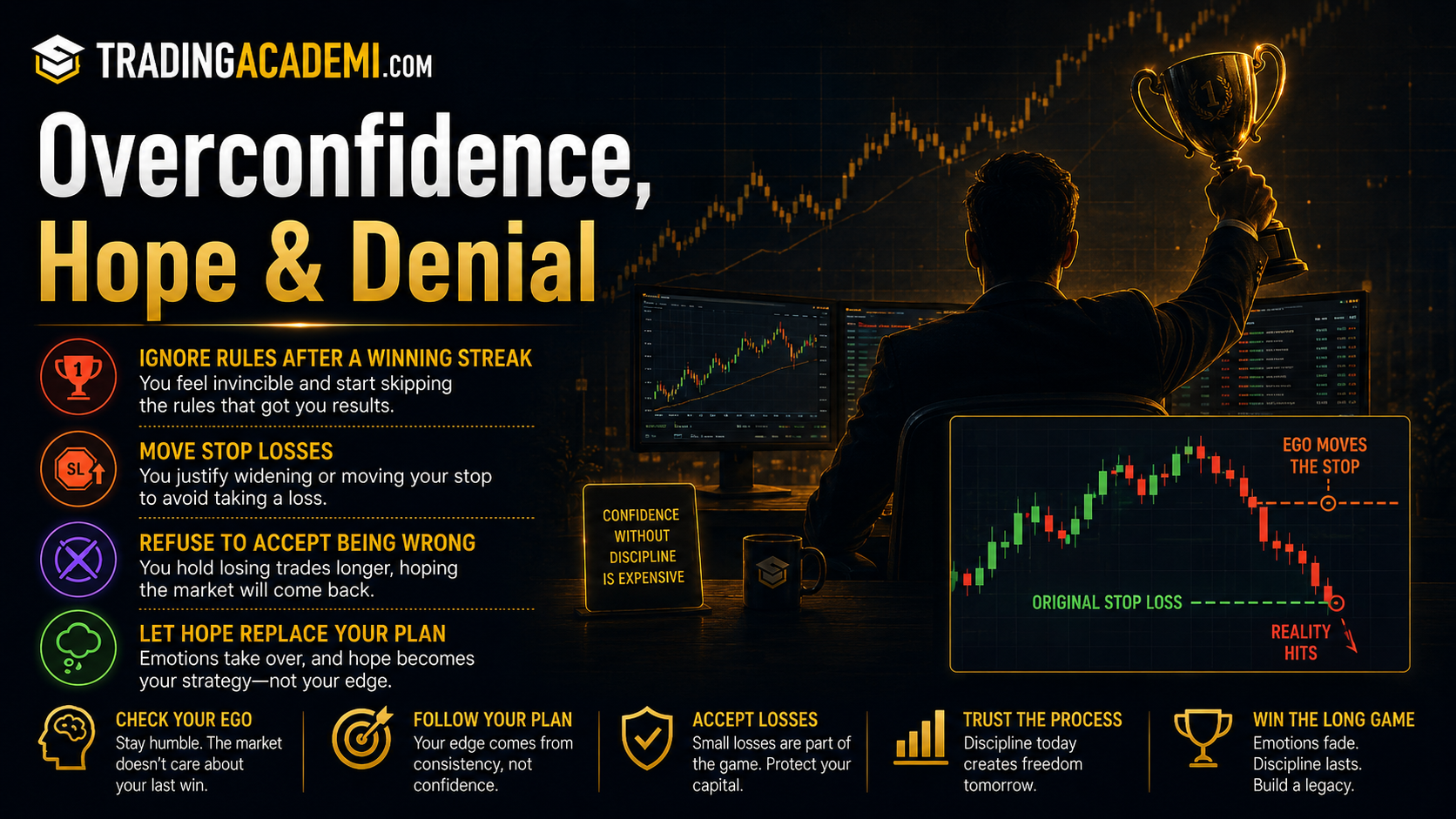
Overconfidence
Overconfidence often appears after a winning streak. A trader wins several trades and starts believing they have mastered the market. They may stop following their checklist because they feel they already know what will happen.
Overconfidence can lead to oversized positions, ignoring risk limits, skipping analysis, using more leverage, taking trades outside the plan, moving targets unrealistically, or refusing to accept losses.
Winning streaks can be dangerous because they make traders feel safe, but the market can change quickly.
A disciplined trader treats every trade as one trade. They do not allow recent wins to justify bad risk.
Confidence is useful when it is based on preparation and discipline. Overconfidence is dangerous when it removes caution.
Hope and Denial
Hope becomes dangerous when a trader uses it as a substitute for a plan.
For example, a trader may enter a trade with a stop loss, but when price approaches the stop, they move it farther away. They tell themselves the market will come back.
This is not patience. This is denial.
A trader may also hold a losing position because they do not want to realize the loss. They may avoid looking at the account, avoid closing the trade, or search for reasons to stay in.
Hope can turn a small planned loss into a large unplanned loss.
This is why a stop loss order is not only a technical tool. It is also a psychological tool. It protects the trader from hesitation when emotions are strong.
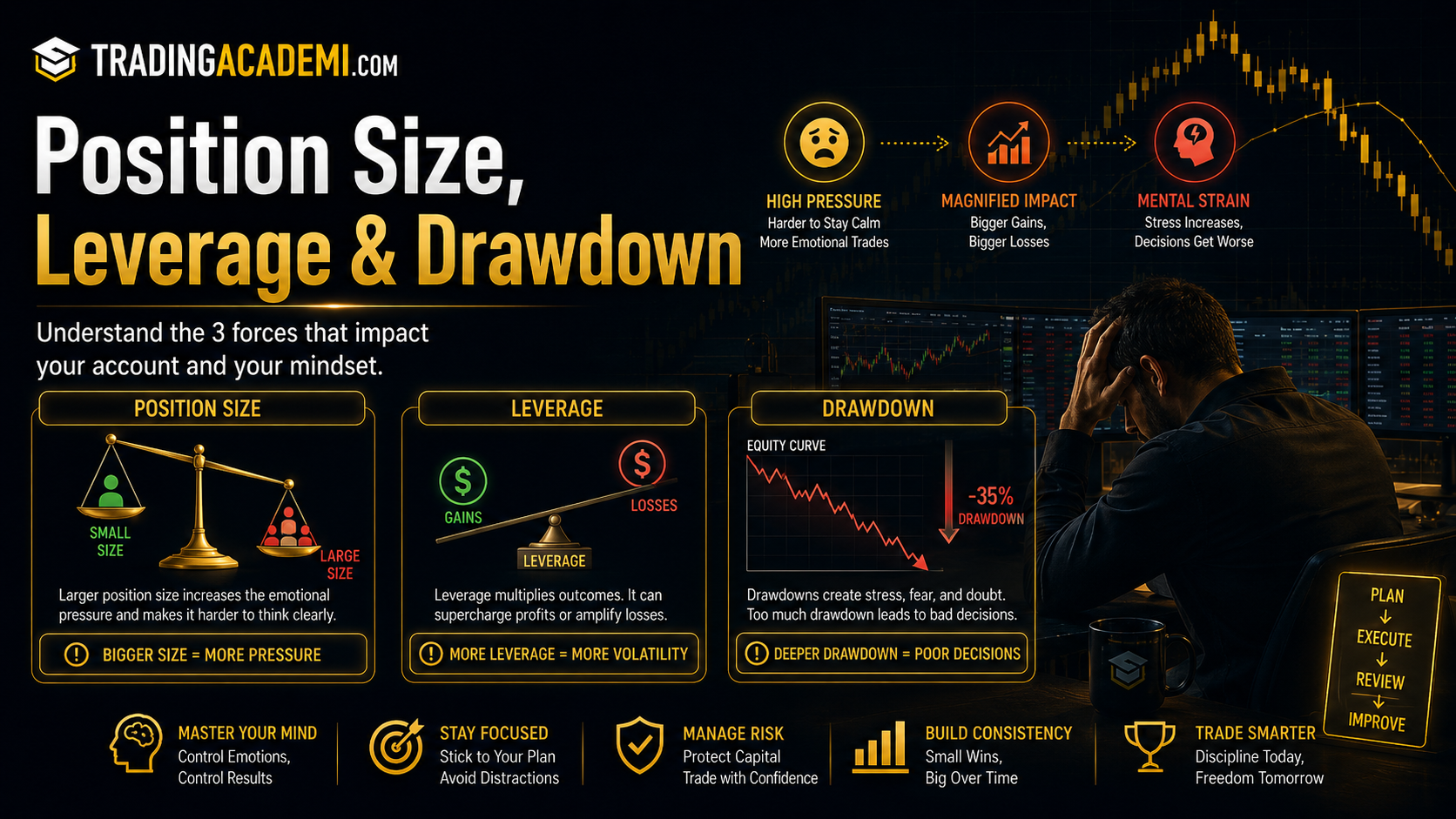
Emotional Risk and Position Size
Position size has a direct effect on emotions. If your trade size is too large, every price movement feels stressful. You may watch every candle closely, panic during normal pullbacks, close too early, or move your stop.
If your position size is reasonable, you can think more clearly.
A good test is simple: can you accept the planned loss before entering the trade?
If the answer is no, your position size may be too large.
Trading with a size you can emotionally handle does not mean you do not care about losses. It means losses are part of the plan. Proper sizing helps you stay disciplined during uncertainty.
Emotional Risk and Leverage
Leverage can make emotional risk much worse. When leverage is high, small market movements can create large account changes. This increases fear, greed, and pressure.
A leveraged trade can make the trader feel like every tick matters. This can lead to impulsive decisions.
For beginners, high leverage often creates emotional instability because the account changes too quickly. If you are learning, it is usually better to focus on control rather than maximum exposure.
Our guide on leverage risk in trading explains how leverage can magnify both gains and losses.
Emotional Risk During Drawdown
Drawdown is one of the hardest periods emotionally. When your account is below its previous high, you may feel pressure to recover.
This pressure can lead to revenge trading, changing strategy too quickly, increasing size, stopping too early on good trades, taking low-quality setups, losing confidence, or ignoring the plan.
Drawdown does not always mean you are a bad trader. Every trader experiences losing periods. The key is how you respond.
A trader with emotional discipline reduces size, reviews trades, follows rules, and waits for high-quality setups. A trader controlled by emotions tries to force recovery.
How to Reduce Emotional Risk
Emotional risk cannot be removed completely, but it can be reduced. The first step is having a written trading plan.
A trading plan should define what markets you trade, what setups you take, when you enter, where you place stop losses, how much you risk per trade, when you stop trading, and how you review trades.
Second, use a checklist before entering each trade. A checklist slows you down and forces you to think.
Third, keep position size reasonable. Fourth, use daily and weekly loss limits. Fifth, journal your trades and emotions. Sixth, take breaks after emotional trades. Seventh, avoid trading when you are tired, angry, distracted, or desperate.
Emotional control is built through structure.
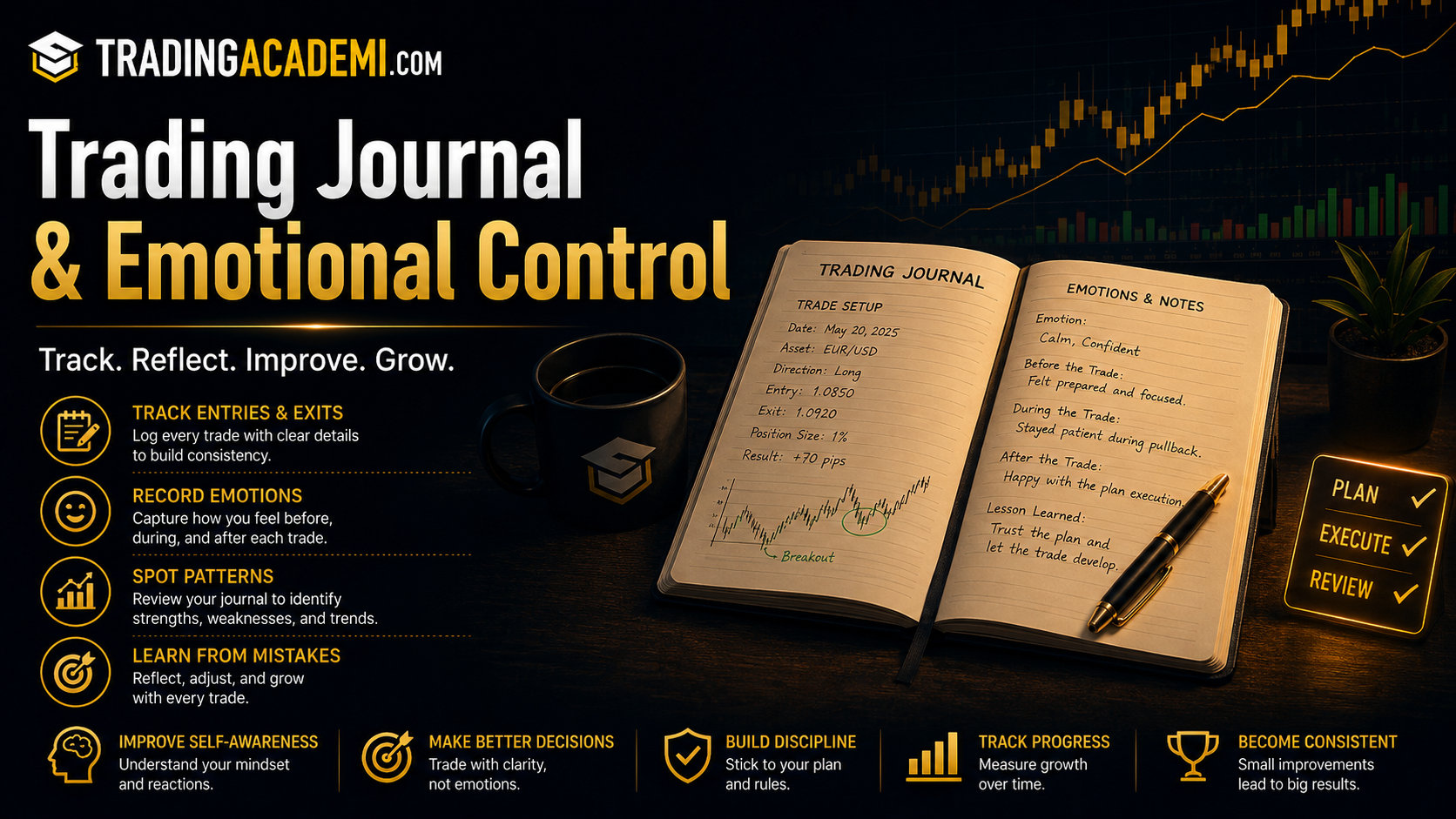
Trading Journal for Emotional Control
A trading journal is one of the best tools for reducing emotional risk because it helps you see patterns in your behavior.
You may discover that you lose more after the first loss of the day, take bad trades during news, close winners too early, or create your biggest losses after increasing size.
Without a journal, emotional mistakes can repeat for months. With a journal, you can identify them and correct them.
A good journal should include the entry and exit, reason for the trade, stop loss and target, position size, result, emotional state, mistakes made, and lesson learned.
Later in this series, you can build a full article around trading journal habits because this topic deserves its own guide.
Rules to Control Emotional Trading
Beginners can reduce emotional mistakes by using simple rules before and during trading. Do not trade without a plan, do not enter because of FOMO, do not increase size after a loss, and do not move your stop loss farther away.
It is also important not to trade because of boredom, not to continue after reaching your daily loss limit, not to use leverage you cannot emotionally handle, and not to chase missed moves.
A trader should also review the journal and avoid confusing confidence with discipline.
The goal is not to become emotionless. The goal is to stop emotions from making decisions.
Emotional Trading Checklist
Before taking a trade, ask yourself whether you are following your trading plan or reacting emotionally.
Ask whether you are entering because of a real setup or because you are afraid of missing out. Ask whether you are trying to recover a previous loss, whether your position size is comfortable, and whether you clearly know your stop loss and target.
You should also check whether the risk-to-reward is acceptable, whether you are calm enough to follow the plan, and whether you would still take the trade if you had not seen social media excitement or recent price movement.
If the answers show emotional pressure, it may be better to wait.
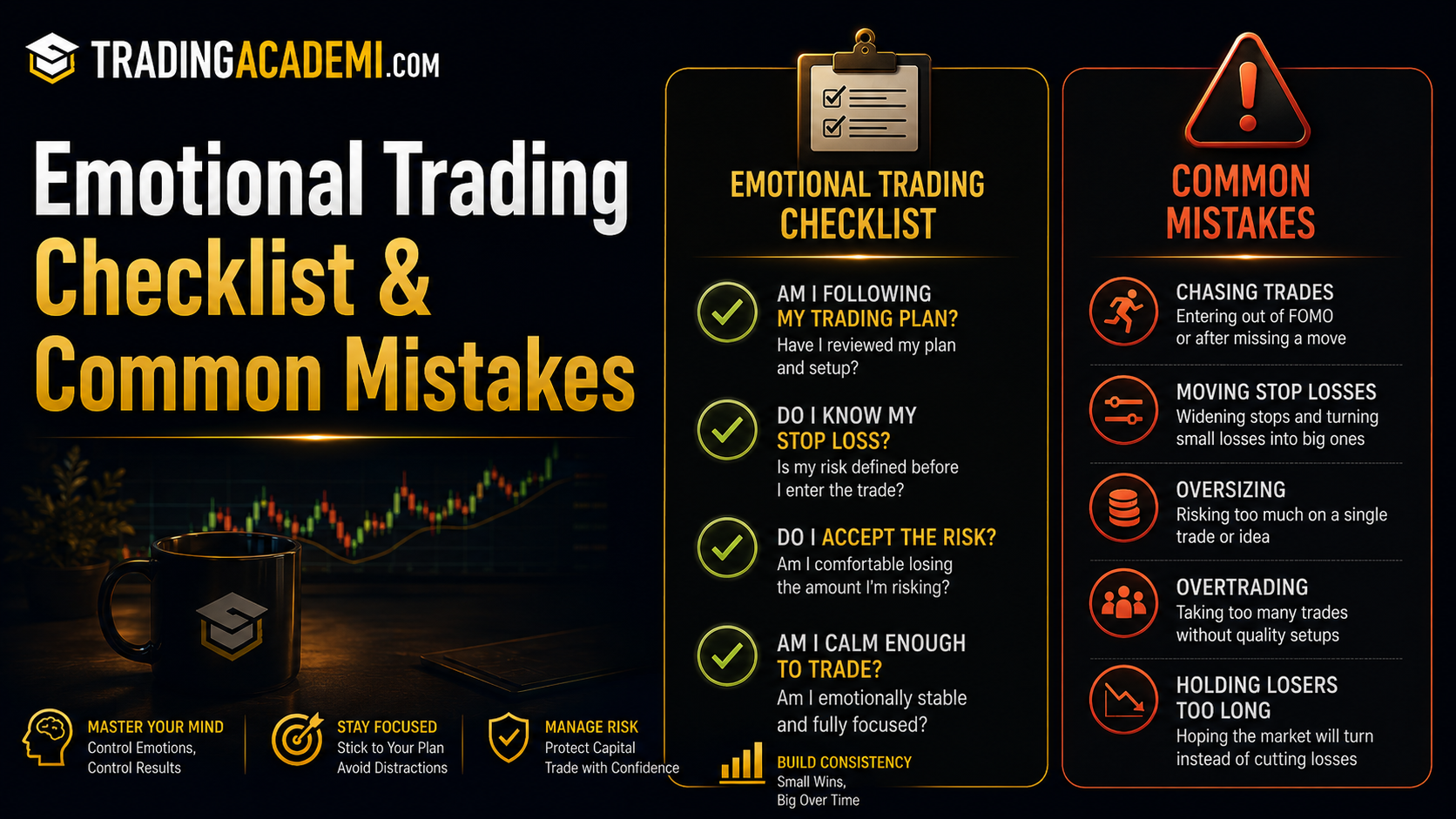
Common Emotional Trading Mistakes
One common emotional mistake is chasing trades after a big move because you fear missing out. Another is revenge trading, where you take another trade immediately after a loss to recover quickly.
Many traders also move stop losses because they refuse to accept the planned loss. Others oversize positions that are too large for their account or emotional comfort.
Fear can cause traders to close winners too early, while hope can make them hold losers too long. Overtrading is another common issue, especially when traders feel bored, excited, or frustrated.
All of these mistakes usually come from the same problem: ignoring the trading plan because emotion feels stronger in the moment.
Example: Emotional Risk in a Trade
Imagine a trader enters a long trade at $50. The stop loss is $48, the target is $54, the risk-to-reward ratio is 1:2, and the position size is calculated correctly.
At first, the trade moves to $51.50. The trader becomes afraid of losing the small profit and closes early. Later, the price reaches $54.
The trading plan worked, but the trader did not follow it.
Now imagine another trader enters the same trade. Price drops near $48, and the trader moves the stop loss to $46 because they do not want to take the loss. The price continues lower, and a planned loss becomes a larger loss.
Both examples show emotional risk. The strategy was not the main problem. The behavior was.
Final Thoughts
Emotional risk is one of the biggest reasons traders struggle. It is not enough to know how to read charts, understand indicators, or identify entries and exits. A trader must also manage fear, greed, FOMO, revenge trading, and overconfidence.
The market will always create emotional pressure. The goal is to build rules that help you respond with discipline.
Good traders are not people who never feel emotions. Good traders are people who do not let emotions control their risk.
Before entering your next trade, ask yourself whether you are following a plan, whether you are risking an amount you can accept, whether you are chasing, whether you are trying to recover, and whether you are calm enough to execute correctly.
If you can answer honestly, you are already improving as a trader.
Trading discipline is built one decision at a time.
Educational Disclaimer
This article is for educational purposes only and should not be considered financial advice. Trading and investing involve risk, including the possible loss of capital. Emotional discipline and risk management tools do not guarantee profits or prevent losses. Always do your own research or consult a qualified financial professional before making financial decisions.