 By Anzo Trader
A trading plan is one of the most important tools a trader can have. Many beginners start trading without a clear plan. They open charts, react to price movement, follow signals, copy other traders, watch the news, or enter trades because the market looks exciting.
At first, this may feel like trading. But without rules, it is usually guessing.
A trading plan gives structure to your decisions. It helps you know what to trade, when to enter, where to exit, how much to risk, and when to stop. It also protects you from emotional decisions and helps you build consistency over time.
A good trading plan does not need to be complicated. In fact, for beginners, a simple plan is often better than a complex one. The goal is not to create perfect rules. The goal is to create clear rules you can actually follow.
Before reading this guide, it can help to understand risk management in trading, position sizing, stop loss orders, risk-to-reward ratio, drawdown control, leverage risk, and emotional risk, because a trading plan connects all of these concepts into one practical system.

What Is a Trading Plan?
A trading plan is a written set of rules that guides your trading decisions. It explains exactly how you approach the market before, during, and after each trade.
A trading plan usually defines the markets you trade, the timeframes you use, the setups you look for, your entry rules, your stop loss rules, your profit targets, your risk per trade, your position sizing method, and your emotional control process.
In simple terms, a trading plan answers this question: what should I do before, during, and after every trade?
Without a trading plan, every trade can become emotional. With a trading plan, every trade has structure.
A plan does not guarantee profits, but it helps you trade with discipline instead of impulse.
Why Trading Plan Rules Matter
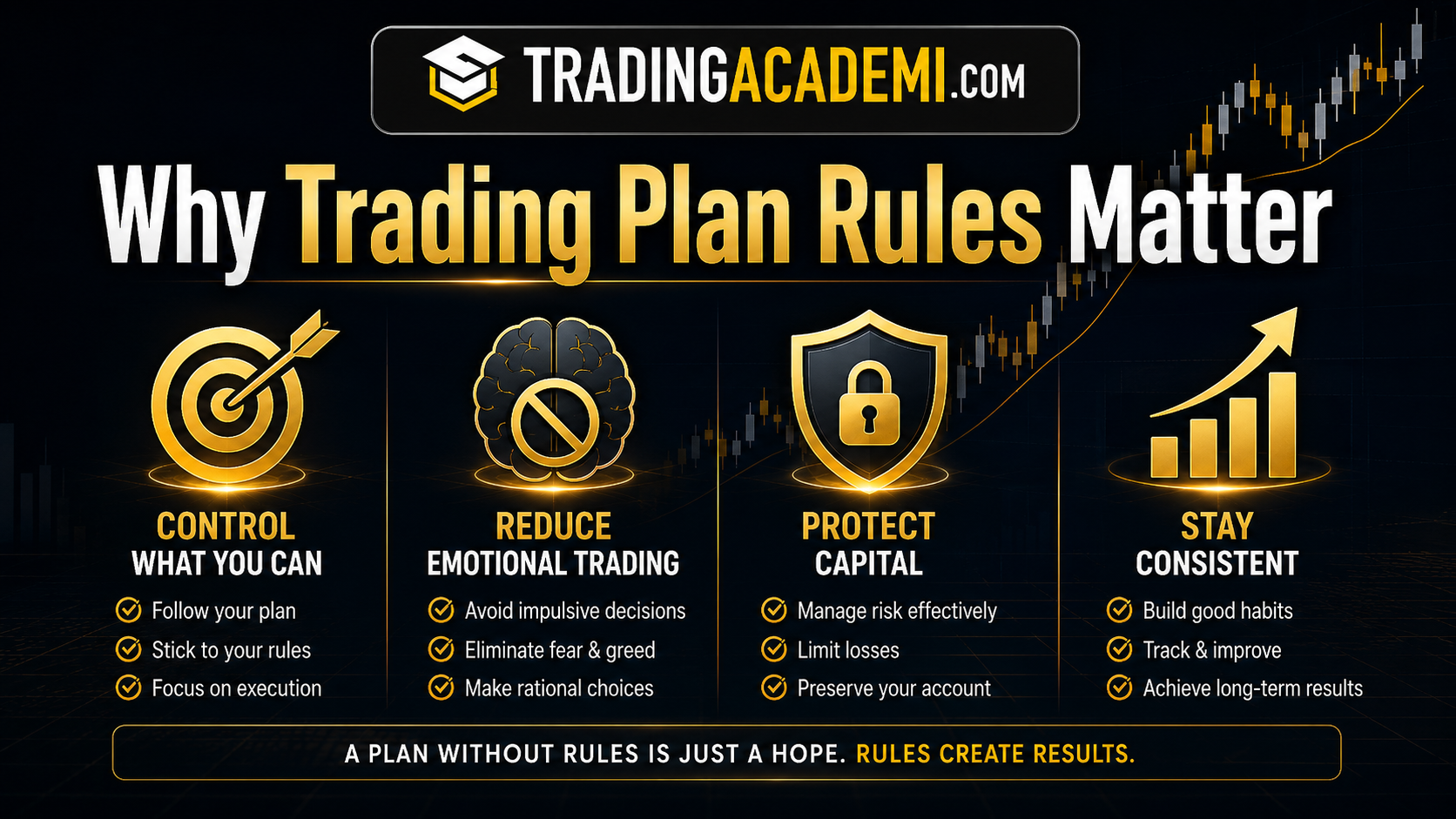
Trading plan rules matter because the market is uncertain. No trader can control price movement. You cannot force the market to respect your analysis, and you cannot guarantee that a setup will win.
But you can control your behavior.
You can control your risk, your position size, your stop loss, your entries, your exits, and whether you stop after reaching a daily loss limit. A trading plan focuses on what you can control, and this is powerful because many trading losses come from behavior, not from the market itself.
A trader without rules may overtrade, revenge trade, increase size after losses, move stop losses, or enter random setups. A trader with clear rules has a better chance of staying consistent.
This is why a trading plan is a major part of trading risk management.

Rule 1: Define Your Trading Market
The first rule is to define what market you trade.
Beginners often jump between markets too quickly. One day they trade forex, the next day they trade crypto, then they try stocks, futures, options, or commodities. This can create confusion because every market behaves differently.
Forex has currency pairs, pip values, spreads, sessions, and economic news. Futures have contracts, tick values, margin requirements, and expiration. Stocks have earnings, sectors, gaps, and company news. Crypto trades 24/7 and can be very volatile.
A beginner should not try to master everything at once. It is usually better to choose one or two markets and study them deeply.
For example, your plan may say that you trade only major forex pairs, only large-cap stocks, only one futures contract, or only Bitcoin and Ethereum. This rule helps you focus instead of jumping from one market to another without structure.
Rule 2: Choose Your Timeframe
A trading plan should define the timeframes you use. Different timeframes create different trading styles.
A scalper may use very short timeframes. A day trader may use intraday charts. A swing trader may use daily or 4-hour charts. A long-term investor may use weekly or monthly charts.
The problem starts when a trader jumps between timeframes emotionally. For example, a trader may enter based on a 5-minute chart, then when the trade goes wrong, switch to a 1-hour chart to justify holding. That is not analysis. That is emotional decision-making.
Your plan should define your main setup timeframe and your entry timeframe. For example, you may use the 1-hour chart for the setup, the 15-minute chart for entry, and the 4-hour chart as a trend filter.
The exact choice depends on your style, but the rule must be clear.
Rule 3: Define Your Trading Setup
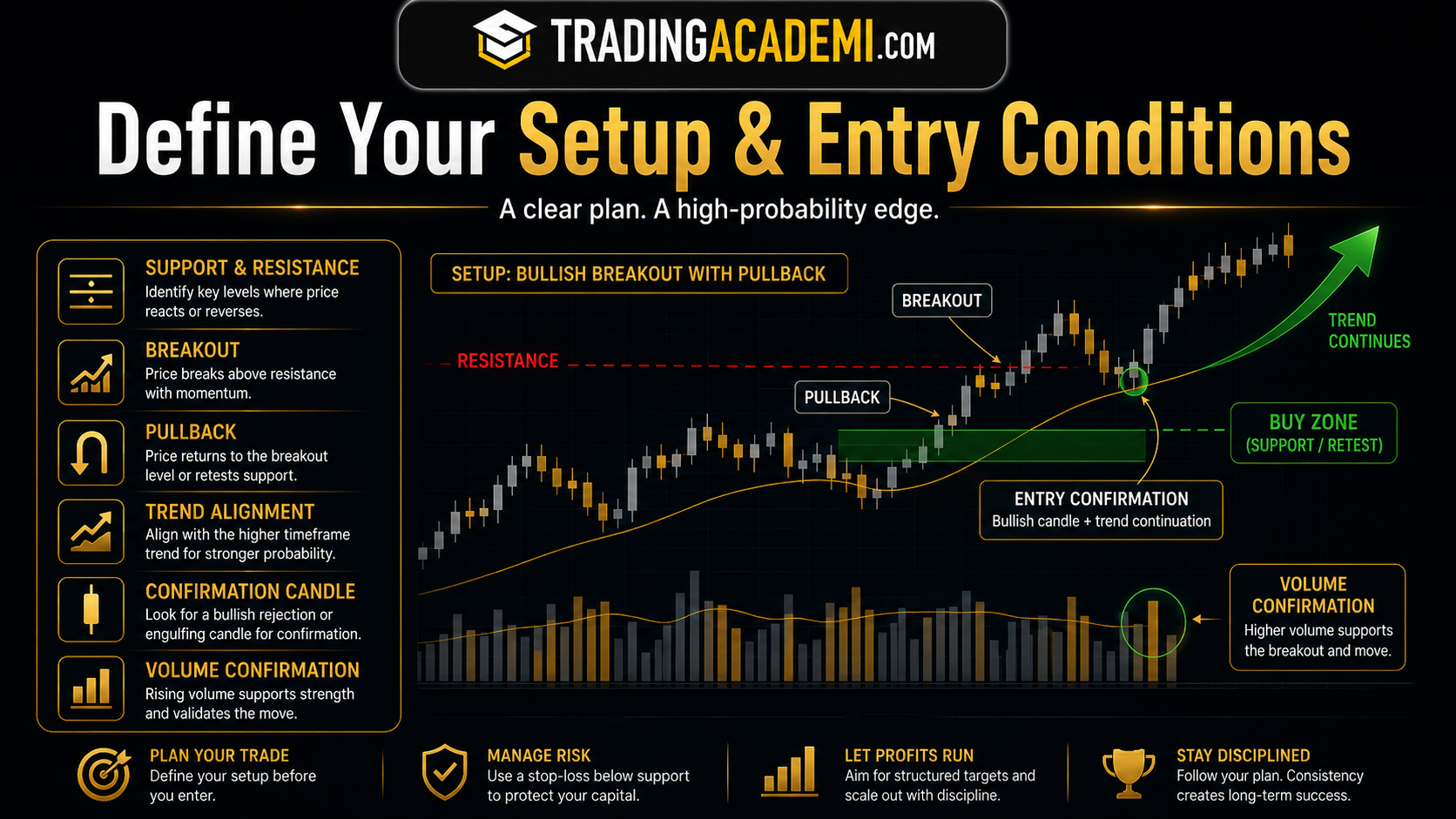
A trading setup is the specific condition that must appear before you enter a trade. This is one of the most important parts of a trading plan because, without a defined setup, you may enter trades for random reasons.
A setup may be based on support and resistance, breakouts, pullbacks, trend continuation, reversals, moving averages, volume, order flow, market structure, technical indicators, or fundamental catalysts.
A beginner should keep the setup simple. For example, your rule may be to buy only pullbacks in an uptrend near support, trade only breakouts after consolidation, enter only when price rejects a key level, or take only trades that align with the higher timeframe trend.
A trading setup should be specific enough that you can look at the chart and say yes or no. If you cannot clearly identify your setup, you are more likely to trade based on emotion.
Rule 4: Define Your Entry Conditions
A setup tells you what you are looking for. Entry conditions tell you exactly when to enter.
Many beginners identify a good market area but enter too early or too late. For example, they may see support and buy immediately before price confirms a reaction. Others wait too long and enter after the move is already extended.
Your entry rule should be clear. You may decide to enter after a breakout candle closes above resistance, after a pullback holds support and creates a confirmation candle, only when volume confirms the move, only when the risk-to-reward ratio is at least 1:2, or only when the trade aligns with the main trend.
The purpose of entry rules is to reduce impulse. You do not enter because the market is moving. You enter because your rule is triggered.
Rule 5: Define Your Stop Loss
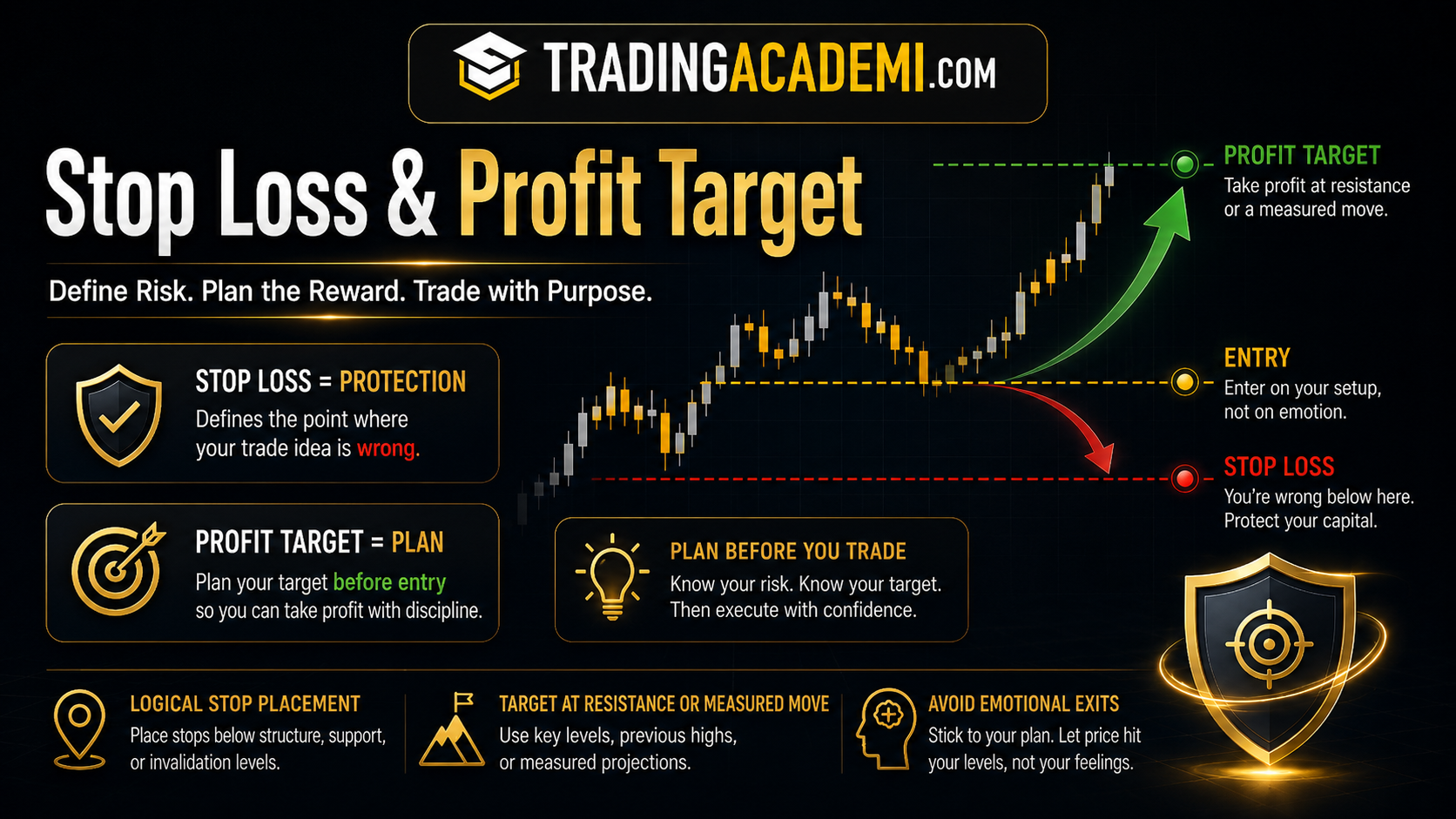
Every trading plan should include stop loss rules. A stop loss defines where your trade idea is wrong.
Without a stop loss, risk becomes unclear. You cannot calculate position size properly, you cannot measure risk-to-reward correctly, and you may hold losing trades too long because you do not want to accept the loss.
Your stop loss should be based on logic. Common stop loss methods include placing the stop below support for long trades, above resistance for short trades, beyond a swing high or swing low, based on volatility, or at the invalidation point of the setup.
A stop loss should not be placed randomly. It should also not be moved farther away because you feel uncomfortable.
Your trading plan should clearly answer three questions: where will I place my stop loss, why is that level valid, and what will I do if price hits it?
Rule 6: Define Your Profit Target
A trading plan should also define how you take profit. Many beginners focus only on entering trades, then once the trade is profitable, they do not know what to do. This creates emotional exits.
A trader may close too early because of fear, hold too long because of greed, or remove the target and hope for more. Your profit target should be planned before entry.
Common target methods include previous support or resistance, measured move targets, risk-to-reward targets, trend continuation levels, partial profit levels, or trailing stop rules.
For example, your plan may say that you take profit at the next resistance level, target at least 1:2 risk-to-reward, take partial profit at 1:1 and let the rest run, or trail the stop after price reaches 1:2.
There is no perfect exit method. The key is consistency. A planned exit is better than an emotional exit.
Rule 7: Define Risk Per Trade
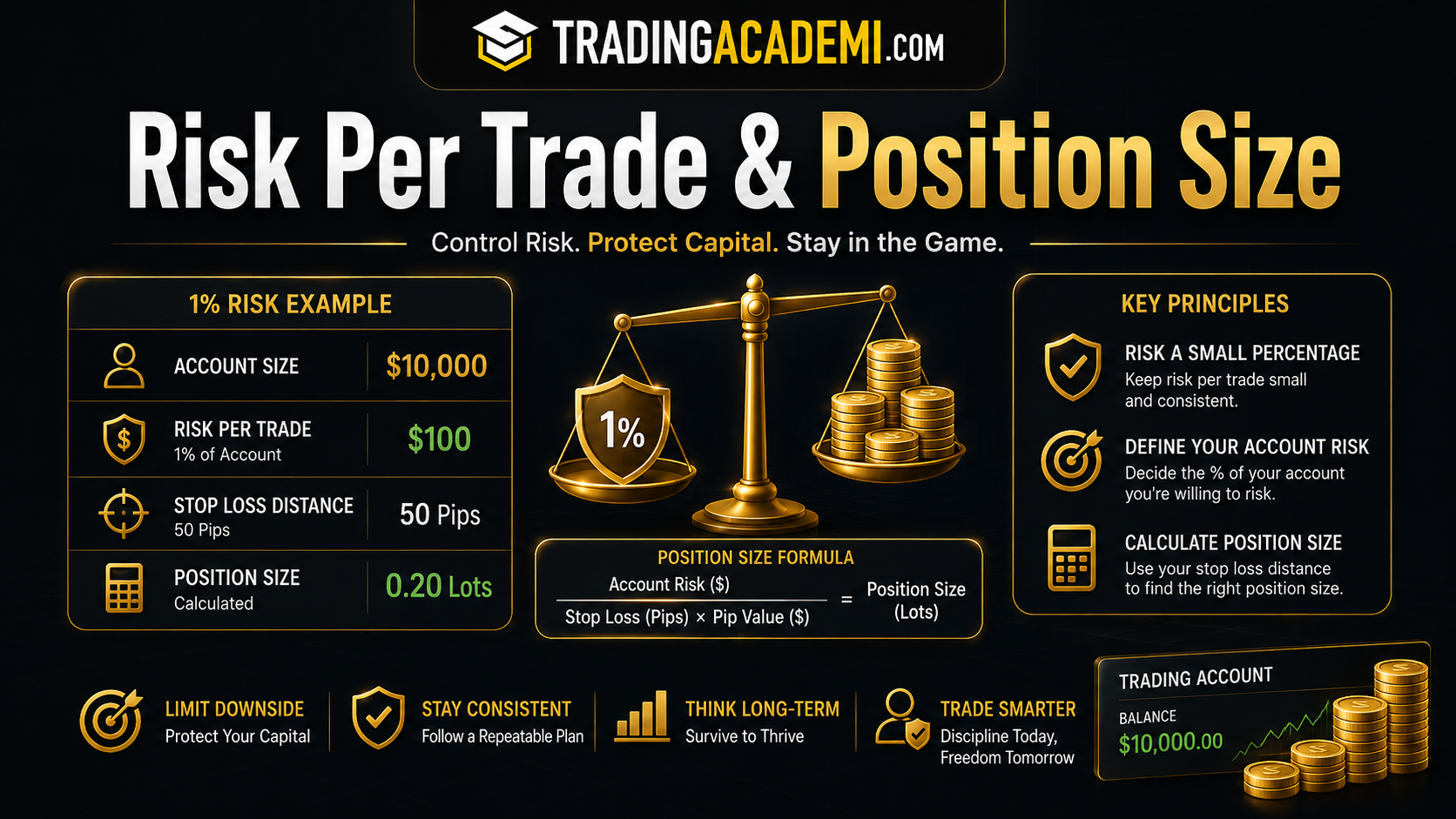
Risk per trade is the amount of your account you are willing to lose if one trade fails. This is a core rule.
A beginner should never decide risk randomly. Many traders use a percentage-based risk model, such as 0.5%, 1%, or 2% per trade. For beginners, smaller risk is usually safer because it gives more room to learn.
For example, if your account is $5,000 and you risk 1%, your planned risk per trade is $50. This means that if your stop loss is hit, the planned loss should be around $50.
Risk per trade keeps losses controlled and helps protect the account during losing streaks. If you risk too much, normal losses can become serious drawdown.
Rule 8: Calculate Position Size
Position sizing converts your risk plan into trade size. Your trading plan should not say, “I will buy a lot.” It should say, “I will calculate position size based on account risk and stop loss distance.”
The basic idea is simple: position size should match your planned risk.
If your stop loss is far away, your position size should usually be smaller. If your stop loss is closer, your position size may be larger, but only if the stop loss is logical.
A common mistake is choosing a large position first, then forcing a tight stop loss to make the risk look acceptable. That is backwards.
The better process is to choose the setup, define the stop loss, define account risk, and then calculate position size.

Rule 9: Set Daily and Weekly Loss Limits
A trading plan should include limits for bad days and bad weeks because even good traders have losing periods.
A daily loss limit prevents one bad day from becoming a disaster. For example, your plan may say that you stop trading after losing 2% in one day, after three losing trades in a row, or after breaking a rule.
A weekly loss limit can also protect the account. For example, if you lose 5% in one week, you stop trading for the rest of the week and review your trades.
Loss limits protect you from emotional decisions. After losses, traders are more likely to revenge trade, overtrade, or increase size. A loss limit creates a clear stopping point before emotions take control.
Rule 10: Define When Not to Trade
A good trading plan does not only tell you when to trade. It also tells you when not to trade.
This is important because many traders lose money during poor conditions. You may decide not to trade when you are tired, angry, distracted, trying to recover losses, or when your setup is not present.
You may also avoid trading before major news, when market conditions are unclear, when spreads are too wide, or when volatility is too extreme for your strategy.
Not trading is still a trading decision. Sometimes the best trade is no trade.
This rule helps reduce emotional risk and unnecessary losses.
Rule 11: Manage Open Trades
A trading plan should explain how you manage a trade after entry. Many beginners enter with a plan, but then change everything once the trade starts moving.
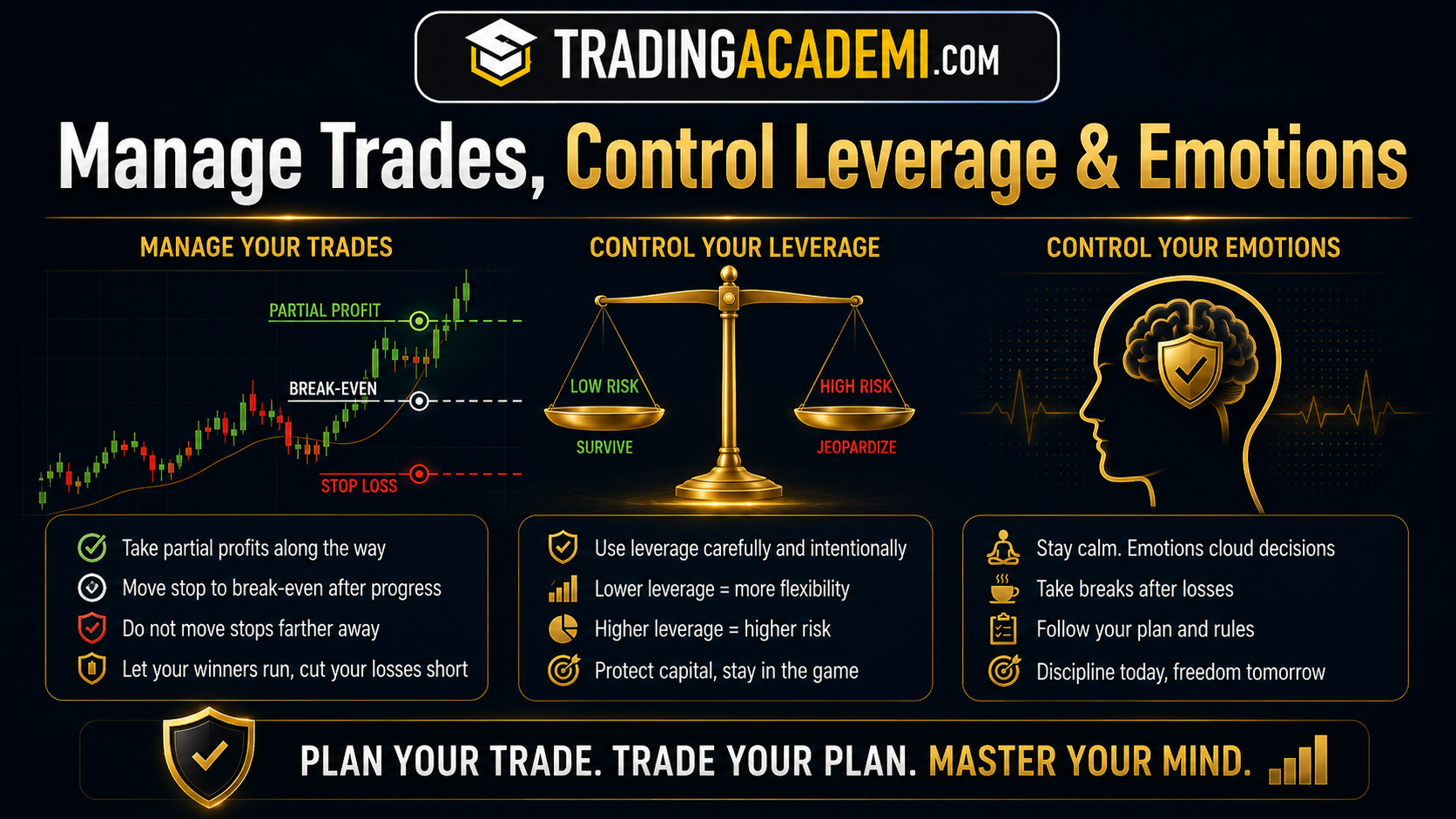
Your trade management rules may include not moving the stop loss farther away, moving the stop to break even only after price reaches a certain level, taking partial profit at a planned target, trailing the stop only with a defined method, not adding to losing trades, and not closing early unless a rule is triggered.
Trade management is where emotions often appear. If price moves slightly against you, fear appears. If price moves in your favor, greed appears. If price goes sideways, impatience appears.
Your plan should guide your actions before those emotions become strong.
Rule 12: Control Leverage
If you use leverage, your plan must include leverage rules. Leverage can increase exposure, make losses larger, and create stronger emotional pressure.
A trading plan should define the maximum leverage allowed, maximum position exposure, margin rules, liquidation awareness, how leverage affects stop loss and position size, and when leverage should be reduced.
A beginner should avoid using leverage just because it is available. The question is not, “How much leverage can I use?” The better question is, “How much exposure can my account safely handle if I am wrong?”
This is especially important if you trade forex, futures, crypto derivatives, or margin stocks.
Rule 13: Follow an Emotional Control Process
A trading plan should include emotional control rules. This may sound simple, but it is very important.
Your emotional process may include taking a break after two losses, stopping trading after breaking a rule, avoiding trading when angry or tired, refusing to enter because of FOMO, avoiding size increases after a loss, writing down your emotion before entering, and reviewing emotional mistakes after each session.
Emotions are normal. The problem is allowing emotions to decide. A trading plan helps you pause before reacting.
It gives you rules when your mind is under pressure.
Rule 14: Keep a Trading Journal
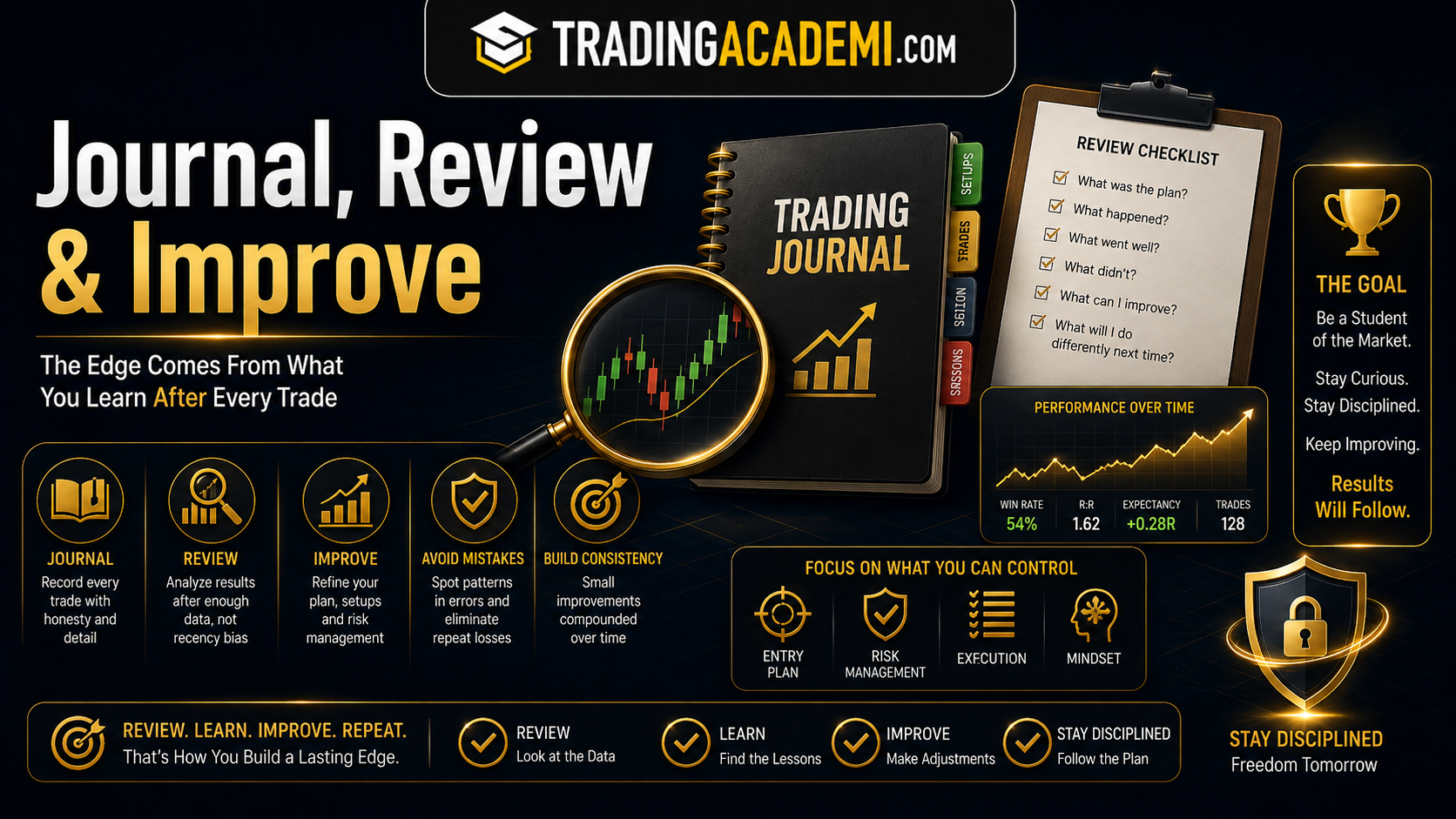
A trading journal helps you improve your plan over time. Your journal should track the entry, exit, market, setup, stop loss, target, risk-to-reward, position size, result, emotion before the trade, emotion during the trade, mistakes, and lesson learned.
Without a journal, you may repeat the same mistakes without noticing. With a journal, you can identify patterns.
For example, you may discover that you lose more when trading after news, close winners too early, perform better during a specific session, or create your biggest losses through revenge trading.
A journal turns trading experience into useful feedback.
Rule 15: Review and Improve the Plan
A trading plan is not something you write once and forget. It should be reviewed and improved over time.
However, you should not change your plan after every losing trade. A few losses do not mean the plan is broken. Review your plan based on enough data, such as 20 trades, 50 trades, one month of trading, or a complete market cycle.
When reviewing, ask whether you are following the plan, which setups perform best, which mistakes repeat, whether your risk is too high, whether your targets are realistic, and whether you trade better at certain times.
The goal is continuous improvement. A good plan evolves through data, not emotion.
Example of Simple Trading Plan Rules
Here is an example of a simple beginner trading plan:
Market: Major forex pairs only
Timeframe: 1-hour setup, 15-minute entry
Setup: Pullback in the direction of the main trend
Entry: Confirmation candle after support or resistance reaction
Stop loss: Beyond the recent swing level
Target: Minimum 1:2 risk-to-reward
Risk per trade: 1% of account
Position size: Calculated before entry
Daily loss limit: 3%
Weekly loss limit: 6%
Leverage: Limited and controlled
No trade if tired, angry, or chasing price
Journal every trade
Review every 20 trades
This is only an example. Your plan should match your strategy, market, schedule, and experience.
The important point is clarity. A simple plan followed consistently is better than a complex plan ignored emotionally.
Trading Plan Checklist
Before entering a trade, ask yourself whether your market is defined, whether your setup is present, and whether the trade matches your timeframe.
You should also know your entry, stop loss, target, risk-to-reward ratio, and position size before entering. Check whether you are within your daily loss limit, whether you are emotionally calm, and whether you are avoiding FOMO or revenge trading.
Finally, ask whether you will journal the trade and whether the trade truly follows your plan.
If the answer is no, the trade may not be ready.
Common Trading Plan Mistakes
One common mistake is trading without a written plan. A plan in your head is easy to change emotionally, but a written plan is clearer.
Another mistake is making the plan too complicated. If your plan has too many rules, you may not follow it. Some traders also change rules too often, especially after every loss, which prevents consistency.
Ignoring risk rules is another serious mistake because a trading plan without risk rules is incomplete. Not journaling trades also makes it difficult to know what is working and what is not.
Many beginners also break the plan during emotional moments. The plan only matters if you follow it when trading becomes uncomfortable.
Finally, copying someone else’s plan blindly can create problems because your plan should match your personality, schedule, account size, and market.
Final Thoughts
Trading plan rules help turn random trading into structured decision-making. A beginner trader should not rely only on feelings, signals, or excitement. The market moves fast, and emotions can easily take control.
A trading plan gives you rules before the pressure begins. It tells you what to trade, when to enter, where to exit, how much to risk, when to stop, and how to improve.
A plan will not make every trade a winner. It will not remove uncertainty, and it will not guarantee profits. But it can help you avoid many of the mistakes that destroy beginner traders.
Before your next trade, remember to plan before you enter, think about risk before profit, follow rules when emotions appear, journal your trades, review with honesty, and improve slowly.
Discipline is not built by one perfect trade. It is built by following your plan again and again.
Educational Disclaimer
This article is for educational purposes only and should not be considered financial advice. Trading and investing involve risk, including the possible loss of capital. A trading plan can help create structure, but it does not guarantee profits or prevent losses. Always do your own research or consult a qualified financial professional before making financial decisions.