 By Anzo Trader
A trading journal is one of the most powerful tools a trader can use to improve. Many beginners believe improvement comes only from finding better indicators, better signals, or better strategies. Those things can help, but they are not enough if you do not understand your own trading behavior.
A trader can repeat the same mistakes for months without realizing it. They may enter too early, close winners too fast, move stop losses, risk too much after a loss, or trade better in some market conditions and worse in others.
Without a journal, these patterns are easy to miss.
A trading journal helps you track what you did, why you did it, how you felt, and what happened after the trade. It turns random trading experience into useful feedback. A journal is not only about recording wins and losses. It is about understanding your decisions.
Before reading this guide, it can help to understand risk management in trading, position sizing, stop loss orders, risk-to-reward ratio, drawdown control, emotional risk, and trading plan rules, because a journal helps you measure whether you are actually following those rules.
What Is a Trading Journal?
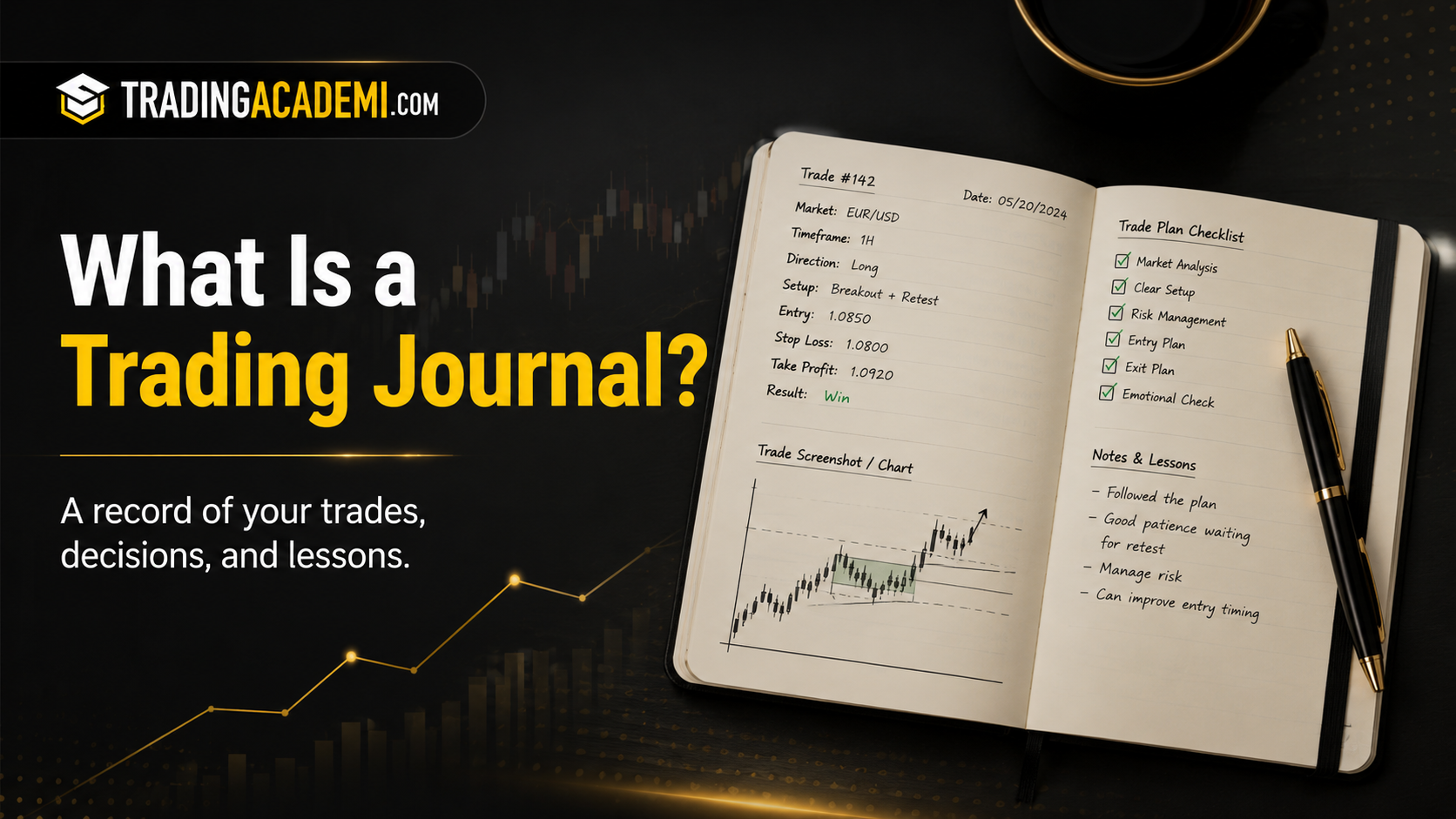
AA trading journal is a record of your trades and trading decisions. It helps you document what happened before, during, and after each trade.
A good trading journal may include the market traded, date and time, setup type, entry price, stop loss, profit target, position size, risk-to-reward ratio, result, reason for entering, reason for exiting, screenshots, emotional state, mistakes, and lessons learned.
In simple terms, a trading journal answers this question: what did I do, why did I do it, and what can I learn from it?
A journal helps you move from guessing to reviewing. It gives you real data about your trading behavior, not just memories or feelings.

Why a Trading Journal Matters
A trading journal matters because traders often remember trades emotionally, not accurately.
After a winning trade, you may remember yourself as disciplined. After a losing trade, you may blame the market. But a journal shows the truth. It can show whether you followed your plan or broke your rules.
It can also show whether your best trades come from specific setups, whether your biggest losses happen after emotional decisions, and whether your risk management is consistent.
This is why journaling is a key part of trading risk management. Risk management is not only about planning risk before a trade. It is also about reviewing whether you respected that risk afterward.
A journal helps you become honest with yourself, and honesty is necessary for improvement.
Trading Journal vs Trade History
Many beginners think their broker history is enough, but it is not.
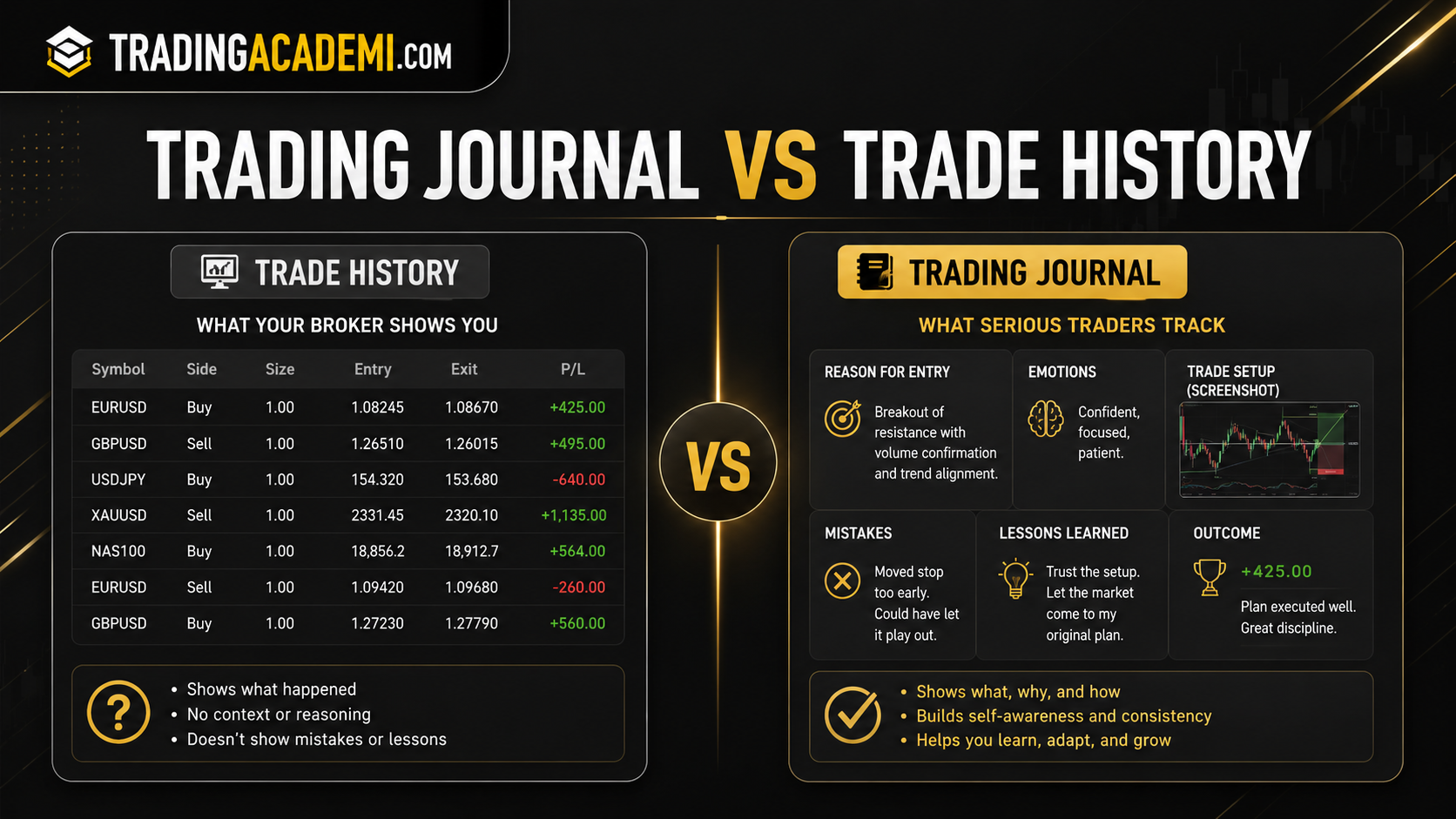
Your trade history may show entry, exit, profit, loss, and time. But it usually does not explain why you took the trade. It does not show your emotional state, whether the trade followed your plan, whether you entered because of FOMO, whether you moved your stop loss, or whether the setup was high quality or random.
A trading journal is deeper than trade history. Trade history shows the result, while a trading journal explains the decision.
Both are useful, but the journal gives more learning value because it helps you understand the behavior behind the numbers.

What Should You Include in a Trading Journal?
A good trading journal should include enough information to help you improve, but it should not be so complicated that you avoid using it.
For beginners, a simple structure is usually best. You can start by recording the market, date and time, trade direction, setup type, entry price, stop loss, profit target, position size, risk per trade, risk-to-reward ratio, exit price, profit or loss, reason for entry, reason for exit, emotional state, screenshots, mistakes, and lesson learned.
This may look like a lot at first, but it becomes easier with practice. The goal is not to write a long story for every trade. The goal is to capture the important details that help you review your decisions later.
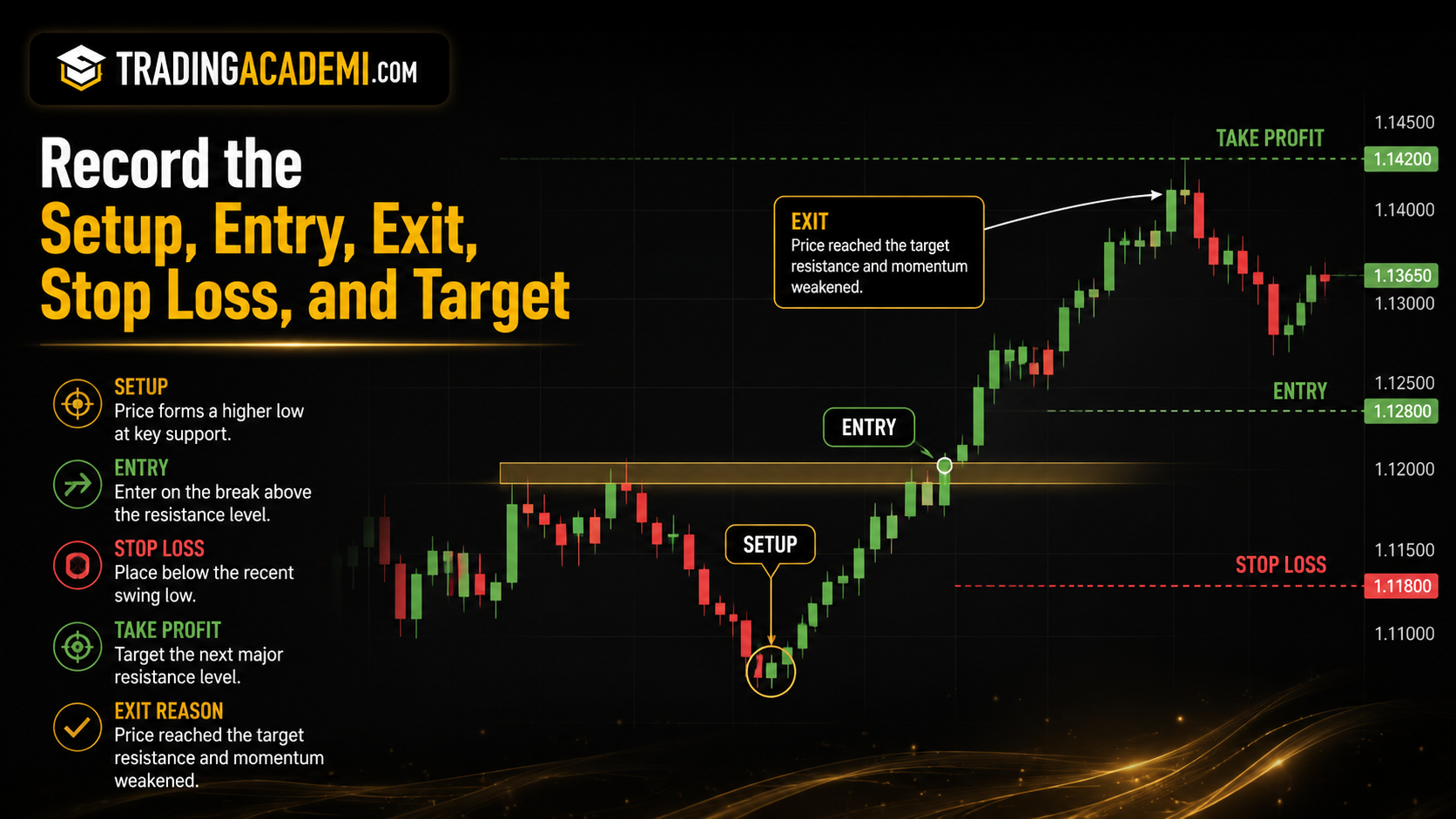
Record the Trade Setup
The setup is the reason you entered the trade, so it is one of the most important parts of the journal. If you do not record the setup, you cannot know which setups perform best.
Examples of setups include breakout, pullback, support bounce, resistance rejection, trend continuation, reversal, moving average setup, news-based setup, order flow setup, or range breakout.
Your journal should clearly identify the setup. For example, you may write: “Bullish pullback in an uptrend near support.” Another example could be: “Breakout above resistance with strong volume.”
This helps you later compare setups and find what works best for you. If your setups are not clearly defined yet, review your trading plan rules before trying to judge your performance.
Record Entry and Exit Reasons
A good journal should include why you entered and why you exited. This is important because many traders enter for one reason and exit for another emotional reason.
For example, you may enter because of a valid breakout setup, but exit early because you felt afraid. Or you may enter based on support, but exit because of panic during normal volatility.
Your journal should capture this honestly.
A good entry reason may be: “Price broke above resistance, retested the level, and formed a bullish confirmation candle.” A good exit reason may be: “Target reached” or “Stopped out according to plan.”
Sometimes the honest exit reason may be: “Closed early because I felt nervous.” That may feel uncomfortable to write, but it is valuable.
A journal should be honest, not perfect.
Track Stop Loss and Profit Target
Your journal should record your stop loss and profit target before the trade. This helps you check whether the trade had structure.
A trade without a clear stop loss is difficult to review. A trade without a target can easily become emotional.
By recording stop loss and target, you can later ask important questions. Was the stop loss logical? Was the target realistic? Did you move the stop loss? Did you close before the target? Did you let a winning trade turn into a loss? Was the risk-to-reward acceptable?
This connects directly with stop loss orders and risk-to-reward ratio. A journal helps you see whether your exits are disciplined or emotional.

Track Position Size and Risk Per Trade
Position size should be included in every trading journal because it shows whether your risk is consistent.
A trader may think they are risking 1% per trade, but the journal may show different behavior. Maybe they risk 1% on normal trades, but 3% after losses. Maybe they increase size after winning streaks. Maybe they trade too large during emotional periods.
This is important because inconsistent position sizing can create unstable results.
Your journal should include account size, risk percentage, dollar risk, position size, stop loss distance, and total exposure. If you need a full explanation, read the guide on position sizing in trading.
A trading journal makes your risk behavior visible.
Track Emotions Before and During the Trade
Many traders ignore emotions when journaling, but that is a mistake. Emotions have a big effect on trading decisions.
Your journal should include how you felt before entering and during the trade. Examples include calm, focused, impatient, fearful, greedy, angry, frustrated, overconfident, tired, distracted, excited, or desperate.
You can also rate emotions from 1 to 5. For example, fear level 4/5, confidence level 3/5, or discipline level 2/5.
Over time, you may discover patterns. Maybe your worst trades happen when you are tired. Maybe you overtrade after the first loss. Maybe you chase when you feel excited. Maybe you close winners too early when fear is high.
This is why journaling is one of the best tools for managing emotional risk in trading.
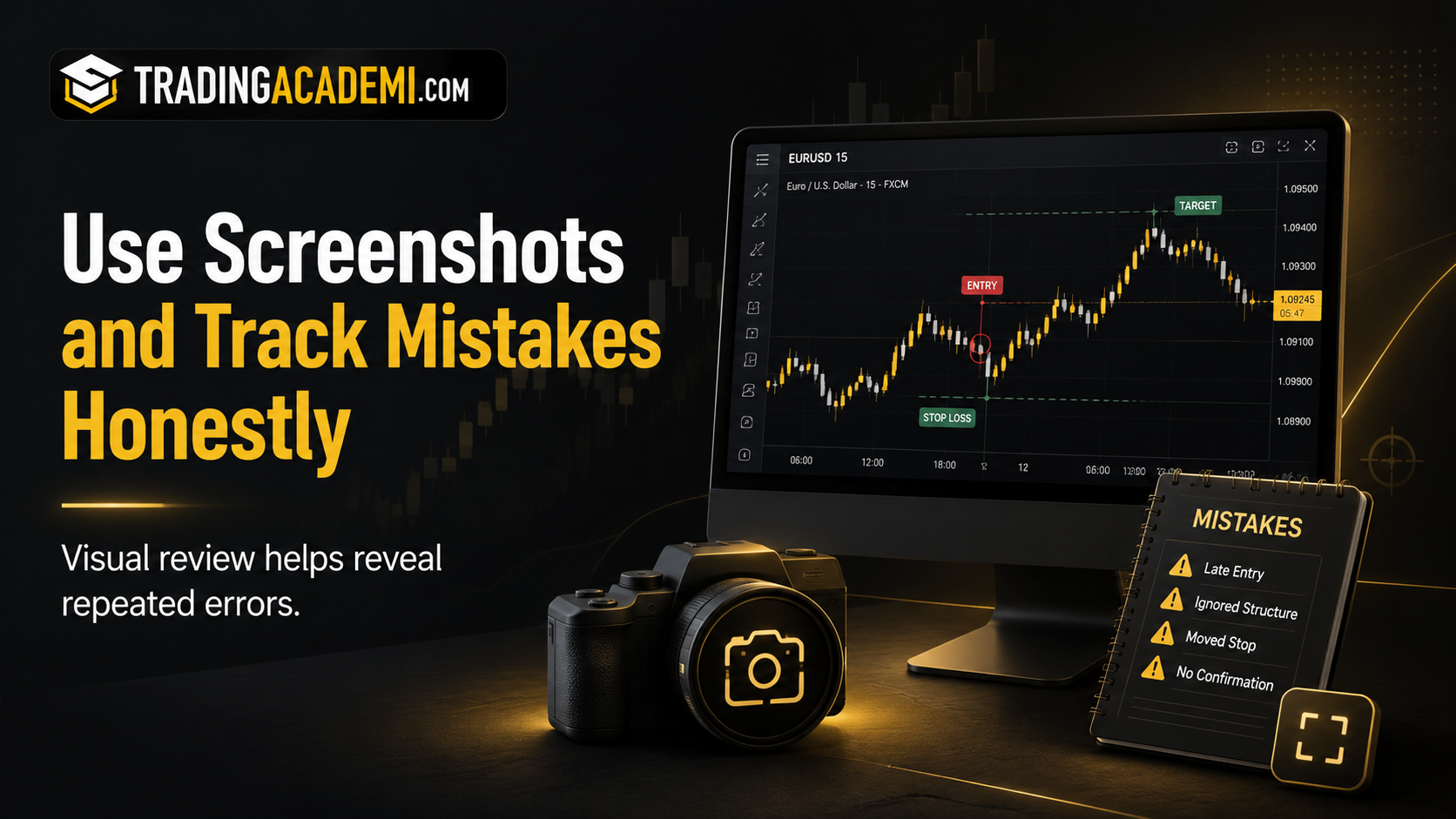
Use Screenshots in Your Trading Journal
Screenshots are very useful because they help you review the chart later. A screenshot can show the setup before entry, the stop loss level, the target level, support and resistance, market structure, entry timing, and the result after exit.
When you review later, you may see mistakes you missed in real time. For example, you may notice that you entered into resistance, that the target was unrealistic, or that the setup was not clean.
Screenshots help you review visually.
For personal study, you can keep screenshots in folders by date, market, or strategy. For example: “Trading Journal / 2026 / July / EURUSD Pullback Trade.” This makes review easier and keeps your trading records organized.
Track Mistakes Honestly
A trading journal should include mistakes, not to criticize yourself, but to improve.
Common mistakes to track include entering too early, entering too late, chasing the trade, ignoring the trend, moving the stop loss, closing winners too early, holding losers too long, using too much leverage, risking too much, trading without a setup, trading while emotional, ignoring news, breaking the daily loss limit, or not following the plan.
The goal is to find repeated mistakes. One mistake may be normal, but a repeated mistake is a pattern. A pattern can be fixed only after it is identified.
This is why honesty matters. A journal only helps if it records what really happened.

Review Winning Trades
Many traders review only losing trades, but that is not enough. Winning trades should also be reviewed.
Ask whether you followed your plan, whether the setup was high quality, whether the entry was good, whether the stop loss was logical, whether the target was realistic, and whether you exited according to plan.
Also ask whether the win came from skill or luck.
Sometimes a winning trade is actually a bad trade that got lucky. For example, you may break your rules, enter emotionally, and still make money. If you do not review it, you may repeat the same bad behavior until it eventually causes a large loss.
Good journaling separates good decisions from lucky outcomes.
Review Losing Trades
Losing trades should also be reviewed carefully, but the goal is not to blame yourself for every loss. A losing trade is not automatically a bad trade.
A good trade can lose if the market does not move as expected. That is normal.
When reviewing a losing trade, ask whether you followed your plan, whether the setup was valid, whether the stop loss was logical, whether the position size was correct, whether the risk was acceptable, and whether you exited according to the rules.
If the trade followed your plan and the loss was controlled, it may be a good loss. A good loss is a planned loss.
The real problem is an unplanned loss caused by broken rules.
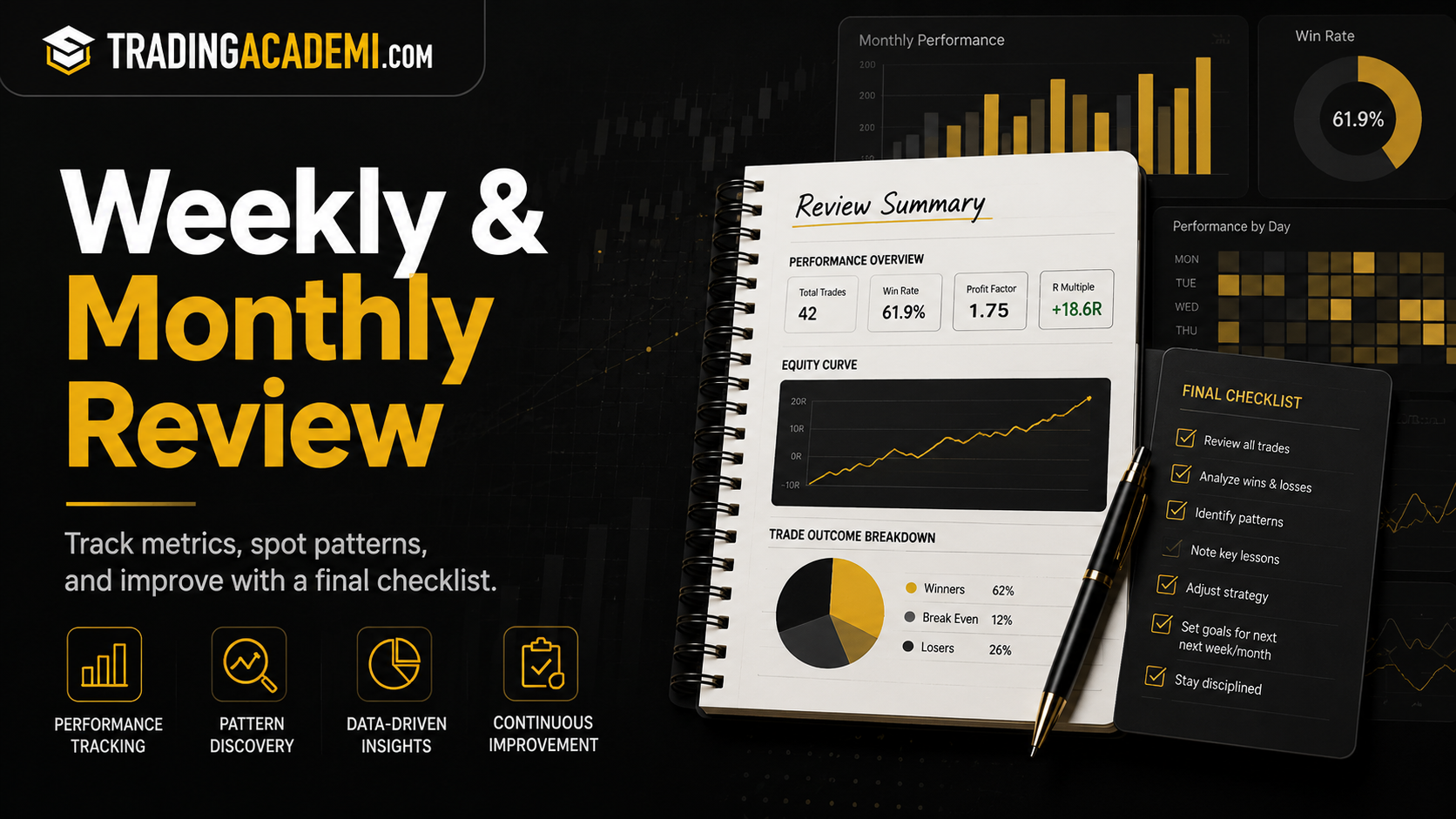
Weekly Trading Journal Review
A weekly review is one of the best habits a beginner can build. At the end of each week, review your trades and look for patterns.
Ask how many trades you took, how many followed your plan, which setups worked best, which setups performed poorly, and what your average risk-to-reward looked like. Also check whether you respected stop losses, respected daily loss limits, and managed emotions well.
A weekly review helps you stay connected to your performance. It prevents you from repeating the same mistake week after week.
This process also supports drawdown control because it helps you identify problems before losses become too large.
Monthly Trading Journal Review
A monthly review gives a bigger picture because one week may be too small to judge a strategy. A month gives more data.
In a monthly review, look for your best-performing setup, worst-performing setup, best trading session, worst trading session, average win, average loss, win rate, risk-to-reward performance, maximum drawdown, biggest mistake, most repeated emotion, and rule-following percentage.
The goal is not only to see profit or loss. The goal is to understand what caused the result.
If you made money but broke many rules, you still need improvement. If you lost money but followed the plan well, you may need more data or strategy refinement.
Trading Journal Metrics to Track
Some useful trading journal metrics include win rate, average win, average loss, risk-to-reward ratio, profit factor, maximum drawdown, number of trades, best setup, worst setup, rule-following percentage, average risk per trade, largest loss, largest win, emotional mistake count, and overtrading count.
You do not need to track everything from the beginning. Start simple, then add more metrics as you improve.
For beginners, one of the most important metrics may be rule-following percentage. If you cannot follow your rules, strategy metrics will not mean much.
Trading Journal Example
Here is a simple example of a trading journal entry:
Market: EUR/USD
Date: July 5
Direction: Long
Setup: Pullback in uptrend
Entry: 1.0850
Stop loss: 1.0825
Target: 1.0900
Risk-to-reward: 1:2
Risk per trade: 1%
Position size: Calculated before entry
Emotion before entry: Calm
Emotion during trade: Slight fear during pullback
Exit: Target reached
Result: Win
Mistake: Almost closed early
Lesson: Trust the plan when the setup is valid
This type of journal entry is simple but useful. It shows the trade, the risk, the emotion, and the lesson.
How a Trading Journal Improves Discipline
A journal improves discipline because it creates accountability. When you know you must write down every trade, you become more careful.
You may hesitate before taking a random trade because you know you will need to explain it later. You may avoid revenge trading because you know the journal will expose it. You may follow your stop loss because you know broken rules will be recorded.
A journal makes trading behavior visible. Once behavior is visible, it becomes easier to improve.
This is why journaling supports trading plan rules.
Digital vs Paper Trading Journal
You can use either a digital journal or a paper journal.
A digital journal can be easier for calculations, filters, screenshots, and statistics. Examples include spreadsheets, Notion, Google Sheets, Excel, specialized trading journal software, or broker exports combined with notes.
A paper journal can be useful for emotional reflection because writing by hand can slow you down and make you think more clearly.
The best journal is the one you will actually use. Do not overcomplicate the tool. A simple spreadsheet used consistently is better than an advanced journal you never update.
Common Trading Journal Mistakes
One common mistake is only journaling losing trades. Winning trades also need review because some winners come from bad decisions that were rewarded by luck.
Another mistake is writing too little detail. If your journal only says “win” or “loss,” it will not teach you much. Writing too much detail can also become a problem if journaling feels too difficult and you stop doing it.
Many traders also forget to record emotions, even though emotions are often the reason rules are broken. Another mistake is recording trades but never reviewing them. Recording is only half the process. Reviewing is where improvement happens.
Some traders also change strategy too quickly before the journal has enough data. Finally, being dishonest makes the journal useless. A journal only works if you record the truth.
Trading Journal Checklist
After each trade, ask whether you followed your trading plan, what setup you traded, why you entered, and why you exited. Check whether your stop loss was clear, whether your target was clear, and whether your position size was correct.
You should also record your risk-to-reward ratio, emotional state, mistakes, and lesson learned.
This checklist keeps your review simple and consistent.
Final Thoughts
A trading journal is not just a record of trades. It is a tool for self-improvement. It helps you understand your strategy, your behavior, your mistakes, your emotions, and your progress.
The market gives feedback every day, but without a journal, that feedback can disappear quickly. A journal helps you capture it.
If you are a beginner, do not wait until you become profitable to start journaling. Start now. Track your trades, emotions, mistakes, rules, and progress. Then review everything honestly and improve one thing at a time.
Trading improvement does not come from guessing. It comes from honest review and consistent adjustment.
A trader who journals seriously has a better chance of building discipline, protecting capital, and improving over time.
Educational Disclaimer
This article is for educational purposes only and should not be considered financial advice. Trading and investing involve risk, including the possible loss of capital. A trading journal can help improve discipline and review, but it does not guarantee profits or prevent losses. Always do your own research or consult a qualified financial professional before making financial decisions.