 By Anzo Trader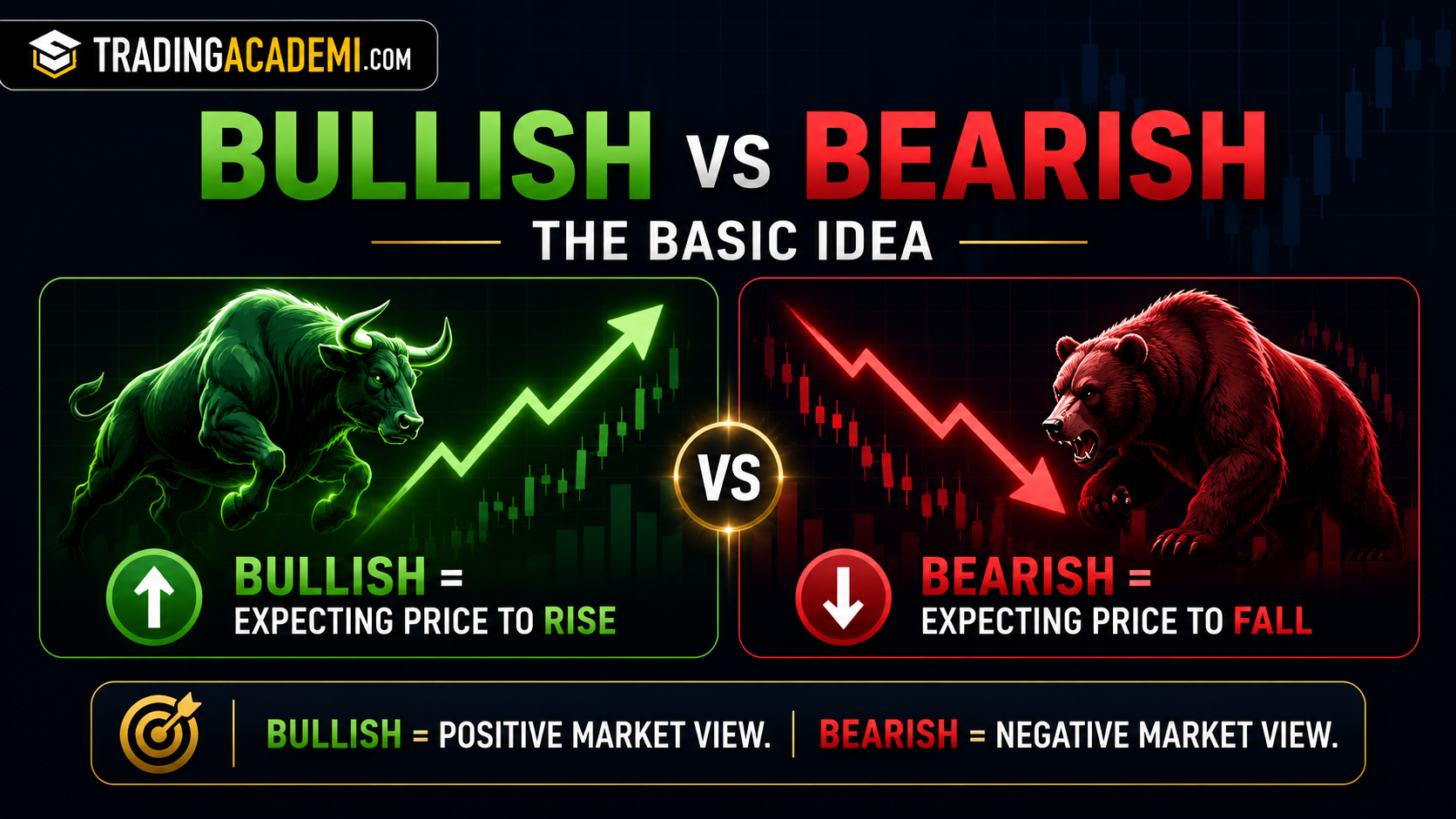
If you are new to trading, two of the first words you will hear are bullish and bearish.
These terms are used everywhere in financial markets. Traders use them when talking about stocks, forex, futures, cryptocurrencies, commodities, indices, and many other assets.
You may hear someone say:
“The market is bullish.”
Or:
“I am bearish on this stock.”
At first, these words may sound confusing, but the idea is simple.
Bullish means the trader expects price to move higher.
Bearish means the trader expects price to move lower.
Understanding bullish and bearish market views is important because these terms describe market direction, trader expectations, and general sentiment.
Before learning advanced strategies, beginners should understand these basic terms clearly. They are part of the foundation of key trading terminology and connect directly with topics like what trading is, types of financial markets, and risk management.
What Does Bullish Mean in Trading?
Bullish means that a trader, investor, or market participant expects price to rise.
When someone is bullish on an asset, they believe that asset may increase in value.
For example:
A trader may be bullish on a stock because the company has strong earnings.
A forex trader may be bullish on the U.S. dollar because of strong economic data.
A crypto trader may be bullish on Bitcoin because price is breaking above resistance.
A futures trader may be bullish on oil because demand is expected to increase.
In simple words:
Bullish = expecting price to go up.
A bullish market is often called a bull market. A bull market is a period when prices are generally rising or when market sentiment is strongly positive.
However, being bullish does not mean the trader is guaranteed to be correct. It only describes their view or expectation.
The market can still move against a bullish opinion.
That is why a bullish view should always be combined with a trading plan, position sizing, and proper risk control.
Why Is It Called Bullish?
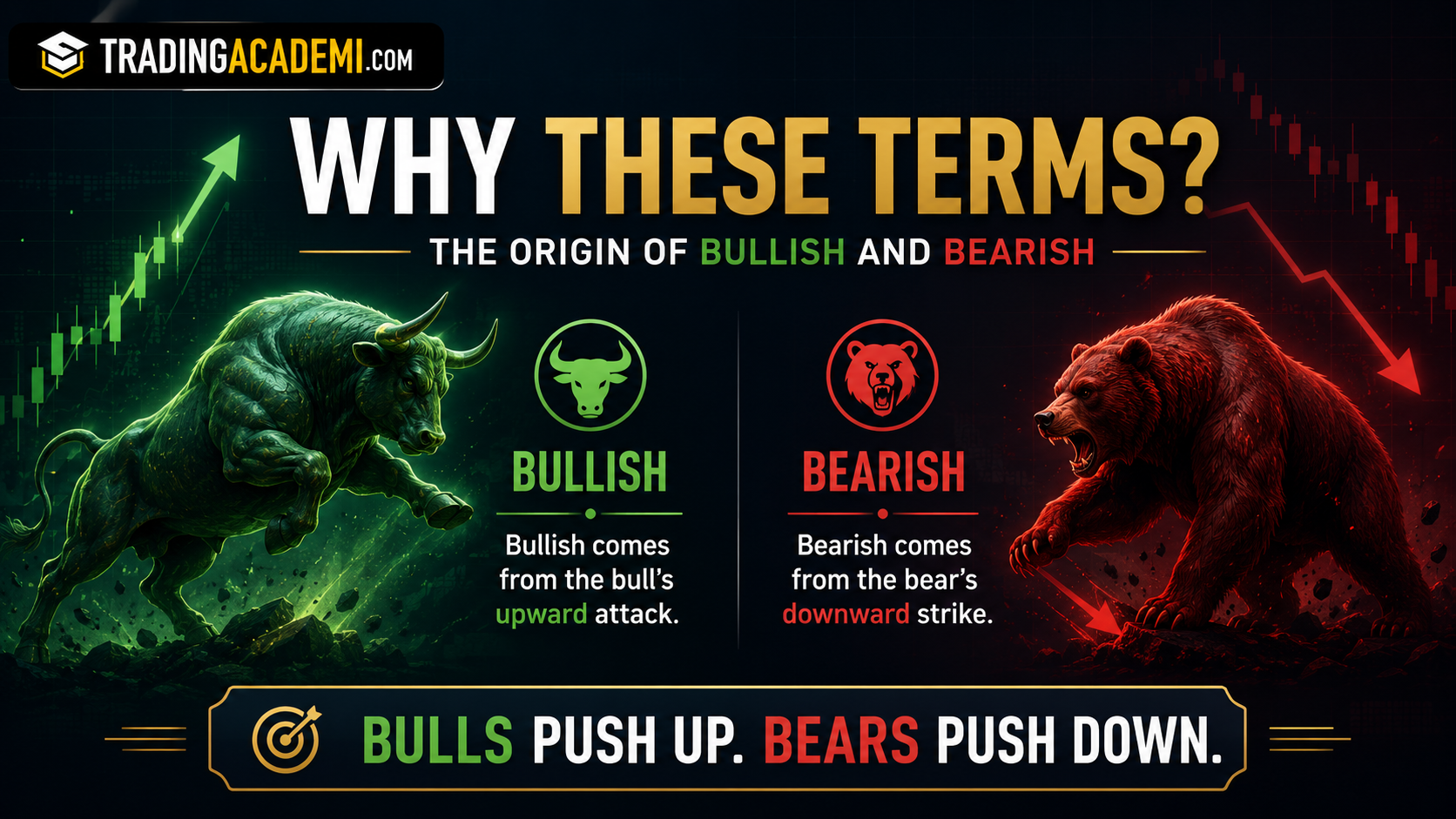
The word “bullish” comes from the way a bull attacks.
A bull usually attacks by pushing its horns upward.
Because of that upward movement, traders use the bull as a symbol of rising prices.
So when someone says the market is bullish, they mean price is expected to move upward.
This is only a symbol, but it is widely used in financial markets.
You may see bull statues, bull icons, or bull market headlines whenever markets are rising strongly.
What Does Bearish Mean in Trading?
Bearish means that a trader, investor, or market participant expects price to fall.
When someone is bearish on an asset, they believe that asset may decrease in value.
For example:
A trader may be bearish on a stock because the company reported weak earnings.
A forex trader may be bearish on a currency because interest rate expectations are falling.
A crypto trader may be bearish after price breaks below support.
A commodities trader may be bearish on gold if demand weakens.
In simple words:
Bearish = expecting price to go down.
A bearish market is often called a bear market. A bear market is a period when prices are generally falling or when market sentiment is strongly negative.
A bearish opinion does not guarantee that price will fall. It only describes the trader’s expectation.
A trader can be bearish and still be wrong.
This is why every trade needs a clear risk plan.
Why Is It Called Bearish?
The word “bearish” comes from the way a bear attacks.
A bear usually attacks by swiping its paws downward.
Because of that downward motion, traders use the bear as a symbol of falling prices.
So when someone says the market is bearish, they mean price is expected to move downward.
This is why rising markets are often connected with bulls, while falling markets are connected with bears.
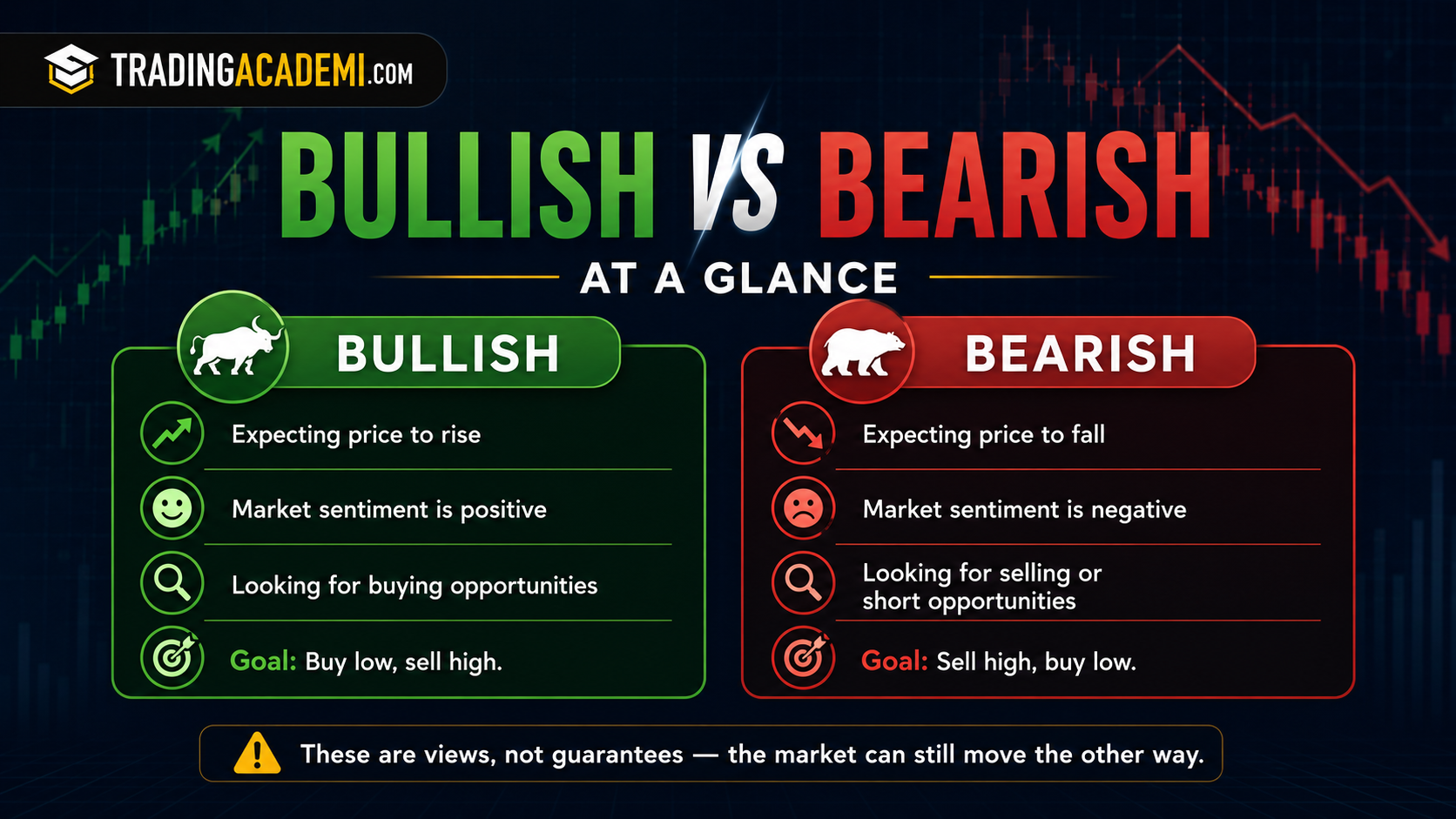
Bullish vs Bearish: Simple Difference
The difference between bullish and bearish is based on expected price direction.
| Term | Meaning | Price Expectation | Common Action |
|---|---|---|---|
| Bullish | Positive market view | Price may rise | Buy or look for long opportunities |
| Bearish | Negative market view | Price may fall | Sell, avoid buying, or look for short opportunities |
A bullish trader is usually looking for reasons to buy or stay in a long position.
A bearish trader is usually looking for reasons to sell, avoid buying, or possibly enter a short position.
This connects with the next important topic: long vs short in trading.
Bullish Does Not Always Mean Buy Immediately
One common beginner mistake is thinking:
“If I am bullish, I should buy now.”
That is not always true.
A trader can be bullish on an asset but still wait for a better entry.
For example, a trader may believe a stock is likely to rise over the next few weeks, but the current price may already be too high. Instead of buying immediately, the trader may wait for a pullback, a breakout, or a better risk-to-reward setup.
Being bullish is only a market opinion.
It does not replace a trading plan.
A good trader may ask:
Where is the entry?
Where is the stop loss?
Where is the target?
What is the risk-to-reward ratio?
How much capital should be risked?
Is the market condition clear?
This is why a bullish idea should be filtered through trading plan rules before taking action.
Bearish Does Not Always Mean Sell Immediately
The same idea applies to bearish opinions.
If a trader is bearish, it does not always mean they should immediately sell or short the market.
Price may already be near support.
The market may be oversold.
The risk-to-reward may be poor.
A strong news event may be coming.
Liquidity may be weak.
The trader may not have confirmation yet.
A bearish view is only a directional bias.
It should not replace analysis, discipline, and risk management.
For example, a trader may be bearish on a stock but wait for price to break below a key support level before taking action.
This is why understanding support and resistance can help traders avoid entering too early.
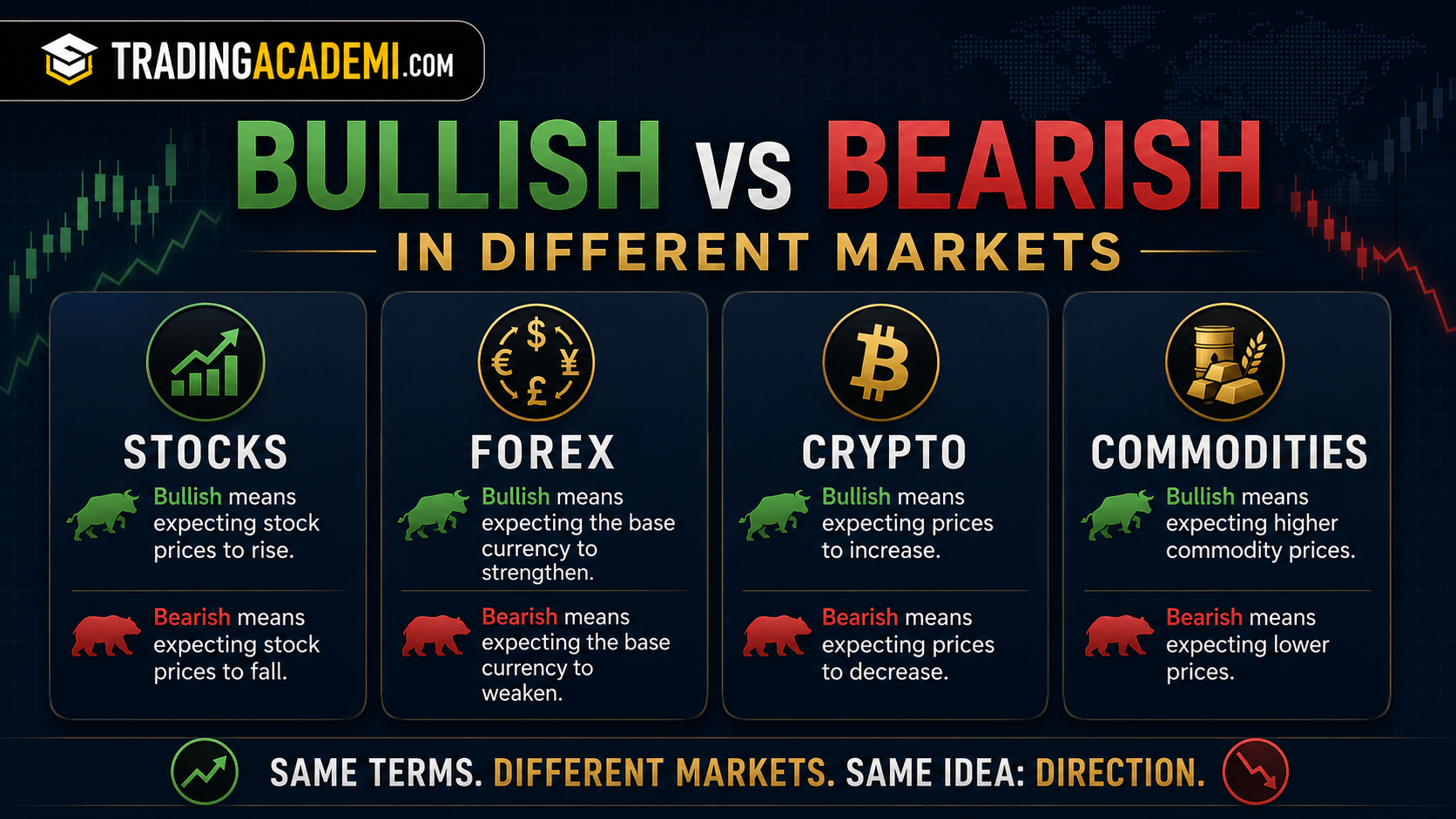
Bullish and Bearish in Different Markets
Bullish and bearish can be used in many markets.
Stock Market
A trader can be bullish on a stock if they expect the company’s share price to rise.
Example:
“I am bullish on this stock because earnings are improving.”
A trader can be bearish if they expect the stock price to fall.
Example:
“I am bearish because revenue is slowing and price is breaking support.”
You can learn more in our guide to the stock market.
Forex Market
In forex, bullish and bearish usually refer to one currency compared with another.
For example, if a trader is bullish on EUR/USD, they expect the euro to strengthen against the U.S. dollar.
If a trader is bearish on EUR/USD, they expect the euro to weaken against the U.S. dollar.
Forex can be confusing for beginners because every pair includes two currencies. This is why it is important to understand the basics of the forex market.
Cryptocurrency Market
A crypto trader may be bullish on Bitcoin if price is trending higher or if market sentiment is positive.
A trader may be bearish if crypto prices are falling, volume is weak, or risk appetite is decreasing.
Crypto markets can be highly volatile, so bullish and bearish views can change quickly.
Learn more in the cryptocurrency market guide.
Commodities Market
Traders can also be bullish or bearish on commodities like gold, oil, natural gas, wheat, or silver.
For example:
A trader may be bullish on oil if demand is expected to rise.
A trader may be bearish on gold if interest rates are expected to move higher.
Commodity prices can react to supply, demand, global events, inflation, and currency strength.
You can review the basics in our commodities market guide.
Bullish and Bearish Market Sentiment
Bullish and bearish are also used to describe market sentiment.
Market sentiment means the general mood or attitude of traders and investors.
If many traders are optimistic, the market sentiment may be bullish.
If many traders are fearful or negative, sentiment may be bearish.
Bullish sentiment can appear when:
Prices are rising
News is positive
Earnings are strong
Economic data is improving
Traders are confident
Risk appetite is high
Bearish sentiment can appear when:
Prices are falling
News is negative
Economic data is weak
Volatility is high
Traders are fearful
Risk appetite is low
However, sentiment can change quickly.
A market can look bullish one day and bearish the next if new information appears.
This is why traders should avoid relying only on emotion or headlines.
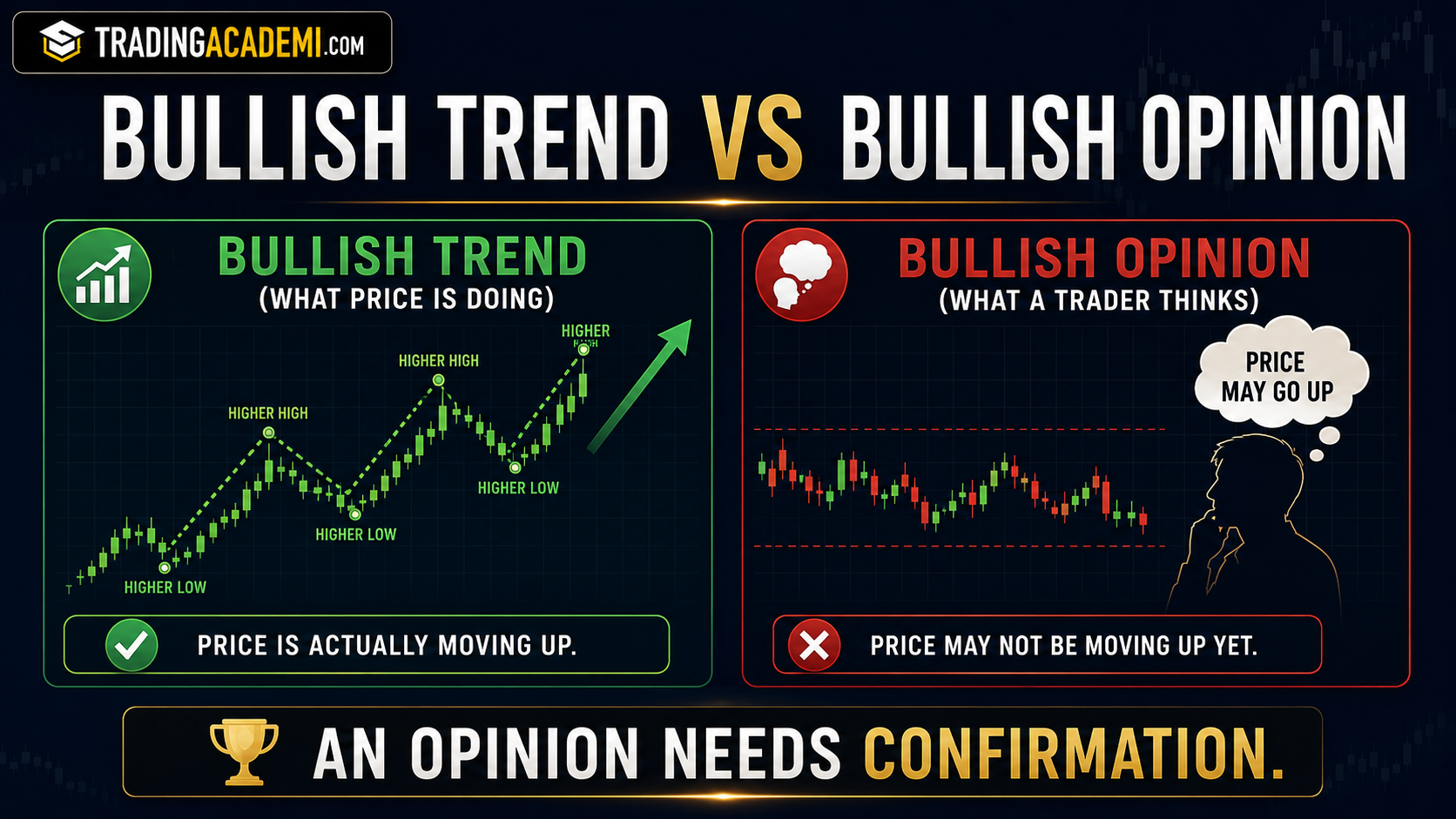
Bullish Trend vs Bullish Opinion
There is an important difference between a bullish trend and a bullish opinion.
A bullish trend means price is actually moving upward.
A bullish opinion means someone believes price may move upward.
These are not the same.
A trader can be bullish even when the chart is not yet bullish.
For example, someone may believe a stock will rise in the future, but the current chart may still be moving sideways or downward.
That is why traders often look for confirmation before entering.
Confirmation may include:
Higher highs and higher lows
Breakout above resistance
Strong volume
Price holding above support
Positive market structure
Clear trend continuation
This connects with the topic of breakouts, pullbacks, trends, and ranges.
Bearish Trend vs Bearish Opinion
The same difference exists with bearish views.
A bearish trend means price is actually moving downward.
A bearish opinion means someone believes price may move downward.
A trader may be bearish, but price might still be rising.
In that case, entering too early can be risky.
Bearish confirmation may include:
Lower highs and lower lows
Breakdown below support
Weak buying pressure
Strong selling volume
Failure to break resistance
Negative market structure
A trader should separate personal opinion from what price is actually doing.
Markets do not move because one trader has an opinion.
Markets move because buyers and sellers act.
Bullish and Bearish in Technical Analysis
Technical traders use bullish and bearish terms when reading charts.
A chart may show bullish signals if price is making higher highs and higher lows.
A chart may show bearish signals if price is making lower highs and lower lows.
Some common bullish technical signs include:
Price breaks above resistance
Price holds above support
Moving averages slope upward
Volume increases during upward moves
Momentum indicators confirm strength
Some common bearish technical signs include:
Price breaks below support
Price fails at resistance
Moving averages slope downward
Volume increases during declines
Momentum indicators show weakness
Technical signals do not guarantee the future.
They simply help traders organize information and build a plan.
Bullish and Bearish in Fundamental Analysis
Fundamental traders also use bullish and bearish views.
In fundamental analysis, a trader or investor studies deeper reasons behind price movement.
A bullish fundamental view may come from:
Strong earnings
Growing revenue
Positive economic data
Strong demand
Better business outlook
Lower debt
Stronger currency conditions
A bearish fundamental view may come from:
Weak earnings
Falling revenue
Negative economic data
Lower demand
Poor business outlook
Higher debt
Uncertainty or risk events
Fundamental analysis is often more common among investors, but traders may also use it to understand the larger market context.
Can a Market Be Bullish and Bearish at the Same Time?
Yes, in different timeframes.
This is very important.
A market can be bullish on the daily chart but bearish on the hourly chart.
For example:
The long-term trend may be rising, but the short-term price may be pulling back.
A beginner may feel confused because one trader says the market is bullish while another says it is bearish. Both may be correct if they are looking at different timeframes.
This is why traders should always define their timeframe.
A day trader may care about short-term direction.
A swing trader may focus on several days or weeks.
An investor may focus on months or years.
Before deciding whether a market is bullish or bearish, ask:
Which timeframe am I analyzing?
Bullish and Bearish Do Not Remove Risk
A bullish or bearish view does not remove risk.
A trader can have a strong opinion and still lose money.
This is one of the most important lessons for beginners.
A good trading decision is not only about direction. It is also about risk.
You may be right about direction but still lose money if:
Your position size is too large
Your stop loss is too tight
Your entry is poor
You use too much leverage
You panic and exit early
You do not follow your plan
This is why every bullish or bearish trade idea should include risk management.
Before entering a trade, define:
Entry
Stop loss
Take profit
Risk amount
Position size
Risk-to-reward ratio
Invalidation level
A market opinion is not enough.
A trading plan is needed.
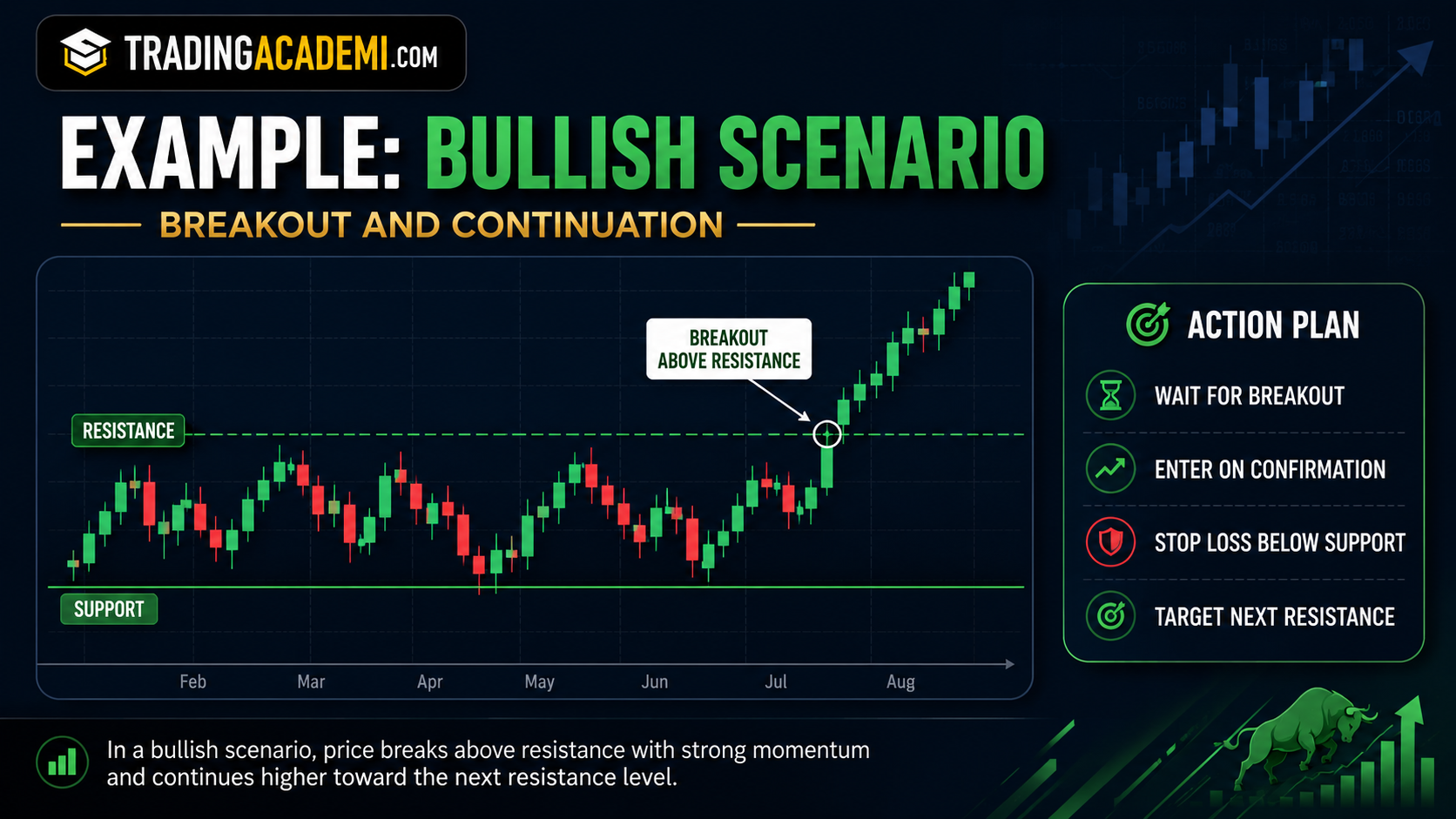
Example of a Bullish Trading Idea
Imagine a stock is trading near resistance.
Price has been moving upward for several weeks.
Volume is increasing.
The company recently reported strong earnings.
A trader may become bullish.
But instead of buying randomly, the trader may create a plan:
If price breaks above resistance and holds, I will look for a long setup.
My stop loss will be below the breakout level.
My target will be the next resistance area.
I will risk only a small percentage of my account.
This is a structured bullish idea.
The trader is not only saying “price will go up.”
The trader is building a plan around the bullish view.
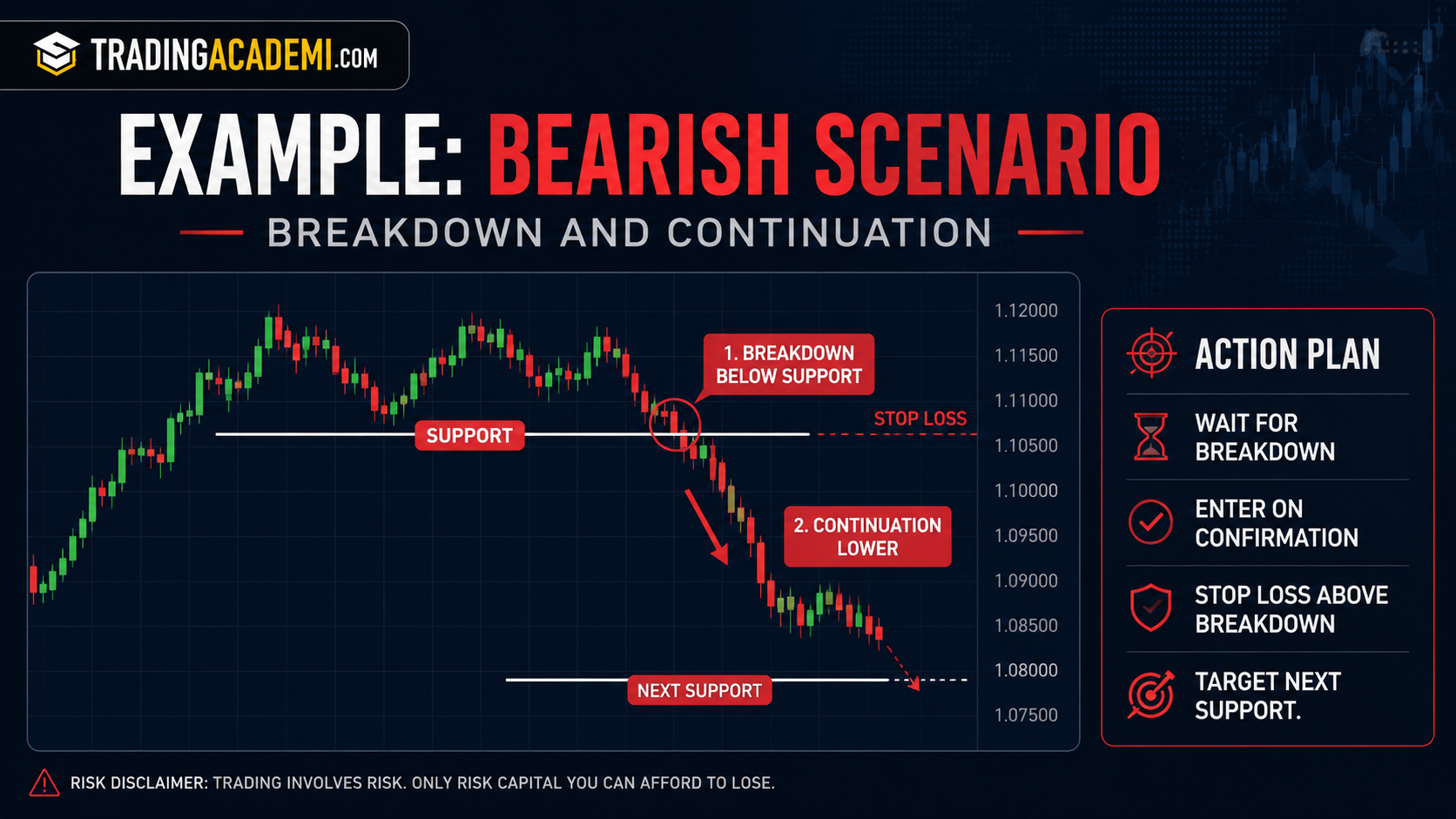
Example of a Bearish Trading Idea
Imagine a crypto asset is falling below support.
Volume increases during the move down.
The overall market is weak.
A trader may become bearish.
A plan may look like this:
If price retests the broken support and fails, I will look for a short setup.
My stop loss will be above the failed retest area.
My target will be the next support level.
I will keep risk small because crypto volatility can be high.
This is a structured bearish idea.
The trader is not only saying “price will fall.”
The trader is planning risk, entry, and exit.
Common Beginner Mistakes With Bullish and Bearish Views
1. Confusing Opinion With Confirmation
A trader may feel bullish before the chart confirms strength.
This can lead to early entries.
2. Buying Only Because the Market Is Bullish
A bullish market can still have pullbacks and losing trades.
3. Shorting Only Because the Market Looks Bearish
A bearish market can still bounce strongly.
4. Ignoring Timeframes
A market may be bullish on one timeframe and bearish on another.
5. Forgetting Risk Management
Even correct opinions can lead to losses without proper risk control.
6. Following Social Media Sentiment
If everyone online is bullish or bearish, that does not mean the trade is safe.
7. Entering Without a Plan
A directional view should always be supported by entry, stop loss, target, and position size.
Bullish vs Bearish Checklist
Before acting on a bullish or bearish idea, ask:
Is my view bullish or bearish?
Which timeframe am I using?
Is price confirming my opinion?
Where is support or resistance?
Where is my entry?
Where is my stop loss?
Where is my target?
What is my risk-to-reward ratio?
How much am I risking?
Am I following my trading plan?
This checklist helps convert an opinion into a more structured trading decision.
Final Thoughts
Bullish and bearish are two of the most important terms in trading.
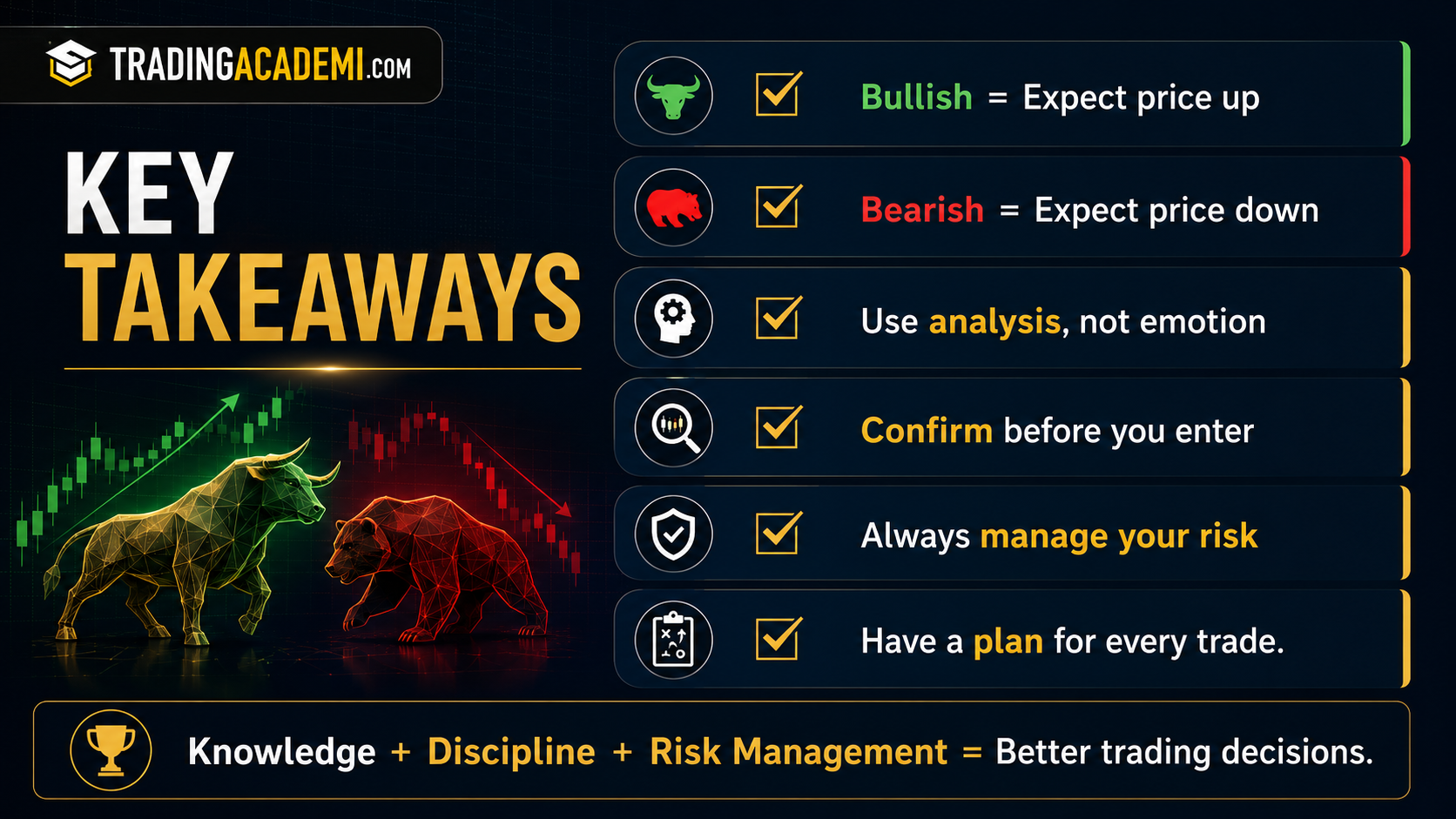
Bullish means expecting price to rise.
Bearish means expecting price to fall.
These terms help traders describe market direction, sentiment, and expectations.
But beginners should remember one important point:
A bullish or bearish opinion is not a trading plan.
A good trader does not enter only because they feel bullish or bearish. A good trader also thinks about risk, timing, entry, stop loss, target, and position size.
Understanding these terms is a strong first step, but real improvement comes from combining market vocabulary with discipline and risk management.
Start by learning the language.
Then learn the process.
Then build your plan.
Educational Disclaimer
This article is for educational purposes only and should not be considered financial advice. Trading and investing involve risk, including the possible loss of capital. Bullish or bearish analysis does not guarantee future price movement. Always do your own research or consult a qualified financial professional before making financial decisions.